 MineArchive
Kibble
| Also known as | Kibble bucket, Bowk (the larger bucket used when sinking a shaft), Hoppit (Kent and South Wales) |
|---|---|
| Category | Structures & Machinery |
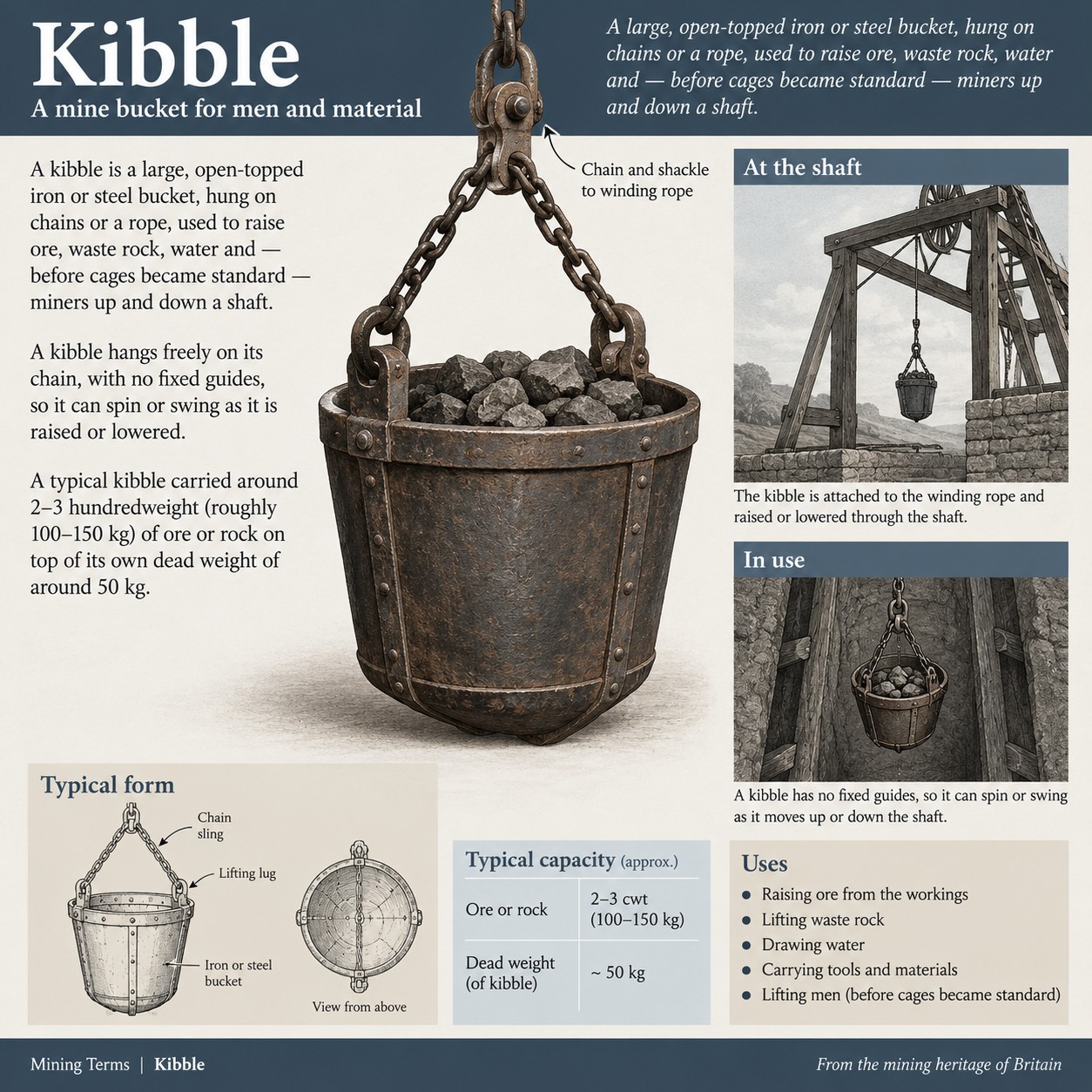
A large, open-topped iron or steel bucket, hung on chains or a rope, used to raise ore, waste rock, water and — before cages became standard — miners up and down a shaft.
Historical usage
Kibbles were the standard means of shaft haulage in Cornish and other British hard-rock mines from at least the 18th century, worked with a horse whim or, later, a steam winding engine, and remained the normal tool for shaft-sinking work long after cages and skips had taken over routine production haulage.
How it worked
A kibble hangs freely on its chain, with no fixed guides, so it can spin or swing as it is raised or lowered. A typical kibble carried around 2–3 hundredweight (roughly 100–150 kg) of ore or rock on top of its own dead weight of around 50 kg.
Why it was used
A kibble was cheap and simple, needing no fixed guides or elaborate shaft furnishing, which made it the obvious choice while a shaft was still being sunk, or for a mine too small to justify a purpose-built winding system.
Risks & limitations
Riding in a kibble to reach or leave the workings was dangerous — there was no cage to prevent a fall, and the load could swing or catch against the shaft sides as it moved. Once a mine matured from sinking into full production, the kibble's lack of guides made it too slow and risky for a shaft's regular working, and it was generally superseded by guided skips for rock and dedicated cages for men.
Regional variation
"Kibble" is the standard British (and especially Cornish) term for this open shaft bucket; broadly equivalent vessels appear under other names in other coalfields and mining countries, generally filling the same shaft-sinking role.
Related terminology
Aerial Ropeway, Bell Pit, Shaft Sinking, Windlass
Mines associated with this term
5 examples chosen from 6 linked records — the term page is not an index.
- Rothes Colliery — Fife (well documented example)
Named twice in this record, first in the history: “…been troubled from the start: in July 1951, during sinking, a loaded hoppit fell 1,000 feet down a shaft, trapping 22 men and killing one. Far…” - Six Bells Colliery — Blaenau Gwent (well documented example)
Named in this record’s history: “…four men were killed during the sinking in February 1895 when the bowk they were riding in went over. Winding began in the later 1890s,…” - Aldridge Colliery — Staffordshire (well documented example)
The sinking bowk whose bow gave way in 1875, killing Charles Jascoe and Joseph Yates. - Bilsthorpe Colliery — Nottinghamshire (well documented example)
Named in this record’s history: “…nine men on staging at the bottom and eight more being lowered in a hoppit; fourteen men were killed and three injured, in what a contemporary…” - Golconda Mine — Derbyshire (well documented example)
Named in this record’s history: “…House (later renamed New Harboro' Farm) and haulage originally by kibble and ladder. Originally worked mainly for lead ore, the mine turned…”
Disasters associated with this term
5 examples chosen from 13 linked records, most direct relationship first.
- Kilton Mine Kibble Accident, 1873 (direct cause)
The disaster's own narrative directly names the kibble that struck a bunton and capsized, throwing the three sinkers to the bottom of the shaft -- the proximate cause of the accident. - East and North Wheal Rose Flooding Disaster (relevant method/equipment)
The disaster's own recorded narrative explicitly describes miners escaping by riding a kibble hauled up on the surface whim machines. - Six Bells Colliery shaft-sinking accident, 1895 (relevant method/equipment)
The bowk was a kibble on the largest scale — an open bucket slung from the winding rope, carrying both spoil and the sinkers themselves. - Abercynon Colliery Shaft Accident, 1895 (contextual relationship)
Named 3 times in this record, first in the summary: “…were killed at Abercynon Colliery on 9 September 1895 when the bowk they were riding struck a projection in the shaft and they were…” - Aldridge Colliery bowk accident (contextual relationship)
Named 6 times in this record, first in the summary: “…South Staffordshire coalfield, when the bow of an ascending sinking bowk snapped and the bowk and its contents fell down the shaft onto them.”
Sources
- (secondary) "Kibble", or iron bucket — Science Museum Group Collection
- (secondary) Definition of sinking kibble — Mindat.org Glossary
Record created: 20 August 2026 · Last researched: 20 August 2026