 MineArchive
Six Bells Colliery
| Also known as | Arael Griffin Colliery, Lancaster's Colliery |
|---|---|
| Location | Six Bells, Abertillery, Ebbw Fach valley, Blaenau Gwent — 51.7196, -3.1334 (exact) |
| Commodity | Coal |
| Type | Coal |
| Worked | From 1892–1988 |
| Maximum depth | Two shafts, each 352 yards (about 322 m) |
| Operators | John Lancaster and Company (1892–1896), Partridge Jones and John Paton (1896–1947), National Coal Board (1947–1987), British Coal Corporation (1987–1988) |
Overview
A big Ebbw Fach steam-coal pit that employed nearly 3,000 men before the First World War, and which is remembered for a single morning in June 1960 when 45 of the 48 men in one district were killed by a firedamp and coal dust explosion — the worst British colliery disaster since the war.
History
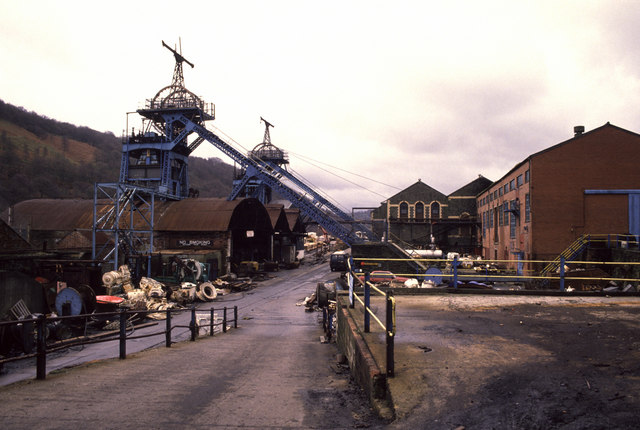
The site had been worked since at least 1863, when a balance shaft was put down at Arael Griffin. The colliery proper began in 1892, when John Lancaster and Company sank two shafts 352 yards deep on either side of the Ebbw Fach river; four men were killed during the sinking in February 1895 when the bowk they were riding in went over. Winding began in the later 1890s, with the coal going away over the Newport and Pontypool Railway. Partridge Jones and Company held the pit from 1896, and Partridge Jones and John Paton from 1936 until nationalisation in 1947. It was a large employer — around 2,857 men in 1914, 2,471 in 1918, 1,534 at vesting day — and was still raising 338,000 tonnes a year with some 1,291 men in 1960, the year of the explosion. In the 1970s Six Bells was merged with Marine Colliery at Cwm and its coal wound there; the combined complex closed in 1988.
Geology
Six Bells worked the South Wales Coalfield's steam coal measures on the eastern side of the basin — Big Vein and Three Quarter in the No. 4 pit, Black Vein and Meadow Vein in the No. 5, and the Old Coal seam in which the 1960 explosion happened. These are gassy coals: firedamp released from the seam as it is cut was the standing hazard of the whole coalfield, and coal dust raised into the air by an initial ignition is what turns a flash into a disaster.
Geological setting: Sedimentary Beds and Seams (well documented example)
Workings
Two shafts of 352 yards, sunk across the river from one another, with a number of slopes driven from 1909 onwards. The pit was mothballed for part of the 1930s depression and reopened under John Paton in 1936.
Closure
After integration with Marine Colliery in the 1970s the Six Bells shafts stopped winding coal in their own right, and British Coal closed the complex in 1988 — some accounts give 1989.
What remains
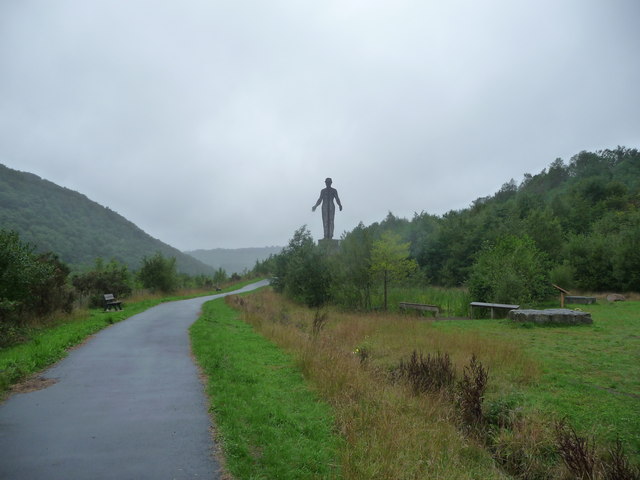
The colliery has been cleared. The site is now Parc Arael Griffin, a public park.
Nothing of the working colliery. The site is dominated instead by the Guardian of the Valleys, a 20-metre figure of a miner by Sebastian Boyesen unveiled on 28 June 2010 — the fiftieth anniversary of the explosion — by Rowan Williams, then Archbishop of Canterbury. Though raised for the Six Bells dead, it is dedicated to mining communities everywhere. An earlier colliery memorial also stands on the site.
Redevelopment
Parkland, with the memorial and interpretation boards where the shafts were.
Related mines
- Hafod Van Colliery — Six Bells Colliery began on the site of an earlier balance shaft at Hafod Van, and its history lists the Hafod Van slopes.
- Marine Colliery — Merged in the 1970s, with Six Bells' coal thereafter wound at Marine.
Nearby mines
- Coed Cae Tillery Colliery — 0.2 miles (0.4 km) SE
- Hafod Van Colliery — 0.2 miles (0.4 km) E
- Aberbeeg Colliery — 1.0 miles (1.5 km) SW
- Pen-y-fan Colliery — 1.3 miles (2.1 km) SW
- Llanhilleth Colliery — 1.7 miles (2.7 km) S
Straight-line distance, within 9 miles (15 km). Show on the map.
Disasters & major incidents
-
Six Bells Colliery shaft-sinking accident, 1895
9 February 1895 · Winding / Shaft Accident · 4 fatalities
Four men sinking the shafts at Arael Griffin — later Six Bells Colliery — were killed on 9 February 1895 when they fell from the bowk carrying them down the shaft. Two more men died the same way before the sinking was finished. -
Six Bells Colliery explosion, 1960
28 June 1960 · Explosion · 45 fatalities
A firedamp and coal dust explosion tore through the 'W' district of the Old Coal seam at Six Bells Colliery, Abertillery, at about 10:45 on the morning of 28 June 1960. Forty-five of the 48 men working in the district were killed. It remains the worst colliery disaster in Britain since the Second World War.
Culture
- Guardian, Six Bells (Art)
Guardian stands over the landscaped site of Six Bells Colliery in memory of the 45 men killed there in 1960.
What's uncertain
Points where sources disagree or the record could not be settled; both accounts are kept. All open questions in the archive.
- Winding began in 1897. (disputed) 2
- Coal extraction is recorded as having commenced in 1898. (disputed) 1
Recorded claims
Individual factual claims, each attached to the source(s) that support it below. Where sources disagree, both are kept.
- John Lancaster and Company sank two shafts, each 352 yards deep, from 1892 on a site worked since at least an 1863 balance shaft at Arael Griffin. 1,2
- Four men were killed on 9 February 1895 during the shaft sinking when the bowk they were riding in went over and they fell to the shaft bottom: William Matthews, Thomas Day, John Lamb and William Lusty. 1,3
- Two further sinkers died in separate falls from the bowk before the shafts were finished — Eli Morgan on 11 April 1895 and Jacob Herbert on 2 May 1895 — which is why some accounts give the February 1895 accident a toll of six. 2,3
- Winding began in 1897. (disputed) 2
- Coal extraction is recorded as having commenced in 1898. (disputed) 1
- The No. 4 pit worked the Big Vein and Three Quarter seams and the No. 5 pit the Black Vein and Meadow Vein, as recorded in 1923. 2
- Employment stood at around 2,857 in 1914, 2,471 in 1918, 2,388 in 1923 and 1,534 at nationalisation in 1947, with 1,291 men in 1960. 1,2
- The colliery produced 338,000 tonnes of coal in 1960. 1
- On 28 June 1960 a firedamp and coal dust explosion in the 'W' district of the Old Coal seam killed 45 of the 48 men working there — the worst British colliery disaster of the post-war period. 1,2
- Six Bells was integrated with Marine Colliery at Cwm during the 1970s and the complex was closed by British Coal in 1988. 1,2
- The Guardian of the Valleys, a 20-metre miner's figure by Sebastian Boyesen, was unveiled on the site on 28 June 2010 by Rowan Williams, Archbishop of Canterbury. 1
- Located at about 51.720 N, 3.133 W. 1
Photographs & further reading
Broadcast coverage of the sixtieth anniversary, with survivors' and families' accounts.
View sourceSources
- (secondary) Six Bells Colliery — Wikipedia
- (secondary) Six Bells Colliery — Welsh Coal Mines
- (primary) Six Bells Colliery (Arael Griffin Nos 4 & 5) — Northern Mine Research Society
- (primary) Mine plans KP2578 and SWT3856: Six Bells / Marine Colliery — British Geological Survey / Mining Remediation Authority mine plans catalogue
- (secondary) Arrael Griffin Colliery, Six Bells — list of fatalities 1890-1988 — Out of the Blue Artifacts
Record created: 24 August 2026 · Last researched: 24 August 2026