 MineArchive
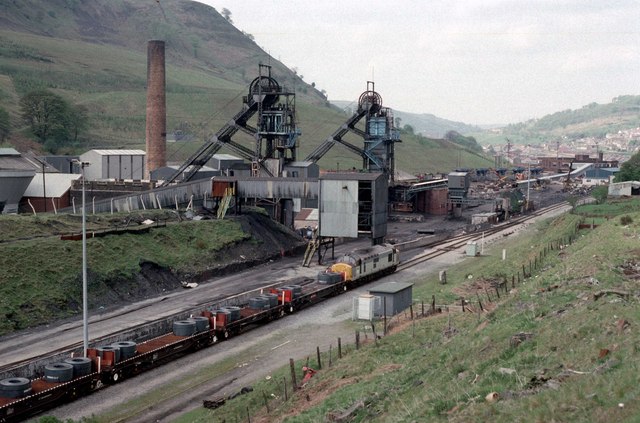
Marine Colliery
| Location | Cwm, Blaenau Gwent — 51.7320, -3.1764 (exact) |
|---|---|
| Commodity | Coal |
| Type | Coal |
| Worked | 1889-91 (sinking)–March 1989 |
| Maximum depth | 418 yards (downcast shaft); 414 yards (upcast shaft) |
| Operators | Ebbw Vale Steel, Iron and Coal Company (1889–1935), Partridge Jones and John Paton (1935–1947) |
Overview
A deep steam-coal colliery at Cwm in the Ebbw Fach valley, sunk 1889-91 by the Ebbw Vale Steel, Iron and Coal Company and worked until March 1989, the last deep mine in the Ebbw valleys. An underground explosion in the Black Vein seam on 1 March 1927 killed around 52 men, one of the major 20th-century South Wales colliery disasters. A scheduled Hathorn Davey pumping engine, relocated on site in 2003, survives as the colliery's principal visible remnant.
History
Sinking began in 1889 and was completed in 1891 by the Ebbw Vale Steel, Iron and Coal Company, with first coal raised in 1893. Two 18ft-diameter shafts were sunk — a downcast shaft 418 yards deep and an upcast shaft 414 yards — and a third shaft followed in 1914 roughly 70 yards north of the original pair, though it never reached the steam coal seams worked by the others. Employment grew from 833 men in 1896 to a peak of around 2,728 in 1919, and output rose from 254,000 tons in the colliery's first full year to 600,000 tons by 1935; a large coal washery, described at the time as the largest in Britain, was built in October 1929. Two men were killed in a roof fall in 1925, two years before the far larger disaster of 1927 — see Disasters, below.
Operation passed in 1935 to Partridge, Jones and John Paton Ltd, who ran the colliery until nationalisation in 1947, after which it was worked by the National Coal Board. In October 1965 around 640 men struck over management's refusal to allow surface warming fires, and that same year Marine became the first colliery in South Wales to install a remotely operated coalface. Coal handling was integrated with the neighbouring Six Bells colliery during the 1970s, and a further £2.5 million was invested in 1982 in a new skip-winding system and surface coal-preparation plant. British Coal announced closure in March 1989, citing geological difficulties, with the loss of 758 jobs — Marine was by then the last deep mine working in the Ebbw valleys of Gwent.
Geology
Coal of the South Wales field: the Black Vein seam, where the explosion of 1 March 1927 killed around 52 men.
Workings
Coal was worked from the Old Coal, Three-Quarter, Big Vein, Elled, Black Vein, Meadow Vein and Upper and Lower Black Vein seams, graded as prime coking coal. Winding, originally by steam engines of 42in and 36in cylinder with a 72in stroke, was later electrified (1,200hp and 1,540hp motors) and renewed again in 1982 with a new skip-winding system. Ventilation was provided first by a 21ft Schiele-type fan moving 120,000 cubic feet a minute, later replaced by a 17ft Walker double-inlet fan rated at 300,000 cubic feet a minute. Pumping was handled by a Hathorn Davey differential pumping engine installed in 1893 in a chamber beneath the downcast shaft's winding engine — a 68in low-pressure cylinder on a 10ft stroke, capable of raising some 50,000 gallons an hour, built entirely of cast iron at a cost of £4,630.
Closure
British Coal announced closure in March 1989, citing geological difficulties, with the loss of 758 jobs.
What remains
The colliery buildings have been demolished and the site cleared. The Hathorn Davey pumping engine survived clearance and was relocated in 2003 to a car park area following new road construction, where it now stands on a concrete plinth as a Scheduled Ancient Monument.
The 1893 Hathorn Davey differential pumping engine (Cadw ref. MM218), assessed as a nationally important, rare surviving intact late-19th-century colliery pumping engine, is the only substantial structure to survive on or near the site.
Related mines
- Beynon Colliery — When Beynon's Upper Deep upcast shaft was closed, the Marine Colliery provided the upcast ventilation shaft for its workings.
- Six Bells Colliery — Merged in the 1970s, with Six Bells' coal thereafter wound at Marine.
- Waunllwyd Colliery — Waunllwyd's workings were integrated with the Marine colliery in 1964, which effectively closed it.
Nearby mines
- Rose Heyworth Colliery — 1.3 miles (2.2 km) NE
- South Griffin Colliery — 1.6 miles (2.5 km) NE
- Waunllwyd Colliery — 1.6 miles (2.5 km) NW
- Pochin Colliery — 1.7 miles (2.7 km) W
- Aberbeeg Colliery — 1.9 miles (3.1 km) SE
Straight-line distance, within 9 miles (15 km). Show on the map.
Disasters & major incidents
-
Marine Colliery explosion, 1927
1 March 1927 · Explosion · 52 fatalities
An underground gas and coal-dust explosion in the Black Vein seam at Marine Colliery killed around 52 men in the early hours of 1 March 1927, one of the major South Wales colliery disasters of the interwar period.
Recorded claims
Individual factual claims, each attached to the source(s) that support it below. Where sources disagree, both are kept.
- Sunk 1889-91 by the Ebbw Vale Steel, Iron and Coal Company; downcast shaft 418 yards deep, upcast shaft 414 yards, both 18ft diameter. A third shaft followed in 1914 but never reached the steam coal seams. 1,2
- Employment rose from 833 men in 1896 to a peak of around 2,728 in 1919; output reached 600,000 tons a year by 1935, falling to roughly 148,000-189,000 tons a year by the late 1970s/early 1980s. 1
- British Coal announced closure in March 1989 citing geological difficulties, with the loss of 758 jobs; Marine was by then the last deep mine working in the Ebbw valleys. 1,2
- The 1893 Hathorn Davey differential pumping engine survives, relocated to a car park in 2003 and scheduled as a nationally important monument (Cadw ref. MM218); it is a 68in low-pressure cylinder engine on a 10ft stroke, capable of raising about 50,000 gallons an hour, built entirely of cast iron at a cost of £4,630. 3
- The BGS/Coal Authority mine plans catalogue holds records for Marine Colliery including a shared Big Vein seam plan with the neighbouring Markham and Six Bells collieries, plus 1974 Mining Remediation Authority abandonment plans. 4
Sources
- (secondary) Marine Colliery 1889-1989 — Northern Mine Research Society
- (secondary) Marine Colliery, Cwm — welshcoalmines.co.uk
- (primary) Marine Colliery pumping engine — Scheduled Monument Full Report (ref. MM218) — Cadw (Welsh Government)
- (primary) Marine Colliery mine plan records — British Geological Survey / Coal Authority mine plans catalogue
Record created: 26 August 2026 · Last researched: 26 August 2026