 MineArchive
Skip-winding
| Category | Structures & Machinery |
|---|
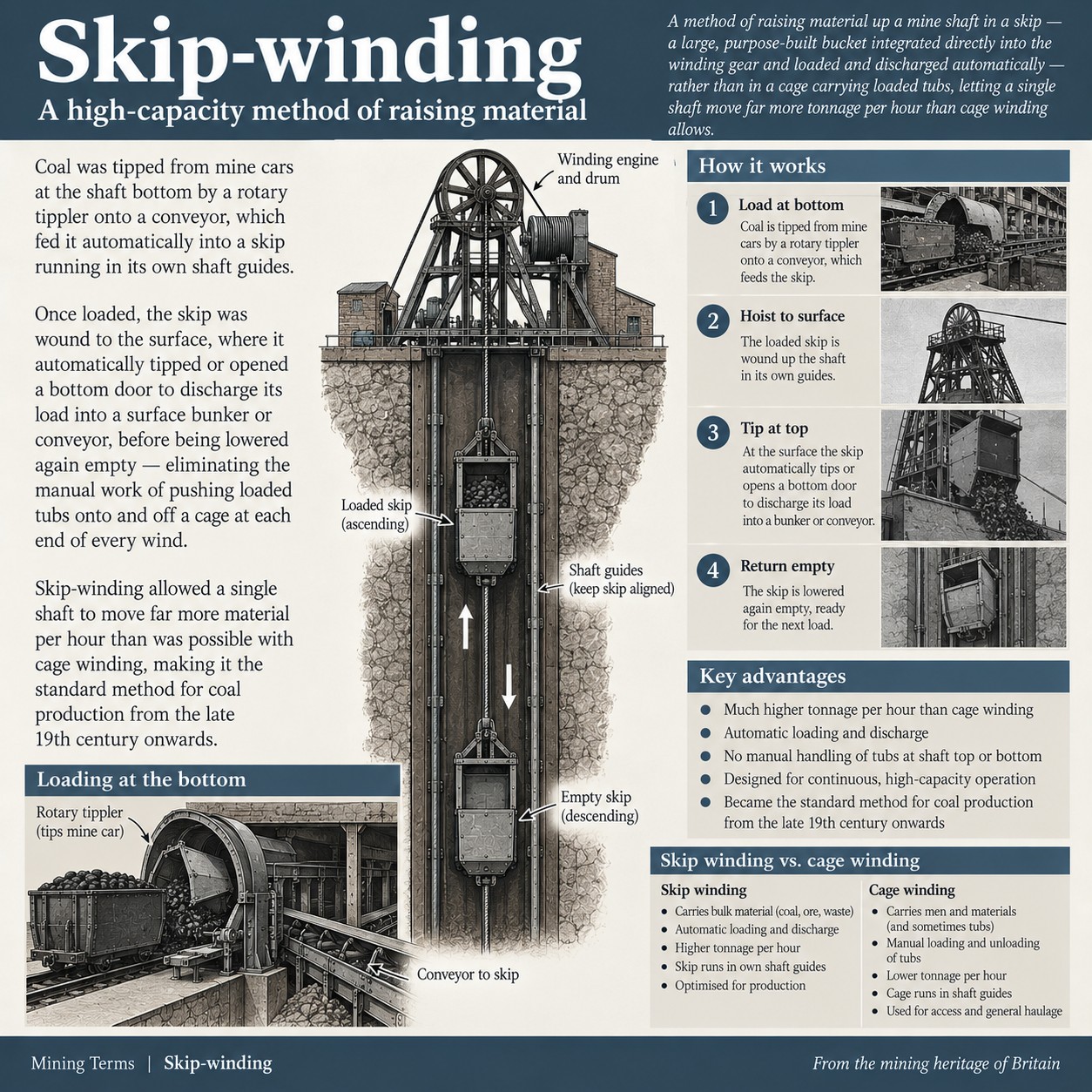
A method of raising material up a mine shaft in a skip — a large, purpose-built bucket integrated directly into the winding gear and loaded and discharged automatically — rather than in a cage carrying loaded tubs, letting a single shaft move far more tonnage per hour than cage winding allows.
Historical usage
Adopted at Britain's larger, more modern collieries from the 1930s onward as pits mechanised and needed higher-capacity shafts. Comrie Colliery, Fife, sunk 1935-40, is recorded as Scotland's first skip-winding installation. By the mid-twentieth century some British collieries reached very large capacities this way: Coedely Colliery's skip-winding plant, installed in 1958 with two 12-ton skips driven by a 3,000 hp motor, could wind 600 tons an hour — more than double the roughly 300 tons an hour typical of a large cage-winding shaft of the period.
How it worked
Coal was tipped from mine cars at the shaft bottom by a rotary tippler onto a conveyor, which fed it automatically into a skip running in its own shaft guides. Once loaded, the skip was wound to the surface, where it automatically tipped or opened a bottom door to discharge its load into a surface bunker or conveyor, before being lowered again empty — eliminating the manual work of pushing loaded tubs onto and off a cage at each end of every wind.
Why it was used
Freed from carrying the dead weight of tubs and from manual loading and unloading, a skip could move a far higher tonnage per hour than a cage of similar size, and its simple, repetitive loading-and-discharge cycle suited automation — increasingly important as collieries grew larger and needed to raise steadily rising tonnages through a limited number of shafts.
Risks & limitations
A skip could carry only bulk material, never men or large equipment, so a colliery relying on skip winding for coal still needed a separate, cage-equipped shaft for winding its workforce and materials. The automated tippler-conveyor-skip loading chain also added real mechanical complexity compared with the relative simplicity of a cage and tubs.
Related terminology
Mines associated with this term
Included only where MineArchive's own research gives a reasonable evidential basis — not every mine where this might plausibly apply.
- Marine Colliery — Blaenau Gwent (well documented example)
Named twice in this record, first in the history: “…the 1970s, and a further £2.5 million was invested in 1982 in a new skip-winding system and surface coal-preparation plant. British Coal announced…” - Bold Colliery — Merseyside (well documented example)
Named in this record’s history: “…colliery was producing around 4,100 tons a day. A further £1 million skip-winding scheme completed in 1977 let the whole colliery's output be wound…” - Comrie Colliery — Fife (well documented example)
Named 4 times in this record, first in the summary: “…commercial production in 1940. Comrie introduced Scotland's first skip-winding system for raising coal and was praised on a 1946 visit by Herbert…” - Hawthorn Combined Mine — County Durham (well documented example)
Named twice in this record, first in the history: “…Murton was brought to bank here from January 1960 through one new skip-winding shaft, with a coal-preparation plant built to handle 750 tons an…”
Sources
- (secondary) Coedely Colliery — Northern Mine Research Society
- (secondary) What Are The Advantages Of Skip Winding Over Cage Winding? — Garlway Machinery
Record created: 26 August 2026 · Last researched: 26 August 2026