 MineArchive
Bold Colliery
| Location | Bold, St Helens, Merseyside — 53.4359, -2.6839 (approximate) |
|---|---|
| Commodity | Coal |
| Type | Coal |
| Worked | 1875–1985 |
Overview
A St Helens colliery worked for 110 years, from 1875 to 1985, whose January 1905 shaft accident killed five men — modernised extensively by the National Coal Board in the 1950s only to be lost, along with most of the Lancashire coalfield, in the closures that followed the 1984-85 miners' strike.
History
Bold Colliery's first two shafts were sunk in 1875-76 to reach the Higher Florida seam at 555 metres; the original sinking company struggled with heavy water ingress from the New Red Sandstone, and the Collins Green Colliery Co. Ltd, which acquired the site in 1878, completed the No. 2 shaft. A third shaft, sunk between 1887 and 1890 to 564 metres and later deepened to around 830 metres, eventually gave access to four workable coal seams. On 20 January 1905, a cage carrying men down the shaft descended too rapidly, overshot the Yard Mine level and crashed onto a sinking platform 30 yards below, killing five miners and seriously injuring fourteen more (see MineArchive's own Disaster record).
Sutton Heath & Lea Green Collieries Ltd took over an unprofitable Bold in 1940 and deepened the workings further to the Rushy Park seam at 839 metres. The colliery was nationalised in January 1947 under the National Coal Board, which carried out a major modernisation between 1949 and 1955 — new electric winding engines, ventilation fans and a new screening plant — aiming to quadruple output by 1961; by the mid-1950s the colliery was producing around 4,100 tons a day. A further £1 million skip-winding scheme completed in 1977 let the whole colliery's output be wound and automatically unloaded through a single shaft.
Geology
Coal Measures of the Lancashire (St Helens) coalfield, worked through four seams — the Four Foot, Yard, Higher Florida and Lower Florida seams — encountered between around 465 and 555 metres depth.
Workings
Three shafts (Nos. 1-3), the last deepened to around 830-839 metres to reach the Rushy Park seam; re-equipped in the 1950s with electric Koepe and Metropolitan Vickers winders and, from 1977, single-shaft skip winding for the whole colliery's output.
Closure
Output and profitability declined sharply through the early 1980s (an £11 million loss in 1981-82); the workforce was cut to 1,080 by March 1984. The colliery survived the 1984-85 strike but the NCB announced its closure that October, and it closed in November 1985 after 110 years' continuous working.
What remains
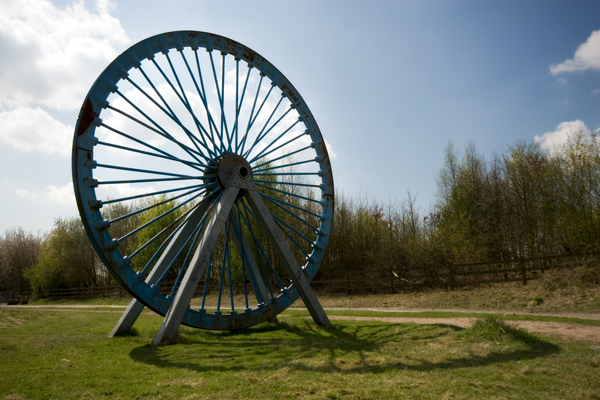
The colliery site is now occupied by a business centre renting out office units.
Related mines
- Collins Green Colliery — The Collins Green Colliery Company worked Bold as well from the 1880s, and the two pits stood about three-quarters of a mile apart; Collins Green is named on the Bold record.
Nearby mines
- Sutton Manor Colliery — 0.6 miles (1.0 km) NE
- Collins Green Colliery — 1.0 miles (1.6 km) NE
- Sherdley Colliery — 1.8 miles (2.8 km) W
- Haydock Colliery — 1.9 miles (3.1 km) NE, Lancashire
- Clock Face Colliery — 2.0 miles (3.2 km) SW
Straight-line distance, within 9 miles (15 km). Show on the map.
Disasters & major incidents
-
Bold Colliery roof fall, 1895
2 September 1895 · Collapse / Roof Fall · 2 fatalities
Two colliers at Bold Colliery, St Helens, were killed by a roof fall on 2 September 1895, and the inquest jury called for officials to be made to visit their men more than once a shift. -
Bold Colliery roof fall, 1899
20 February 1899 · Collapse / Roof Fall · 3 fatalities
Three drawers eating their breakfast at Bold Colliery, St Helens, were killed on 20 February 1899 when runaway boxes knocked out a roof bar above them. -
Bold Colliery shaft accident, 1905
20 January 1905 · Winding / Shaft Accident · 5 fatalities
A cage carrying men down the shaft at Bold Colliery, St Helens, descended too rapidly on 20 January 1905, overshooting the Yard Mine level and crashing onto a sinking platform thirty yards below, killing five miners and seriously injuring fourteen more.
Recorded claims
Individual factual claims, each attached to the source(s) that support it below. Where sources disagree, both are kept.
- The first two shafts were sunk in 1875-76 to reach the Higher Florida seam at 555 metres; Collins Green Colliery Co. Ltd, which acquired the site in 1878, completed the No. 2 shaft after the original sinking company struggled with water ingress. 1
- On 20 January 1905, a cage descending the shaft overshot the Yard Mine level and crashed onto a sinking platform 30 yards below, killing five miners and seriously injuring fourteen more. 1
- The colliery was nationalised in January 1947 under the National Coal Board, which carried out a major modernisation between 1949 and 1955 aiming to quadruple output by 1961. 1
- Bold survived the 1984-85 miners' strike, but the NCB announced its closure in October 1985 and it closed that November, ending 110 years of continuous working. 1,2
Sources
- (secondary) Bold Colliery (1875-1985) — Northern Mine Research Society
- (secondary) Bold Colliery Part 2 — Sutton Beauty & Heritage
Record created: 28 August 2026 · Last researched: 28 August 2026