 MineArchive
Screens
| Also known as | Screening Plant (The North Staffordshire glossary's own wording.), Screen (The singular, of one grid rather than the plant.), Picking Belt (The belt alongside the screens where stone and dirt were taken out of the coal by hand.), Picking Table (The hand-picking conveyor or table beside the screens), Plate Table (Colliery-inventory name for the picking table (Canmore, Greenrigg 1948)), Hand Picking |
|---|---|
| Category | Ore Processing |
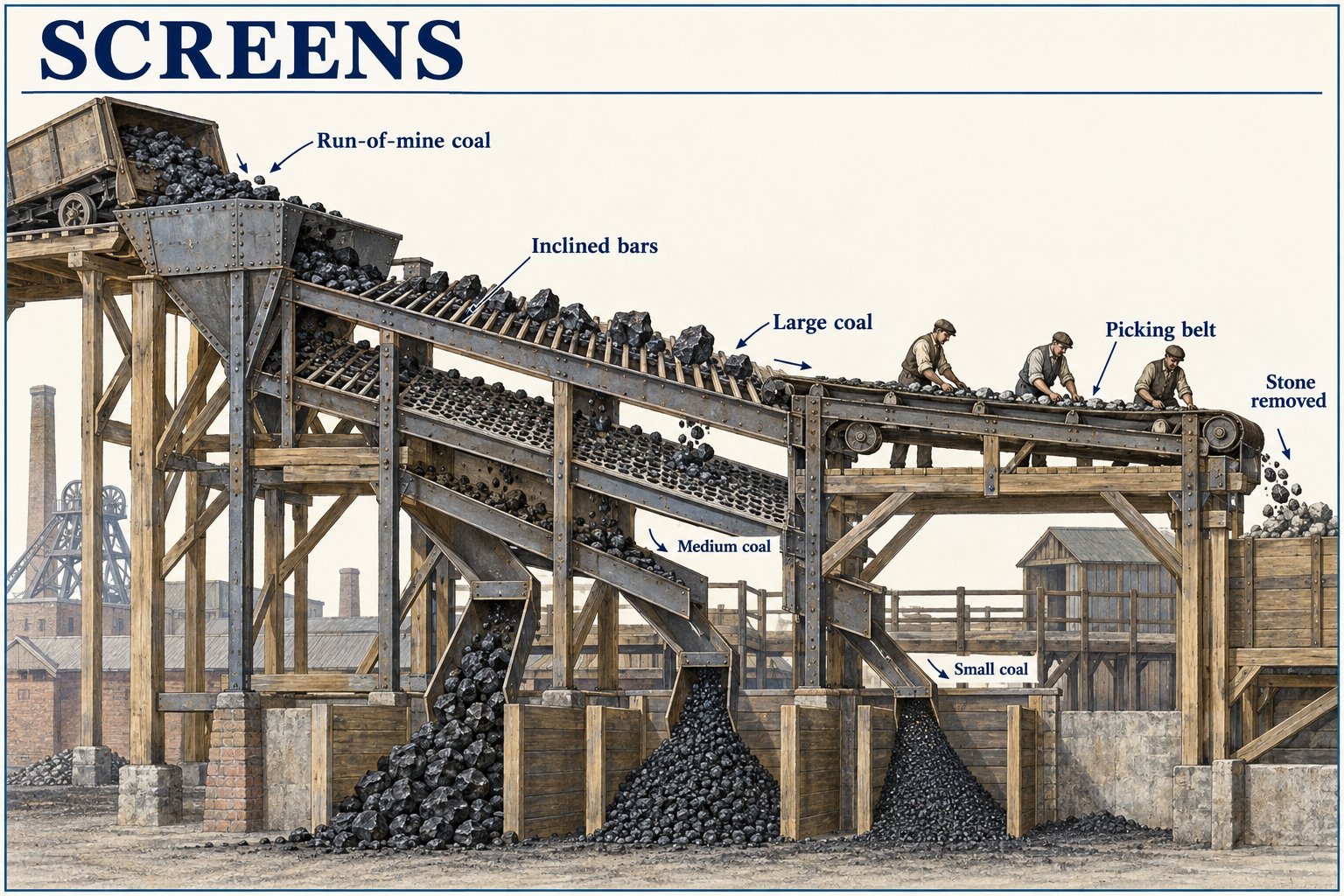
The plant on the pit bank where run-of-mine coal was graded dry, by size, before sale — Gresley's 1883 glossary calls it 'a mechanical apparatus (a sort of gridiron) for separating small from large coals'. Bars set a fixed distance apart, or steel plates punched with holes, let the small through and carried the large on, and what passed over and what fell through were sold as different products at different prices.

Historical usage
Screens were the most conspicuous thing on a colliery surface after the headgear, and the Lists of Mines and the National Coal Board's own reports count them like plant: this archive's Riddochhill record has two screens and a Baum washer in 1948, and its Glentaggart record one screen for dry coal and no washing at all. Where a colliery had no washery the screens were the whole of its coal preparation.
They also shaped the working day above ground. The screen picking belts were where women, boys and injured or elderly men worked, sorting stone and dirt out of the coal by hand as it went past, and the sidings and shunting around them killed people regularly: this archive's Carronhall record has Robert Galloway, a shunter, fatally crushed between waggons on his way to the screens in 1909, and its Riddochhill record has Peter Aitken junior, aged fourteen, crushed in 1904 in a dross waggon moving from one screen to another with four inches of clearance above him.
The pit brow women of Lancashire, who worked at the screens on the pit bank picking stone from the coal until the 1960s, were the best-known of that workforce; the North Staffordshire glossary has the pit brow lassies 'sorting the coal on the picking tables and in the screens' among their tasks.
How it worked
Coal came up the shaft in tubs, was tipped, and ran over a screen: a grid of iron bars or a punched steel plate, often shaken or inclined, sometimes several in sequence with the openings getting larger. Everything that fell through one screen and stayed on top of the next was one size of coal. Gresley records the bars of a screen varying between a quarter of an inch and two and a half inches apart, and names the products by where they ended up — dross and slack passing through the finest, and 'lumps' being the largest coal that did pass over. Picking belts alongside took out the stone and pyrites by hand.
Screening is dry work and stops at grading. Washing is a separate and later stage that uses water to separate coal from stone by density, and a colliery could have screens and no washery, which many did.
The picking belt, also called the picking table or plate table, was a slow conveyor or rotating table on which the coal was spread thin enough for stone and middlings to be lifted off by hand; the North Staffordshire glossary defines hand picking as 'the removal, by hand, of stone and middlings from the run-of-mine on a conveyor belt or rotating table'. Colliery inventories counted them like screens: Greenrigg Colliery in West Lothian had three plate tables and a Baum washer in 1948.
Why it was used
Because coal was not one product. House coal, steam coal, manufacturing coal, gas coal and coking coal were sold in different sizes to different buyers at different prices, and a colliery that tipped its output into one heap threw money away. Screening was the cheapest way to turn a shaft's worth of mixed coal into a saleable range of sizes, and it needed no water, no chemicals and very little power.
Risks & limitations
Screening sorts by size and nothing else: it cannot separate coal from stone of the same size, which is what washing is for, so a dirty seam screened but not washed went out dirty. The screens themselves were noisy, dusty and dangerous — the surface accident reports in this archive are full of the sidings that fed them — and the dust raised at the picking belts is part of the reason colliery surface work was not the safe alternative to going underground that it looks like.
Regional variation
General British usage. Gresley notes a second and unrelated sense, still current in the North East in the twentieth century, of a screen as a cloth brattice or curtain hung across an underground road to direct the ventilation, which the North Staffordshire glossary records as also being called traps. That sense has nothing to do with the pit bank and is the reason this record is titled in the plural: on a colliery, 'the screens' is the place.
Related terminology
Mines associated with this term
5 examples chosen from 114 linked records — the term page is not an index.
- Bedford Colliery — Greater Manchester (well documented example)
Named in this record’s history: “…between Nook and Gin Pit collieries and put in new headgear and screens. It passed to the National Coal Board in 1947 and closed in 1967,…” - Gin Pit Colliery — Greater Manchester (well documented example)
Named in this record’s history: “…steam and gas coal, with pit-brow lasses sorting coal on the screens; in 1923 the figures were 237 and 57. The company, reorganised as…” - Hoyland Silkstone Colliery — South Yorkshire (well documented example)
Named in this record’s workings: “…machine was at work on one face by 1903. At the surface there were screens, locomotives and an incline; the old tramroad to the canal gave way…” - Swinden Quarry — North Yorkshire (well documented example)
Named in this record’s history: “…it in 1994; a second application, offering to move all crushing and screening plant into the pit, send more stone by rail and eventually leave a…” - Aber Colliery — Bridgend (well documented example)
Named in this record’s workings: “…No. 2 Rhondda (closed 1894) and the No. 3 Rhondda (from about 1886); screens and sidings later used for Cwmfuwch Colliery's coal.”
Disasters associated with this term
Included only where MineArchive's own research gives a reasonable evidential basis, with the nature of the relationship stated — not every disaster where this term might plausibly apply.
- Alvecote Colliery Cage Accident (contextual relationship)
Named twice in this record, first in the summary: “…cause down to management's neglect of machinery maintenance, and new screens and a new cage system followed.” - Easington Colliery explosion, 1951 (contextual relationship)
Named in this record’s memorials: “…year, 2002. A separate Grade II-listed memorial, including memorial screens and a bas-relief of a miner, was erected in 1953-54.” - Snydale Colliery powder-fume deaths (contextual relationship)
Named in this record’s contributing factors: “The brattice cloth -- a temporary canvas or timber ventilation screen used to direct air to a working face -- had not been extended to the…” - Willington Colliery Boiler Explosion, 1867 (contextual relationship)
Named 4 times in this record, first in the summary: “…George Young, a screenman of seventeen, and George Webster, a screen boy of eleven. All three deaths were at the pit bank rather than…”
Sources
- (primary) A Glossary of Terms Used in Coal Mining, by William S. Gresley, 1883 — Internet Archive
- (primary) Greenrigg Colliery — Canmore / trove.scot (NS96SW 23) — Historic Environment Scotland
- (secondary) Glossary of mining terms (H) — North Staffordshire Miners’ Group, Apedale
- (secondary) Glossary of mining terms (P) — North Staffordshire Miners' Group — Apedale Heritage Centre
- (secondary) Glossary of mining terms — North Staffordshire Miners' Group, Apedale Heritage Centre — North Staffordshire Miners' Group
- (secondary) Pit brow women — Wikipedia — Wikipedia
Record created: 10 September 2026 · Last researched: 12 September 2026