 MineArchive
Heapstead
| Also known as | Heap-stead, Pit bank, Pit top |
|---|---|
| Category | Structures & Machinery |
The whole of the surface works about a colliery shaft — the raised platform or bank at the shaft top with its headgear, screens and loading arrangements, and the engine houses, workshops and stores grouped round it.
Historical usage
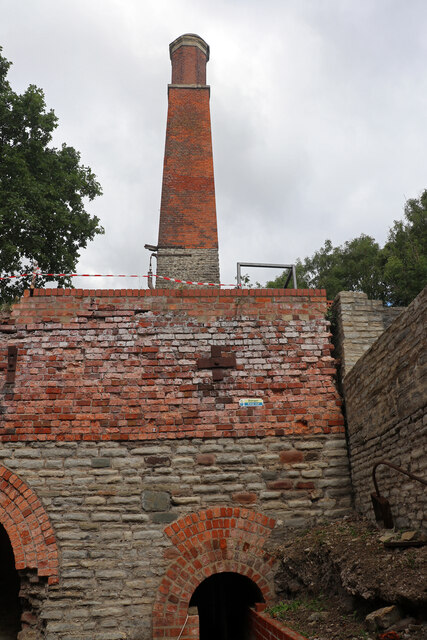
Gresley's 1883 glossary defines the heapstead as the entire surface works about a colliery shaft, including the headgear, loading and screening arrangements, and the winding and pumping engines with their houses, the workshops and stores sometimes built into the same block round the pit top; his plate shows the heapstead of a large colliery in plan. The raised platform itself let full tubs be run out from the cage on the level, tipped over the screens and dropped into wagons on the railway below, so the heapstead of a Victorian pit was often a substantial masonry or brick structure on arches. At Vobster Breach in Somerset the heapstead of the 1860s survives as a levelled terrace revetted in stone with the headgear mounting blocks still in place, one of the best preserved mid-19th-century colliery surfaces in England.
How it worked
Coal came up the shaft in tubs in the cage, was pushed off across the heapstead to the screens for sizing and picking, and fell by gravity into railway wagons or carts standing at a lower level; empties went back round to the shaft. The winding and pumping engines in their houses, and often the workshops and stores, stood on or beside the platform, and the spoil went out to the heap beyond.
Why it was used
Raising the pit top above the railway or roadway turned the handling of coal into a downhill job, and gathering the engines, screens and shops round the shaft kept everything the shaft served within a few yards of it.
Risks & limitations
The heapstead was the busiest ground on the surface, with moving tubs, the open shaft and the screens all within a few yards; Gresley's heap-keeper, the head banksman, looked after the sorting and cleaning of the coals and kept order about the pit top. When a pit closed the heapstead was usually the first thing cleared and landscaped, so few survive.
Regional variation
A north-of-England word, spelt heapstead or heap-stead; the same thing is the pit bank or pit top in the Midlands and elsewhere, and Gresley gives pit bank as the raised ground or platforms on which the coals are sorted and screened at surface.
Related terminology
Banksman, Engine House, Headgear, Screens
Mines associated with this term
5 examples chosen from 25 linked records — the term page is not an index.
- Chatterley Whitfield Colliery — Staffordshire (well documented example)
Named in this record’s surface remains: “…(c. 1900), the Institute Shaft headgear (c. 1910), the Winstanley Heapstead (c. 1913), and associated railway sidings and pumping equipment.” - Great Western Colliery — Rhondda Cynon Taf (well documented example)
Named in this record’s workings: “…Ventilation was by two Schiele fans of 15 ft 3 in diameter at the pit tops, and compressed air generated at surface powered underground haulage…” - Williamthorpe Colliery — Derbyshire (well documented example)
Named twice in this record, first in the current condition: “…estate on Tupton Way off Park Road, Holmewood; part of the original heapstead survives, No. 1 shaft is capped with steel and pipes emerge from it,…” - Bonville's Court Colliery — Pembrokeshire (well documented example)
Named twice in this record, first in the current condition: “…Court Country Park on the edge of Saundersfoot. The colliery's heapstead survives and is a listed building; the incline and the course of the…” - Digby Colliery — Nottinghamshire (well documented example)
Named in this record’s history: “…down the shaft in October 1866 with 'no proper protection' at the pit top, belongs to the sinking. The Lists of Mines record the pit from…”
Disasters associated with this term
5 examples chosen from 17 linked records, most direct relationship first.
- Chatterley Whitfield (Whitfield) Colliery explosion (contextual relationship)
Named in this record’s rescue and recovery: “…force of the explosion collapsed the Laura pit, and its shaft and pit top were abandoned altogether; a new upcast, the Platt, was sunk to the…” - Clay Cross Colliery accident of 1865 (contextual relationship)
Named in this record’s narrative: “…a loud explosion. Eight bodies were recovered and brought to the pit bank.” - Exhall Colliery fire (contextual relationship)
Named twice in this record, first in the cause: “A paraffin torch lamp fell into the wheel race below the pit bank and set fire to the woodwork at the top of the downcast shaft.” - Falla Hill Colliery fire, 1902 (contextual relationship)
Named in this record’s narrative: “…out in the forenoon. Men who received timely warning rushed to the pit bank and were drawn up safely, but the four who died were far into the…” - Far Green Colliery shaft accident, 1859 (contextual relationship)
Named twice in this record, first in the contributing factors: “The engine house door was fastened shut, but its window facing the pit bank stood open, allowing the overlooker and timekeeper to engage the…”
Sources
- (primary) A Glossary of Terms Used in Coal Mining, by William S. Gresley, 1883 — Internet Archive
- (primary) Vobster Breach colliery, 890m ENE of Tweed Farm, Leigh-on-Mendip (List entry 1014867) — Historic England
Record created: 22 September 2026 · Last researched: 22 September 2026