 MineArchive
Chatterley Whitfield (Whitfield) Colliery explosion
A smithy fire spread through the ventilation flue and ignited gas underground, and further explosions followed when ventilation was cut to fight the fire — sources give the final death toll as anywhere from 21 to 28.
| Date | 7 February 1881 |
|---|---|
| Mine | Chatterley Whitfield Colliery |
| Region | Staffordshire |
| Primary type | Explosion |
| Associated types | Fire |
| Fatalities | 24 (The Durham Mining Museum names twenty-four men and boys killed on 7 February 1881, the youngest sixteen and the oldest sixty, and the total of twenty-four is the one the colliery's own history carries. Other accounts give twenty-one killed with about half a dozen bodies not recovered, and figures up to twenty-eight have been published. The names on the museum's list are John Bailey, Christopher Beech, Joseph Beech, Henry Boulton, Richard Cottonbury, George Dale, Joseph Dale, John Davis, William Dean, James Fletcher, Samuel Gaskell, William T. Gidman, Thomas Hargreaves, Arthur Holcroft, William Lockett, Cain Mayer, Robert Miles, Edward Moreton, William Morton, Arthur Poole, John Seargeant, Henry Stubbs, John Thompson and Samuel Vickers. Among them were five firemen, the underlooker, the colliery carpenter, an engineer, the lampman and the assistant manager. The Northern Mine Research Society's reading of the inquest evidence gives 26 killed underground, with further deaths among men injured at the pit bank taking its estimate to at least 28.) |
| Context | During active mining |
Cause
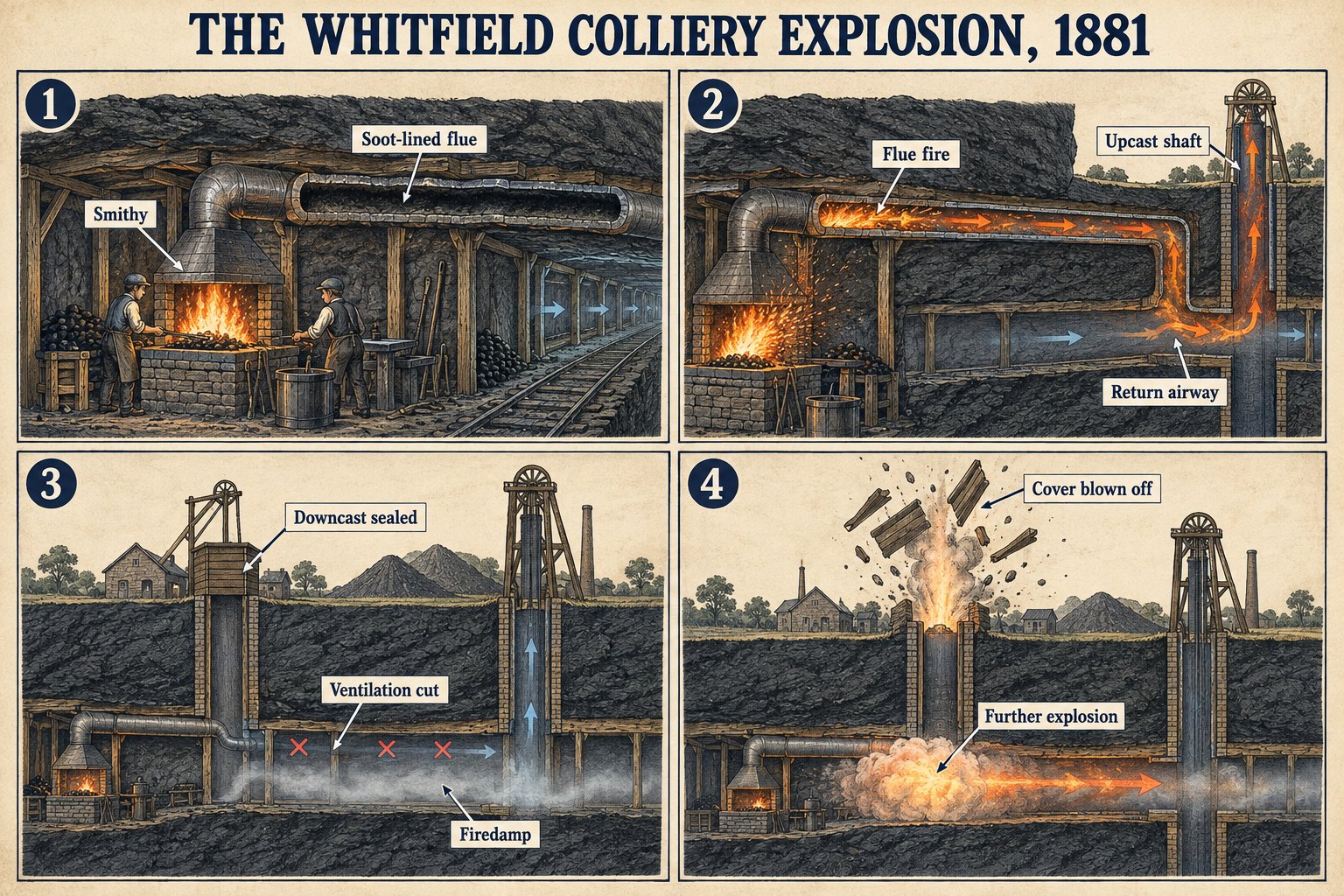
Boys built an unusually large fire in an underground smithy; the flue serving it had recently been moved away from the main ventilation current and was coated in soot, which caught alight from forge sparks and spread flame into the mine's air circuit. The Northern Mine Research Society's account of the inquest evidence adds that the boys tending the forge had fed it coal rather than the usual breeze, that the flue ended in a crosscut where the fire took hold, and that it spread into the return airway near the upcast shaft of a mine already known as fiery.
Contributing factors
The smithy flue had been moved some months earlier away from the main intake air current and was thickly coated in soot. The Durham Mining Museum attributes the explosion itself to coal dust rather than to firedamp alone, the flame from the burning flue finding dust in the airways. Cutting the ventilation to fight the fire, the step that made the later explosions possible, was taken with men still underground.
What happened
Shortly before 11pm on 6 February 1881, boys built up an unusually large fire in an underground blacksmith's forge at Whitfield Colliery. The flue serving the smithy had been relocated away from the main intake air current some months earlier and had become heavily coated in soot and coal dust, which caught alight from sparks off the forge. The fire spread into the ventilation system, and at around 3:10am on 7 February an explosion tore through the workings. In the effort to fight the fire, the downcast shaft was covered to starve it of oxygen — but this also cut off ventilation to the rest of the mine, allowing gas to accumulate and triggering at least one further explosion, which blew the shaft covering off again.
Rescue & recovery
The fire could not be put out underground. The upcast Laura shaft was filled and the downcast Institute shaft partly filled and covered to smother it, and the pit was left sealed for several weeks with the dead still inside. The force of the explosion collapsed the Laura pit, and its shaft and pit top were abandoned altogether; a new upcast, the Platt, was sunk to the Cockshead seam to replace it and was finished in 1883, while the Middle Pit shaft was deepened to the Hardmine seam in 1881 to make up the lost output.
Investigation & inquiry
A coroner's inquest found colliery manager E. Thomson guilty of culpable negligence over two of the deaths, by a 13-1 verdict. Thomson was subsequently tried on the resulting charge; the presiding judge directed that what he had done did not amount to culpable negligence in law, and the jury returned a Not Guilty verdict. The inquest jury called the placing of the underground smithy 'a mistake and great error of judgement', and the negligence it found lay in not withdrawing the men from the pit once its dangerous condition was known.
Legal & regulatory aftermath
The inquest was held at the Norton Arms near the colliery, sitting again in June, and returned a verdict of manslaughter against the manager. He was tried at Stafford Assizes, where the trial judge, Justice Cave, directed that what he had done did not amount to culpable negligence and the jury acquitted him. Sources give his name as both E. Thomson and Edwin Thompson.
What's uncertain
Points where sources disagree or the record could not be settled; both accounts are kept. All open questions in the archive.
- The Northern Mine Research Society's account gives 26 men killed underground, rising to at least 28 once deaths from injuries at the surface are included. (disputed) 1
- Other secondary accounts give the toll as 21 or 24 men and boys. (disputed) 2
- The Durham Mining Museum names twenty-four men and boys killed on 7 February 1881, and the colliery's own published history gives twenty-four. Contemporary accounts give twenty-one killed with about six bodies unrecovered, and totals as high as twenty-eight have been published. (disputed) 3,4
Recorded claims
Individual factual claims, each attached to the source(s) that support it below. Where sources disagree, both are kept.
- The Northern Mine Research Society's account gives 26 men killed underground, rising to at least 28 once deaths from injuries at the surface are included. (disputed) 1
- Other secondary accounts give the toll as 21 or 24 men and boys. (disputed) 2
- A coroner's inquest found manager E. Thomson guilty of culpable negligence by 13 votes to 1, but a subsequent criminal trial returned a Not Guilty verdict after the judge directed that his actions did not amount to culpable negligence in law. 1
- The Durham Mining Museum names twenty-four men and boys killed on 7 February 1881, and the colliery's own published history gives twenty-four. Contemporary accounts give twenty-one killed with about six bodies unrecovered, and totals as high as twenty-eight have been published. (disputed) 3,4
- The Durham Mining Museum records the cause of death for all twenty-four as an explosion of coal dust, ignition caused by the underground smithy. 4
- The explosion collapsed the Laura pit, whose shaft and pit top were abandoned; the Institute shaft was partly filled to smother the fire, and a new upcast shaft, the Platt, was sunk to replace the Laura and completed in 1883. 3
- The inquiry sat at the Norton Arms public house, and the manager was tried at Stafford Assizes on a charge of manslaughter and acquitted. 3
Related terminology
Mining terms this disaster is structurally linked to, with the nature of the relationship.
- Coal (contextual relationship)
Coal dust did the damage before any coal was burnt: the smithy flue was heavily coated in soot and coal dust, which caught from forge sparks and carried fire into the ventilation system. - Crosscut (contextual relationship)
The smithy flue ended in a crosscut, and it was there that the fire took hold before it reached the return airway. - Downcast Shaft and Upcast Shaft (contextual relationship)
Covering the downcast shaft to starve the fire of air also cut ventilation to the rest of the mine, letting gas build until it exploded and blew the covering off again. - Firedamp (contextual relationship)
A fiery pit: the fire reaching the return airway found gas as well as dust, and the explosions followed. - Heapstead (contextual relationship)
Named in this record’s rescue and recovery: “…force of the explosion collapsed the Laura pit, and its shaft and pit top were abandoned altogether; a new upcast, the Platt, was sunk to the…” - Return Airway (contextual relationship)
The smithy flue had been moved away from the main intake air current months earlier — a change to the ventilation circuit that let a forge fire reach the workings. - Shaft (contextual relationship)
The shaft covering, put on to smother the fire below, was blown clean off by the explosion that cutting the ventilation had caused.
Photographs & further reading
This page doesn't try to reproduce everything — these are the best original sources found for this disaster.
A history of the colliery covering the 1881 disaster, the loss of the Laura shaft, the inquiry at the Norton Arms and the sinking of the Platt pit.
View sourceThe colliery's record, including the names, ages and occupations of the twenty-four killed on 7 February 1881 and the cause recorded against each.
View sourceSources
- (secondary) Whitefield Colliery Explosion - Hanley - 1881 — Northern Mine Research Society
- (secondary) Mining Accidents and Disasters — Poldark Mine
- (secondary) Chatterley Whitfield — Wikipedia
- (primary) Whitfield Colliery (UK) — Durham Mining Museum
Record created: 20 August 2026 · Last researched: 11 September 2026