 MineArchive
Crosscut
| Also known as | Crut (North Staffordshire), Crutt (North Staffordshire), Cross-measures Drift (The general term the glossaries give as a synonym.), Crutter (North Staffordshire) |
|---|---|
| Category | Mine Workings & Access |
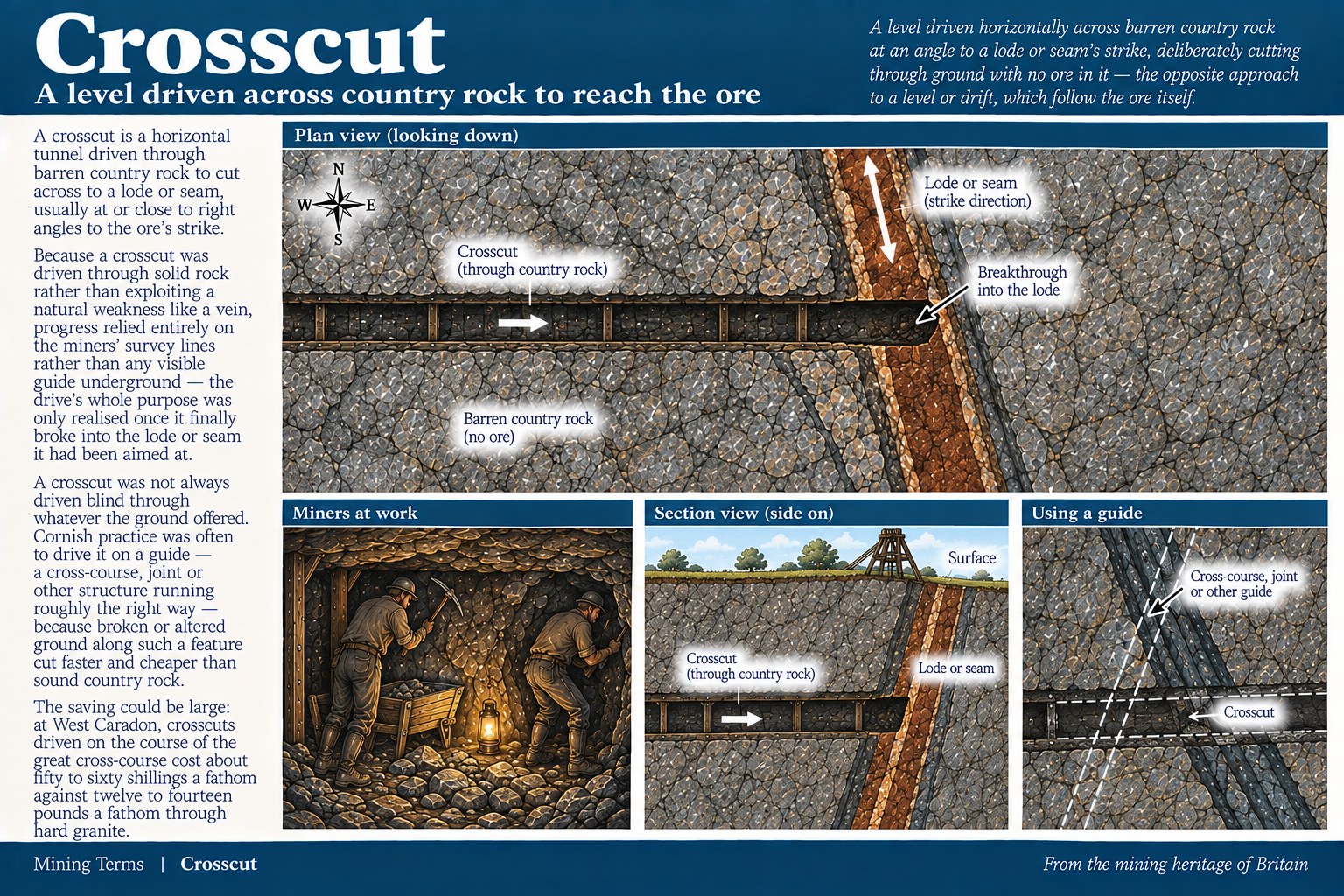
A level driven horizontally across barren country rock at an angle to a lode or seam's strike, deliberately cutting through ground with no ore in it — the opposite approach to a level or drift, which follow the ore itself.
Historical usage
Crosscutting was standard practice wherever a mine's ground held several roughly parallel lodes or seams: rather than sinking a separate shaft to reach each one, a single crosscut driven from an existing shaft or level could intersect several veins in turn, each one then worked outward along its own strike by ordinary levels.
How it worked
Because a crosscut was driven through solid rock rather than exploiting a natural weakness like a vein, progress relied entirely on the miners' survey lines rather than any visible guide underground — the drive's whole purpose was only realised once it finally broke into the lode or seam it had been aimed at. A crosscut was not always driven blind through whatever the ground offered. Cornish practice was often to drive it on a guide — a cross-course, joint or other structure running roughly the right way — because broken or altered ground along such a feature cut faster and cheaper than sound country rock. The saving could be large: at West Caradon, crosscuts driven on the course of the great cross-course cost about fifty to sixty shillings a fathom against twelve to fourteen pounds a fathom through hard granite.
Why it was used
A single crosscut reaching several parallel veins from one shaft and haulage system was far cheaper than sinking and equipping a new shaft on every lode, making it the standard way of exploiting ground with more than one vein close together. There was a second return besides access. Because a crosscut deliberately goes through ground nobody has worked, it is the one drivage in a mine that can find something unlooked for, and Cornish sources list the discovery of unknown mineralisation among its purposes rather than as a lucky accident.
Risks & limitations
Crosscutting meant driving blind through unproductive rock with no ore to offset the cost of the work, making it one of the most expensive forms of underground development per fathom — undertaken only where survey and geological judgement gave real confidence that a lode lay within reach.
Regional variation
A general underground-mining technique rather than a regionally distinctive one, used wherever multiple parallel veins or seams needed to be reached from shared shaft and haulage infrastructure.
Related terminology
Mines associated with this term
5 examples chosen from 20 linked records — the term page is not an index.
- Minnie Pit — Staffordshire (well documented example)
Named in this record’s workings: “…watched for heatings. The main haulage ran to the Banbury Dip cruts.” - Berthlwyd Colliery — Swansea (well documented example)
Named 3 times in this record, first in the summary: “…until 1937. It began on the Hughes seam, and about 1910 drove a cross-measures drift a mile long to reach other seams — striking the Penlan at 427 yards…” - Cilely Colliery — Rhondda Cynon Taf (well documented example)
Named 4 times in this record, first in the summary: “…156 yards to the Abergorki, from which the steam coal was won by a cross-measures drift through a sixty-yard fault. It raised nearly 214,000 tons in 1905…” - Cligga Head — Cornwall (well documented example)
Named in this record’s workings: “…200 and 300 ft, each with main drives east and west and numbered crosscuts running off them, as recorded in the surviving BGS plans. The…” - Deer Hills Baryte Mine — Cumbria (well documented example)
Named twice in this record, first in the history: “…after identifying promising quantities of baryte in the lodes there. Crosscuts were driven and a small amount of ore extracted, but the lode proved…”
Disasters associated with this term
5 examples chosen from 11 linked records, most direct relationship first.
- Albion Colliery explosion, 1906 (contextual relationship)
Named in this record’s narrative: “…who collapsed where the air was clearing and lived; Hill missed the crosscut, lost his way and died. The relighter's attendant was found a few…” - Apedale Colliery Sladderhill No. 3 Pit explosion, 1891 (contextual relationship)
Named in this record’s narrative: “…over Apedale in 1890. The Bullhurst district, reached by a 420-yard crut from the 200-yard shaft, was the only one worked in three shifts;…” - Cambrian Colliery explosion, 1905 (contextual relationship)
Named 3 times in this record, first in the cause: “Inspector F.A. Gray concluded the explosion began at No.6 crosscut when a stone fell and broke the glass of a bonneted Clanny-type…” - Chatterley Whitfield (Whitfield) Colliery explosion (contextual relationship)
The smithy flue ended in a crosscut, and it was there that the fire took hold before it reached the return airway. - Diglake Colliery Inrush, 1895 (contextual relationship)
Named in this record’s narrative: “…to Boyle's Hall. The water divided at the foot of the Ten Feet crut, part flowing east into the Seven Feet and part west into the Eight…”
Sources
- (primary) A Glossary of Terms Used in Coal Mining, by William S. Gresley, 1883 — Internet Archive
- (secondary) A Cornish mining glossary — Cornish Mining World Heritage Site (UNESCO)
- (secondary) Definition of crosscut — Mindat
- (secondary) Glossary of mining terms — North Staffordshire Miners' Group, Apedale Heritage Centre — North Staffordshire Miners' Group
- (secondary) Mining - Horizontal openings: drifts — Encyclopaedia Britannica
Record created: 22 August 2026 · Last researched: 10 September 2026