 MineArchive
Cambrian Colliery explosion, 1905
A firedamp explosion at Cambrian Colliery's No.1 pit in Clydach Vale killed 35 men on the night of 10 March 1905, apparently ignited when a bratticeman's safety lamp broke against falling rock; a five-day underground fire that followed prevented any further rescue.
| Date | 10 March 1905 |
|---|---|
| Mine | Cambrian Colliery |
| Region | Rhondda Cynon Taf |
| Type | Explosion |
| Fatalities | 35 (The Northern Mine Research Society's detailed account gives 35 dead, 32 bodies recovered and 2 never found; a Wikipedia summary elsewhere gives 33 — the more granular NMRS figure is used here. All but one of the Six Feet seam's complement of 66 pit horses also died.) |
| Injuries | 11 men were hospitalised with severe burns; a number of other men escaped with lesser injuries. |
| Context | During active mining |
Cause
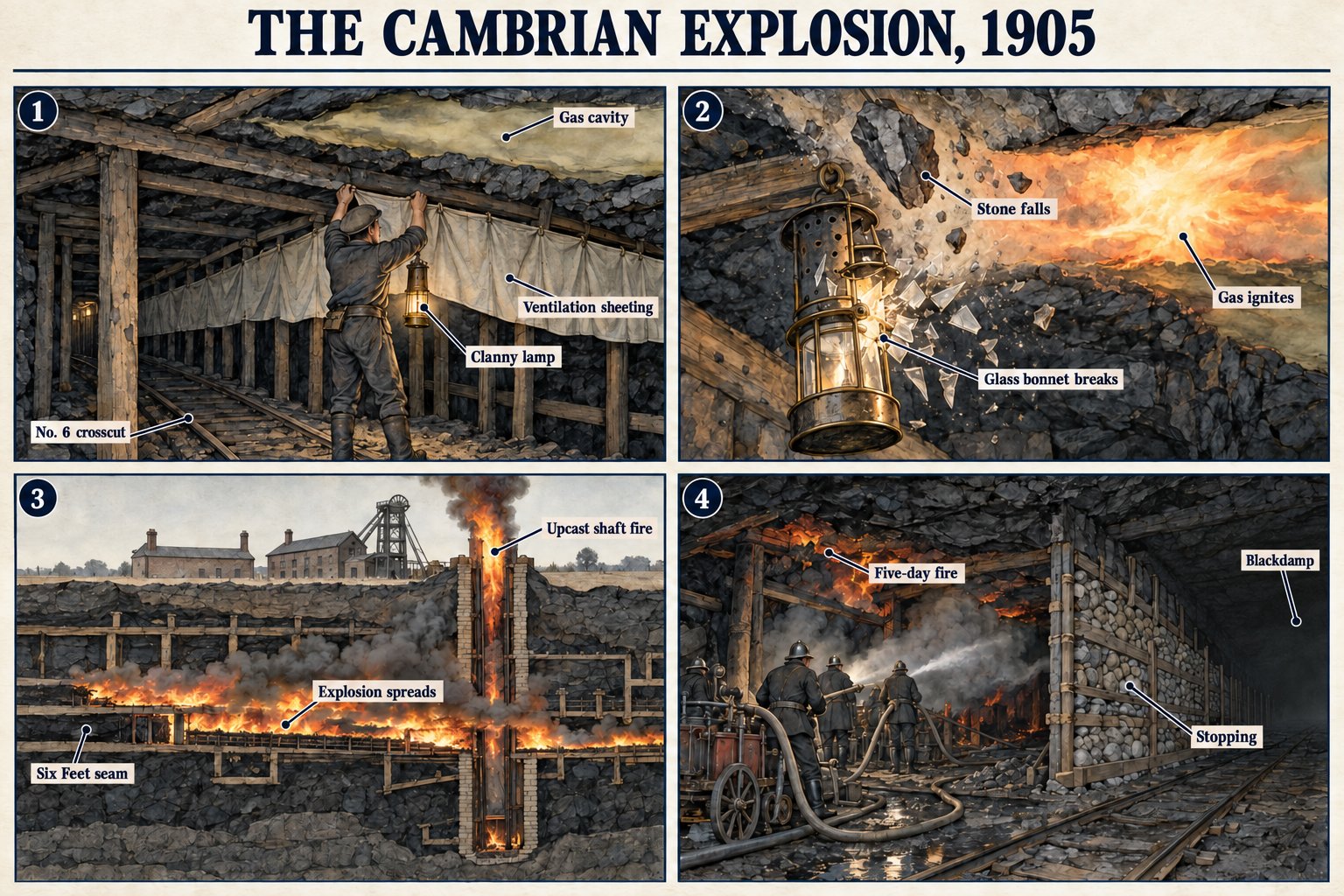
Inspector F.A. Gray concluded the explosion began at No.6 crosscut when a stone fell and broke the glass of a bonneted Clanny-type safety lamp carried by bratticeman David Enoch, igniting gas that had accumulated nearby; the inquest jury found no one to blame for the explosion itself.
Contributing factors
The Clanny-type lamp's glass bonnet was more prone to a sharp internal explosion when broken than the alternative Davy lamp design; a similar accident, caused the same way, had occurred at Aberaman Colliery only weeks earlier, on 30 December 1904. Evidence at the inquest also showed lamps were not consistently issued to the same worker each shift, in tension with safety rules requiring it.
What happened
Around 47 men were underground in the Six Feet seam on the night shift when the explosion struck at 6.25pm. Fireman Thomas Richards had earlier found gas in a cavity near No.5 crosscut and left bratticeman David Enoch to hang ventilation sheeting there; investigators concluded his lamp broke against a falling stone moments before the blast. A single detonation was heard; dust was blown up the downcast shaft, and the upcast shaft caught fire almost immediately. The explosion swept the whole district and every roadway in it.
Rescue & recovery
Managers found the No.1 shaft cage stuck at the bottom and descended instead via No.2 shaft to reach the Coronation seam, where they found 60 uninjured men, and rescued a further 15 badly burned survivors near the downcast shaft and No.1 Dip. Officials fought the resulting fire through the night; a plan to seal the shafts against a second explosion was reversed by Inspector Gray, who believed the fire could still be beaten. It was not fully extinguished until 14 March. Blackdamp then made recovery hazardous in turn, requiring a 20-foot-thick stopping — 17 feet of turf, 3 feet of concrete, 3 feet of clay and 3.5 feet of brickwork — to contain it; full exploration and recovery of the dead took three weeks, and two bodies were never found. Inspector Gray himself suffered carbon monoxide poisoning during the rescue, with acute headache, a racing pulse and hours of arm paralysis.
Investigation & inquiry
An inquest jury returned its verdict on 13 March 1905: the explosion began at No.6 crosscut and resulted from the failure of David Enoch's lamp, with no blame attaching to anyone for causing it. The jury's rider urged stricter enforcement of the rule requiring the same lamp to be issued to the same man every shift. Inspector Gray's own report highlighted the particular danger of bonneted Clanny lamps with glass components, drawing an explicit parallel with the near-identical Aberaman Colliery accident ten weeks earlier.
Changes to practice & legislation
The disaster, alongside the closely comparable Aberaman accident, reinforced official concern over glass-bonneted safety lamps and over lax enforcement of individual lamp issuing — both flagged directly in Inspector Gray's report, though this was one of several such disasters across the coalfield rather than a single trigger for new legislation.
Memorials & commemoration
The Cambrian Colliery memorial near Clydach Vale commemorates the dead of both this disaster and the 1965 explosion (see the mine's own record).
Recorded claims
Individual factual claims, each attached to the source(s) that support it below. Where sources disagree, both are kept.
- Inspector F.A. Gray concluded the explosion began at No.6 crosscut when a stone fell and broke the glass of bratticeman David Enoch's bonneted Clanny-type safety lamp, igniting accumulated gas; the inquest jury attached no blame to anyone for the explosion itself. 1
- The explosion killed 35 men (32 bodies recovered, 2 never found) and all but one of the 66 pit horses working the Six Feet seam. 1
- A fire following the explosion burned for five days before being fully extinguished on 14 March, after which blackdamp forced a 20-foot-thick stopping to be built before full recovery of the dead could be completed over three weeks. 1
Related terminology
Mining terms this disaster is structurally linked to, with the nature of the relationship.
- Chokedamp (contextual relationship)
Named in this record’s rescue and recovery: “…could still be beaten. It was not fully extinguished until 14 March. Blackdamp then made recovery hazardous in turn, requiring a 20-foot-thick…” - Crosscut (contextual relationship)
Named 3 times in this record, first in the cause: “Inspector F.A. Gray concluded the explosion began at No.6 crosscut when a stone fell and broke the glass of a bonneted Clanny-type…” - Downcast Shaft and Upcast Shaft (contextual relationship)
Named 3 times in this record, first in the narrative: “…the blast. A single detonation was heard; dust was blown up the downcast shaft, and the upcast shaft caught fire almost immediately. The explosion…” - Fireman (contextual relationship)
Named in this record’s narrative: “…Feet seam on the night shift when the explosion struck at 6.25pm. Fireman Thomas Richards had earlier found gas in a cavity near No.5 crosscut…” - Safety Lamp (contextual relationship)
Named 3 times in this record, first in the summary: “…the night of 10 March 1905, apparently ignited when a bratticeman's safety lamp broke against falling rock; a five-day underground fire that…”
Sources
- (secondary) Cambrian Colliery Explosion - Clydach - 1905 — Northern Mine Research Society
- (secondary) Cambrian Colliery — Wikipedia
- (secondary) Cambrian disasters — welshcoalmines.co.uk
Record created: 27 August 2026 · Last researched: 27 August 2026