 MineArchive
Cambrian Colliery
| Location | Clydach Vale, near Tonypandy, Rhondda Cynon Taf — 51.6240, -3.4880 (exact) |
|---|---|
| Commodity | Coal |
| Type | Coal |
| Worked | 1872 (No. 1 shaft)–24 September 1966 |
| Maximum depth | 1,577 feet (No.3 shaft, the deepest, reaching the Lower Five Feet/Gellideg level) |
| Operators | Cambrian Collieries Ltd (1872–1966) |
Overview
A giant of the Rhondda coalfield at Clydach Vale, struck twice by disaster — in 1905 and again in 1965, the last major mining disaster in South Wales history — and whose owning combine gave its name to the bitter strike that led to the 1910 Tonypandy Riots.
History
Samuel Thomas and the brothers John Osborne and Osborne Henry Riches sank Cambrian Colliery's No.1 shaft from 1872, in the Clydach Vale side valley of the Rhondda Fawr; a No.2 shaft followed in 1874, a No.3 shaft between 1889 and 1891, and a No.4 shaft from 1912. Within twenty years the colliery was raising over 700 tons of coal a day, and by 1895 its owners had gone public as Cambrian Collieries Ltd. In 1906 the company became part of the Cambrian Combine, a cartel of South Wales coal companies — including the Glamorgan, Naval and Britannic Merthyr companies — formed to coordinate prices and wages across the coalfield.
That combine gave its name to the bitter Cambrian Combine dispute of 1910-11, one of the most notorious industrial disputes in Welsh history. It began on 1 August 1910, when men employed by the combine's Naval Colliery Company at the Ely Pit in nearby Penygraig found lockout notices waiting for them; within weeks close to a sixth of all miners in South Wales were out. Confrontations between strikers and police in Tonypandy came to a head on 8 November 1910, when a miner, Samuel Rhys, died of head injuries amid rioting that injured hundreds more; Home Secretary Winston Churchill's decision to send troops toward the valleys, though he in fact held back the reinforcements requested by police, earned him lasting resentment in Wales. The strike collapsed in defeat after a full year, in September 1911, the men returning to work on worse terms than before.
Employment at Cambrian Colliery itself peaked in 1925 at 4,100 men underground and 798 on the surface, and production peaked at around a million tons a year in the 1920s. Both figures declined steeply thereafter: by 1965-66 only 781 people worked there in total, and annual output had fallen to 187,600 tons. The colliery is remembered above all for two separate explosion disasters twenty years apart — one on 10 March 1905, the other on 17 May 1965 — together the worst of any single South Wales colliery, killing at least 64 men between them (see Disasters, below). The 1965 explosion was the last major mining disaster in South Wales history. Cambrian Colliery closed on 24 September 1966.
Geology
Cambrian worked a sequence of South Wales coalfield seams including the Six Feet, Pentre, Lower Five Feet, Coronation, Nine Feet, Bute, Two Foot Nine and Yard seams; the Four Feet seam was abandoned after 1893, probably through exhaustion. No.3 shaft, serving as the return air upcast, reached 1,577 feet at the Lower Five Feet/Gellideg level, making it the deepest of the colliery's four shafts.
Workings
No.1 and No.2 shafts were the original sinking shafts from the 1870s, with No.3 (1889-91) added as a return-air upcast reaching the deepest working level, and No.4 begun in 1912. In 1905 ventilation was provided by a 35-foot Waddle fan moving 348,000 cubic feet of air a minute, with over 4,000 yards of water pipe run through the main roads and a spraying system used to wet coal on the trams as a dust-suppression measure — advanced practice for its time, though it did not prevent that year's disaster.
Closure
Cambrian closed on 24 September 1966, its workforce and output both having fallen dramatically from their 1920s peak; annual production in its final year was 187,600 tons, against around a million tons a year forty years earlier.
What remains
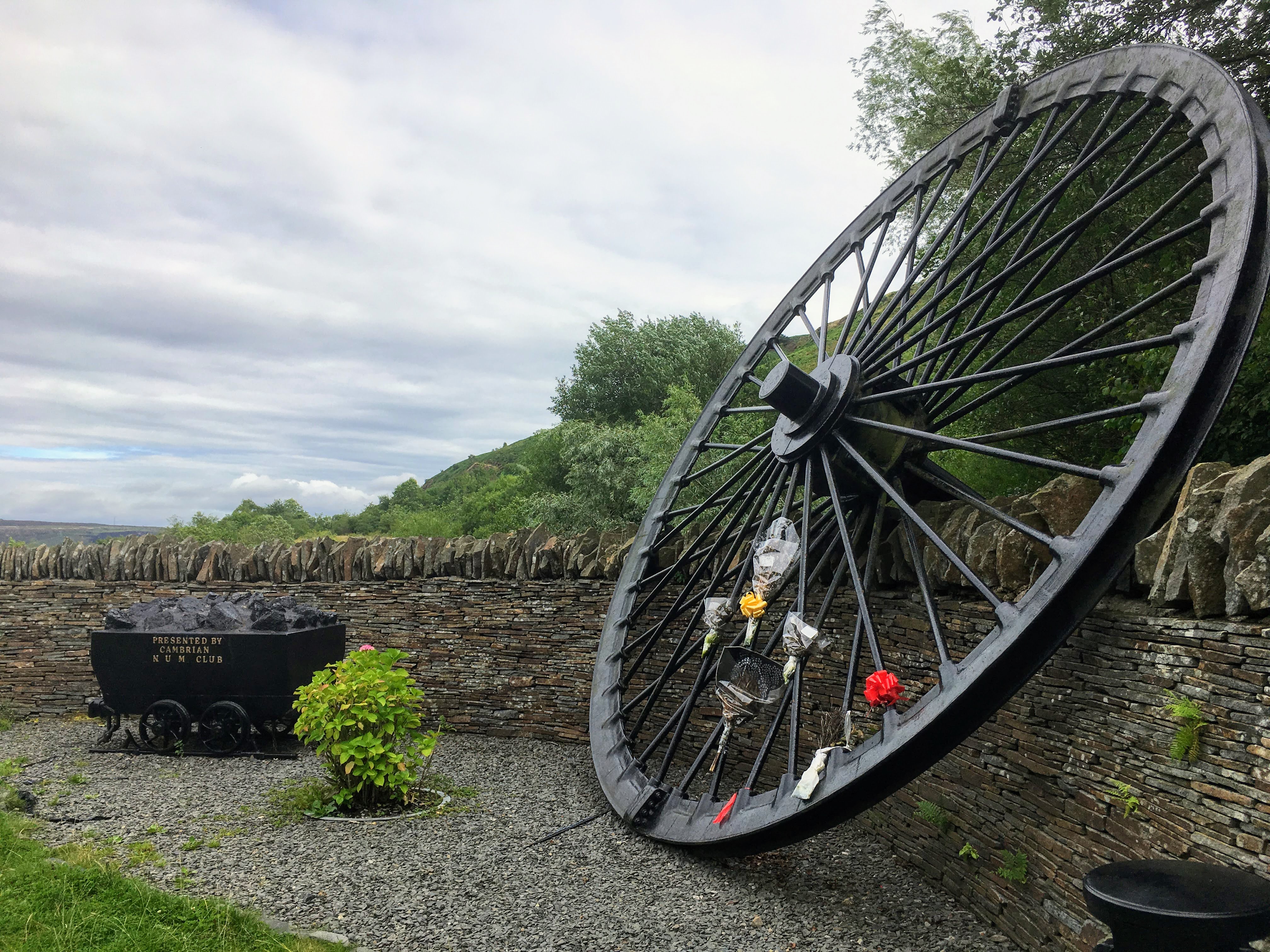
A memorial near Clydach Vale commemorates those killed in the colliery's two explosion disasters.
Related mines
- Glamorgan Colliery — Both were pits of the Cambrian Combine, which absorbed the Glamorgan Coal Company in 1908, and both were at the centre of the strike of 1910 and 1911 and the Tonypandy riots that came out of it.
- Naval Colliery — Both belonged to the Cambrian Combine and were shut down together at the start of the 1910-11 Cambrian Combine dispute, one of the most significant industrial disputes in Welsh history.
Nearby mines
- Blaenclydach Colliery — 0.6 miles (1.0 km) E
- Eastern Colliery — 1.0 miles (1.6 km) N
- Glamorgan Colliery — 1.4 miles (2.3 km) E
- Dinas Main Colliery — 1.5 miles (2.5 km) S
- Gelli Colliery — 1.5 miles (2.5 km) NE
Straight-line distance, within 9 miles (15 km). Show on the map.
Disasters & major incidents
-
Cambrian Colliery shaft accident, 1892
8 August 1892 · Collapse / Roof Fall · 2 fatalities
A squeeze in the Cambrian No. 2 shaft at Clydach Vale pushed out its lining early on 8 August 1892, burying three men cleaning the sump and killing two. -
Cambrian Colliery steam pipe burst, 1900
11 November 1900 · Machinery · 4 fatalities
Four men died of scalds at Cambrian Colliery, Clydach Vale, on Sunday 11 November 1900 when the main steam pipe burst in the No. 2 winding-engine house while new exhaustion gear was being fitted. -
Cambrian Colliery roof fall, 1902
September 1902 · Collapse / Roof Fall · 2 fatalities
Two men riding out on a journey of coal at Cambrian Colliery, Clydach Vale, were buried in September 1902 when a tram knocked out a collar and the roof fell. -
Cambrian Colliery explosion, 1905
10 March 1905 · Explosion · 35 fatalities
A firedamp explosion at Cambrian Colliery's No.1 pit in Clydach Vale killed 35 men on the night of 10 March 1905, apparently ignited when a bratticeman's safety lamp broke against falling rock; a five-day underground fire that followed prevented any further rescue. -
Cambrian Colliery explosion, 1965
17 May 1965 · Explosion · 30 fatalities
A firedamp explosion at Cambrian Colliery, caused by an electrical arc igniting gas that had built up after a ventilation structure was left open for over two hours, killed 30 men on 17 May 1965 — the last major mining disaster in South Wales history.
Recorded claims
Individual factual claims, each attached to the source(s) that support it below. Where sources disagree, both are kept.
- Samuel Thomas and the Riches brothers sank Cambrian Colliery's No.1 shaft from 1872 in Clydach Vale, with No.2 following in 1874, No.3 in 1889-91 and No.4 from 1912; within twenty years the colliery was raising over 700 tons of coal a day, and the company went public as Cambrian Collieries Ltd in 1895. 1
- Cambrian Collieries Ltd became part of the Cambrian Combine in 1906, a cartel of South Wales coal companies; the combine's 1910 lockout at the Naval Colliery Company's Ely Pit in Penygraig escalated into the Cambrian Combine dispute, culminating in the Tonypandy Riots of 8 November 1910, in which miner Samuel Rhys died and Home Secretary Winston Churchill's handling of police and troop deployments caused lasting controversy in Wales. 2,3
- Employment peaked in 1925 at 4,100 men underground and 798 on the surface, with production around a million tons a year in the 1920s; by 1965-66 the workforce had fallen to 781 in total and annual output to 187,600 tons. 1
- The colliery worked the Six Feet, Pentre, Lower Five Feet, Coronation, Nine Feet, Bute, Two Foot Nine and Yard seams (the Four Feet seam was abandoned after 1893); No.3 shaft, the deepest, reached 1,577 feet at the Lower Five Feet/Gellideg level. 1
- Cambrian Colliery closed on 24 September 1966. 4,1
Sources
- (secondary) Cambrian Colliery — welshcoalmines.co.uk
- (secondary) Cambrian Combine miners strike and Tonypandy riot, 1910 — libcom.org
- (secondary) Tonypandy riots — Wikipedia
- (secondary) Cambrian Colliery — Wikipedia
Record created: 27 August 2026 · Last researched: 27 August 2026