 MineArchive
Waddle Fan
| Also known as | Waddle Ventilator (Gresley's 1883 wording, listing it with the Guibal and Schiele.), Waddell Fan (A common misspelling, including in some published sources.), Waddle open-runner fan (The form used in this archive's Ellistown record, describing the caseless design.) |
|---|---|
| Category | Structures & Machinery |
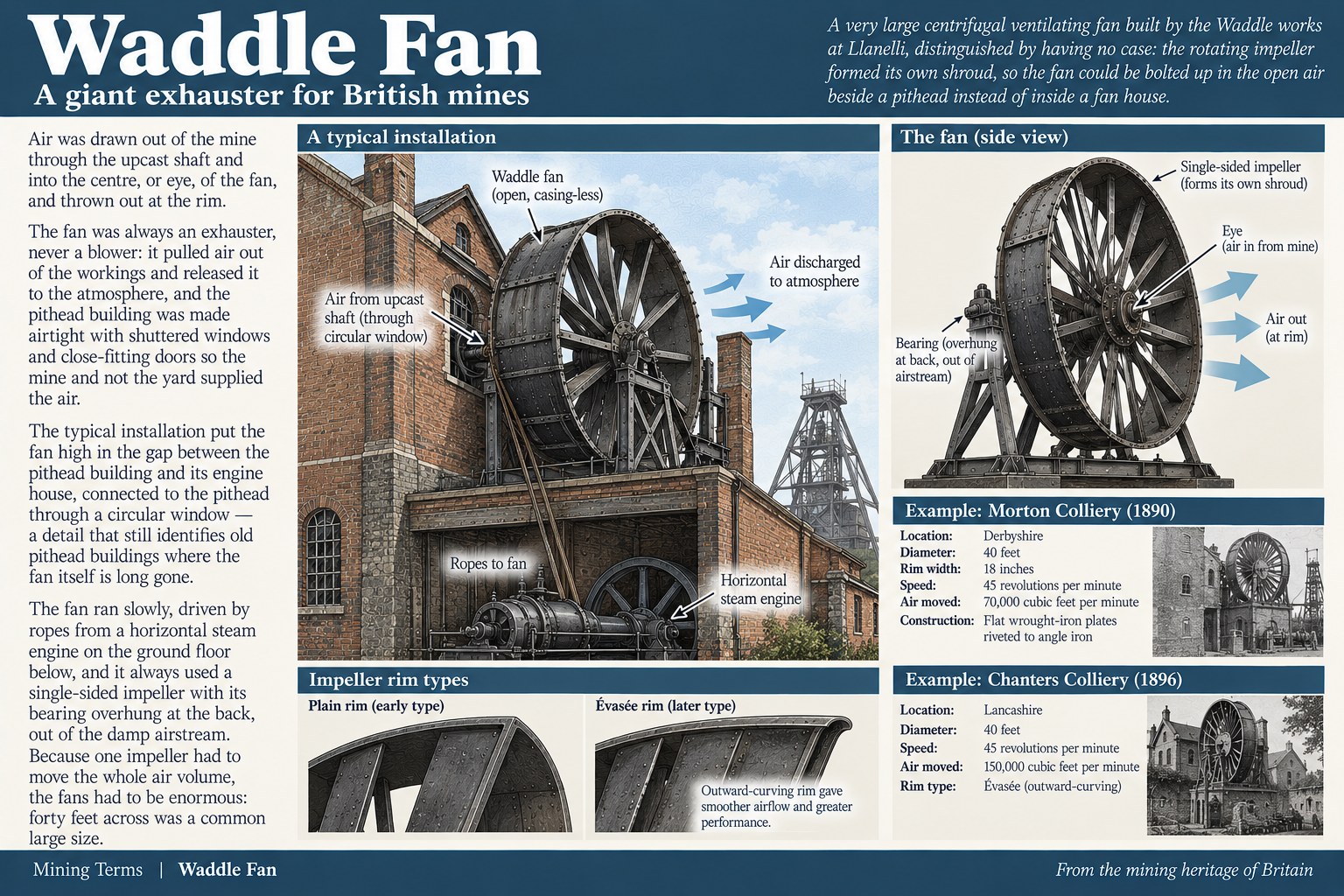
A very large centrifugal ventilating fan built by the Waddle works at Llanelli, distinguished by having no case: the rotating impeller formed its own shroud, so the fan could be bolted up in the open air beside a pithead instead of inside a fan house. Waddle were the only makers to build fans of this form at this size.

Historical usage
Mechanical ventilation became compulsory in British mines after the Hartley Colliery disaster of 1862, which killed two hundred and four men and boys when the beam of the pumping engine broke and fell down the colliery's single shaft, trapping everyone below. The law that followed required separate downcast and upcast shafts and fans rather than the old ventilation furnace, and that made a market. The Waddle sold into it particularly well, because a fan that carried its own casing could be retro-fitted to an existing pithead with very little building work.
They were commonest in South Wales, near the works, and were used across the English coalfields too. This archive's own records find them at Cambrian, where a thirty-five-foot Waddle was moving 348,000 cubic feet of air a minute in 1905; at Nixon's Navigation, where a forty-foot fan survived into the 1980s; at Abercwmboi, where a forty-foot Waddle replaced the ventilation furnace in 1874; at Ellistown, driven by a Belliss and Morcom enclosed engine; and at Cwmaman and Dunnikier, where the fan is what the Lists of Mines record replacing the furnace.
The firm was in business at Llanelli from 1830 to 1970. It traded as the Waddle Fan and Engineering Company until that partnership between Hugh William Waddle and Ronald Edward Bill was dissolved on 14 July 1891, after which Waddle carried the business on alone from the Llanmore Works as the Waddle Patent Fan and Engineering Company.
How it worked
Air was drawn out of the mine through the upcast shaft and into the centre, or eye, of the fan, and thrown out at the rim. The fan was always an exhauster, never a blower: it pulled air out of the workings and released it to the atmosphere, and the pithead building was made airtight with shuttered windows and close-fitting doors so the mine and not the yard supplied the air.
The typical installation put the fan high in the gap between the pithead building and its engine house, connected to the pithead through a circular window — a detail that still identifies old pithead buildings where the fan itself is long gone. The fan ran slowly, driven by ropes from a horizontal steam engine on the ground floor below, and it always used a single-sided impeller with its bearing overhung at the back, out of the damp airstream. Because one impeller had to move the whole air volume, the fans had to be enormous: forty feet across was a common large size.
The early ones were plain. A fan of 1890 at Morton Colliery in Derbyshire, forty feet across and eighteen inches wide at the rim, was built of flat wrought-iron plates riveted to angle iron, ran at forty-five revolutions a minute and moved 70,000 cubic feet of air. Six years later a fan of the same size and speed at Chanters Colliery in Lancashire moved 150,000, the difference being an outward-curving évasée rim that gave smoother airflow and straighter internal blades.
Why it was used
Because it was cheap to install on a pit that already existed. A cased fan needs a building; a Waddle needs a bearing and a rope drive. For a colliery told by law to put in mechanical ventilation, that mattered more than efficiency.
Risks & limitations
The design died of electricity. A Waddle turned slowly and suited a steam engine; when electric motors came in after the First World War they ran faster, and a forty-foot fan at speed has so high a rim velocity that it turns turbulent and vibrates. The industry moved to pairs of much smaller fans, around seventeen feet, and the caseless design was unsuited to that. Waddle Engineering never made the transition and the fans went out with the steam that drove them.
Regional variation
Made at Llanelli and commonest in South Wales, though sold across the British coalfields. The name is sometimes wrongly spelled Waddell. The Waddle sat alongside the other named centrifugal ventilators of the period — the Guibal, which this archive holds as a term of its own, the Schiele, the Rammel and the Struve — and Gresley's 1883 glossary lists it among them.
Related terminology
Mines associated with this term
5 examples chosen from 42 linked records — the term page is not an index.
- Nixon's Navigation Colliery — Rhondda Cynon Taf (surviving physical example)
The forty-foot Waddle fan here outlived the colliery, surviving into the 1980s after the site had been cleared; its driving steam engine is preserved at Big Pit. - Cambrian Colliery — Rhondda Cynon Taf (well documented example)
In 1905 ventilation here was provided by a thirty-five-foot Waddle fan moving 348,000 cubic feet of air a minute — one of the fullest performance figures for a Waddle anywhere in this archive. - Aber Colliery — Bridgend (well documented example)
Named twice in this record, first in the history: “…Colliery Company from 1886. It produced house coal, and its 20-foot Waddle fan was stopped on Saturday afternoons and not restarted until nine on…” - Baddesley Colliery — Warwickshire (well documented example)
Named in this record’s workings: “…shaft bottom hauling coal back up. The colliery was ventilated by a Waddell fan.” - Bishwell Colliery — Swansea (well documented example)
Named in this record’s workings: “Ventilated from 1881 by an 18-foot Waddle fan; the later working employed 15 men in 1929.”
Disasters associated with this term
5 examples chosen from 8 linked records, most direct relationship first.
- Genwen Colliery explosion, 1907 (relevant method/equipment)
A 25-foot Waddle fan. - Glynea Colliery explosion, 1913 (relevant method/equipment)
A 21-foot Waddle fan ventilated the mine. - Abercwmboi Colliery Explosion, 1870 (contextual relationship)
Named twice in this record, first in the aftermath: “…the sources read. The colliery replaced its furnace with a 40-foot Waddle fan in 1874.” - Baddesley Colliery Explosion (contextual relationship)
Named in this record’s rescue and recovery: “…when the pit was reopened, explored and the bodies recovered. The Waddell fan had survived undamaged and the colliery ventilated well enough that…” - Broadoak Colliery explosion, 1897 (contextual relationship)
Named in this record’s narrative: “…seam by the pillar and stall method; ventilation was by a 20-foot Waddle fan and the mine was lit by locked safety lamps. A night shift went to…”
Sources
- (primary) A Glossary of Terms Used in Coal Mining, by William S. Gresley, 1883 — Internet Archive
- (secondary) Waddle Patent Fan and Engineering Co — Grace's Guide
- (secondary) Waddle fan — Wikipedia
Record created: 10 September 2026 · Last researched: 10 September 2026