 MineArchive
Guibal Fan
| Category | Structures & Machinery |
|---|
A large, steam-driven centrifugal ventilating fan, patented in 1862 by the Belgian engineer Théophile Guibal, that became the dominant mechanical ventilation technology in British and European collieries and ironstone mines from the 1860s until well into the twentieth century.
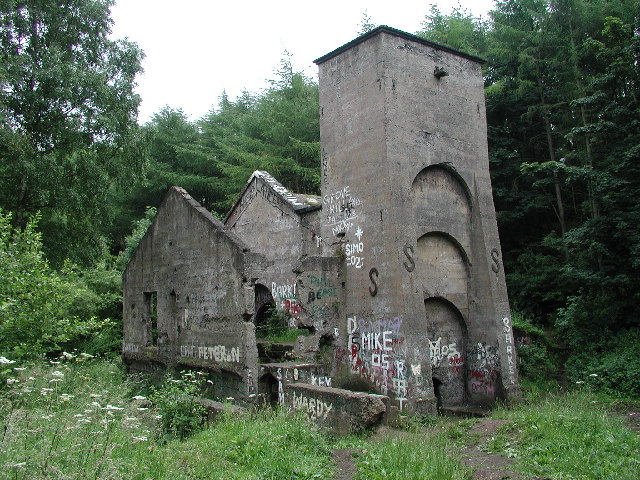
Historical usage
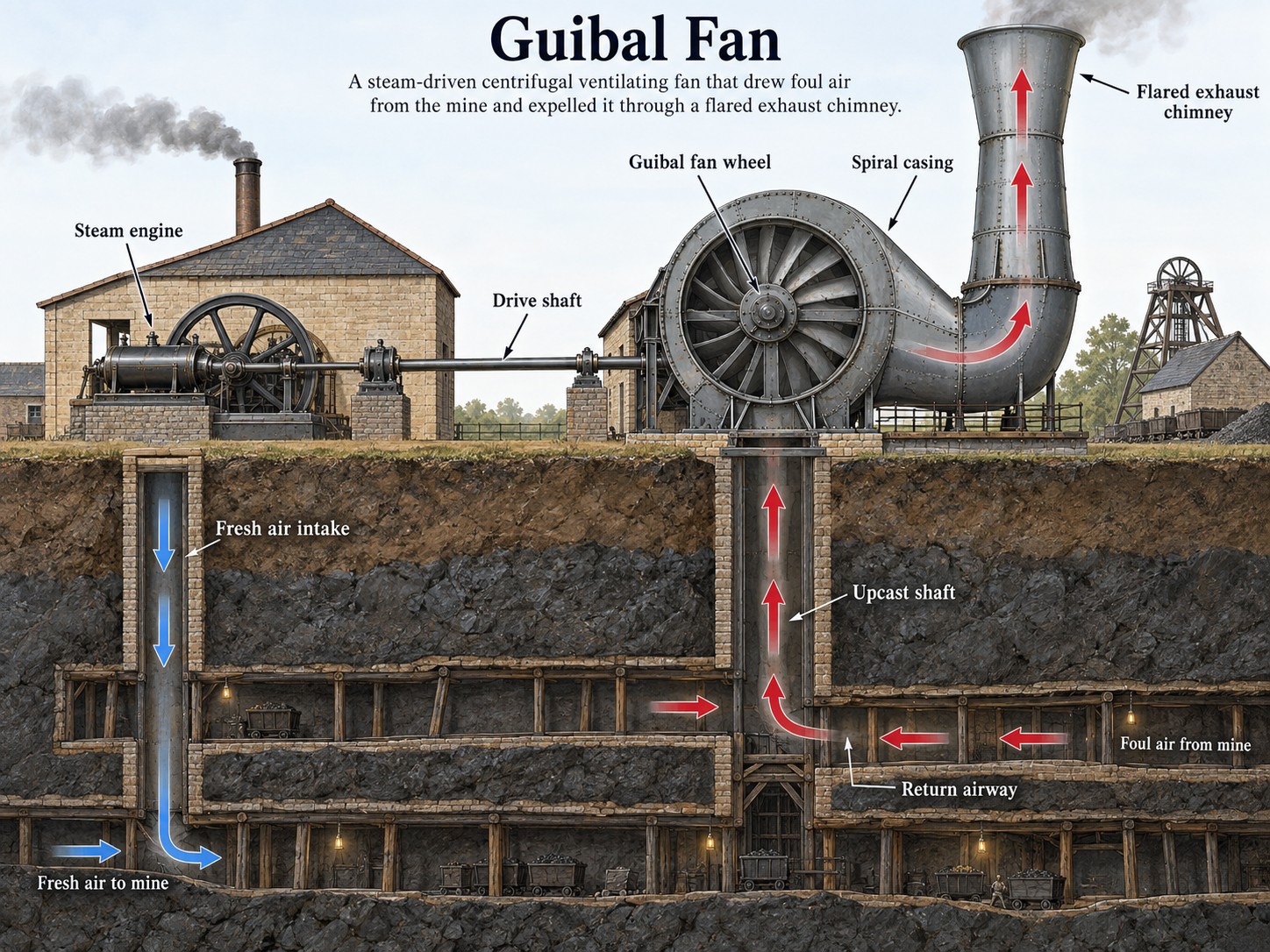
Guibal, who co-founded and taught for forty years at the École des Mines du Hainaut, first proved his fan design at the Mariemont and Bascoup collieries in Belgium's Hainaut coalfield in the early 1860s. Its two key design features — a tightly fitted spiral casing with an adjustable discharge shutter, and an évasée (flared) exhaust chimney that recovered velocity as static pressure — made it markedly more efficient than earlier fan designs. It spread rapidly: most new British colliery ventilators installed after 1860 were Guibal fans, and by the later 1870s they outnumbered rival Fabry blowers four to one in Germany's Ruhr coalfield.
How it worked
A steam engine turned a large centrifugal fan wheel — typically 30 to 40 feet in diameter — housed in the fan's distinctive spiral casing; the fan drew foul air up and out of the mine through a return airway, drawing fresh air in to replace it through the intake shaft or adit. The flared exhaust chimney recovered energy that would otherwise have been lost as the exhausted air slowed down, improving overall efficiency.
Why it was used
Guibal's design let mines ventilate far larger and deeper workings than older methods such as a furnace burning at the shaft bottom (which itself posed an obvious ignition risk in a gassy pit) or smaller, less efficient fan designs, directly enabling the exploitation of coal and ironstone at greater depths than had previously been practical.
Risks & limitations
A mechanical fan of this kind still depended on being run continuously and reliably — several nineteenth-century mining disasters, including at Apedale Colliery, occurred at collieries in the process of replacing older furnace ventilation with a fan, or where fan capacity had not kept pace with the mine's growth.
Related terminology
Furnace Ventilation, Waddle Fan
Mines associated with this term
5 examples chosen from 37 linked records — the term page is not an index.
- Eston Ironstone Mines — North Yorkshire (well documented example)
Named twice in this record, first in the workings: “…from the drift mouths ran down by gravity. Ventilation was by Guibal fan; one installed in 1869 was 37 feet in diameter, and the fan house…” - New Hawne Colliery — West Midlands (well documented example)
Named 4 times in this record, first in the workings: “…buildings include the winding engine house and the housing for a Guibal fan, the mechanical ventilator that drew air through the workings.” - Abram Colliery — Greater Manchester (well documented example)
Named 3 times in this record, first in the history: “…were 18 feet in diameter and reached the Arley mine at 650 yards. A Guibal fan was installed in 1877 and a 46-foot Guibal fan by Walker Brothers in…” - Addison Colliery — Tyne and Wear (well documented example)
Named twice in this record, first in the history: “…Brockwell (3 ft 10 in at 45 fathoms). It was ventilated by a 16-foot Guibal fan, had 180 beehive coke ovens and raised 450 tons a day. Addison…” - B Winning Colliery — Derbyshire (well documented example)
Named in this record’s workings: “…in at the top, with lifting hoods, and the pit was ventilated by a Guibal fan 36 feet in diameter and 12 feet wide. The winding engine had two…”
Disasters associated with this term
5 examples chosen from 7 linked records, most direct relationship first.
- Walker Colliery explosion, 1887 (relevant method/equipment)
A Guibal fan on the Jane Pit ventilated the mine. - Abram Colliery explosion, 1881 (contextual relationship)
Named in this record’s narrative: “…longwall, with locked safety lamps and blasting forbidden; a 46-foot Guibal fan was passing nearly eighty thousand cubic feet of air a minute. The…” - Bersham Colliery explosion (contextual relationship)
Named in this record’s narrative: “…the downcast ten feet six inches across and the upcast thirteen. A Guibal fan thirty feet in diameter put 43,110 cubic feet of air a minute…” - Blackwell A Winning Colliery explosion, 1895 (contextual relationship)
The pit was ventilated by a 45-foot Guibal fan, which was running normally at the time. - St Helen's Colliery explosion, 1888 (contextual relationship)
Named in this record’s narrative: “…the Main seam and the Ten Quarters seam 34 fathoms above it. A Guibal fan at the upcast exhausted the air, about 37,170 cubic feet a minute…”
Sources
- (primary) Huntcliffe Guibal fan house, Skelton and Brotton — Historic England listing — Historic England
- (secondary) Lifecycles in Coal Mine Ventilation Technologies, 1850-1914 — Economic History Society
Record created: 2 September 2026 · Last researched: 2 September 2026