 MineArchive
Bersham Colliery explosion
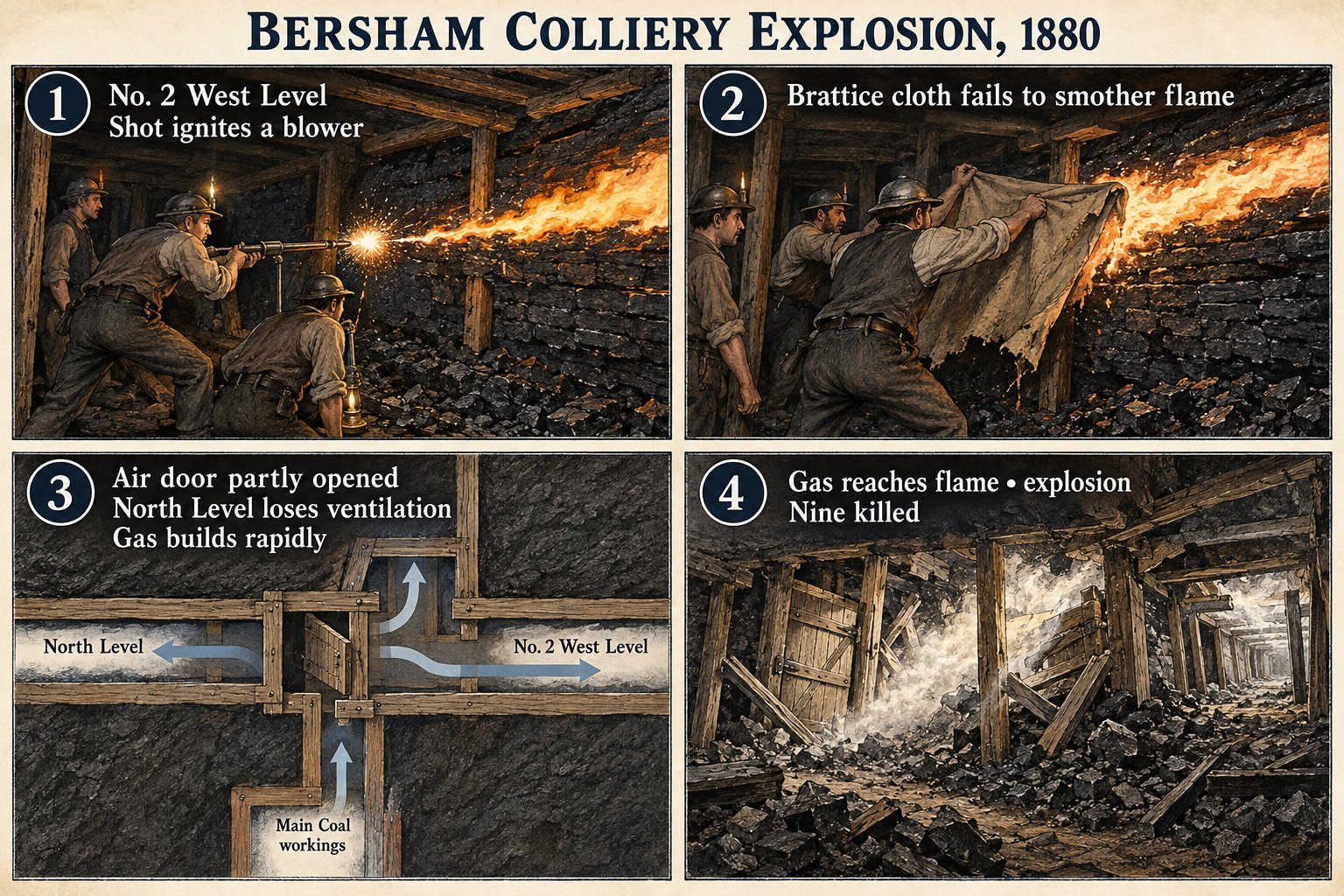
A shot fired into the coal at the far end of No. 2 West Level on the evening of 3 August 1880 ignited a blower. The colliers tried to brush it out with brattice cloth, failed, and went up for the manager. He came down with eight others to seal the district off, and partly opened an air door to clear the smoke. That cut the ventilation to the North Level, gas built up quickly and reached the flames. Nine of the nine men who had gone down died.
| Date | 3 August 1880 |
|---|---|
| Mine | Bersham Colliery |
| Region | Wrexham |
| Type | Explosion |
| Fatalities | 9 (Nine. Eight were killed by the blast and the pitman Henry Valentine, found alive underground, died a few days later.) |
| Context | During active mining |
Cause
Firedamp, ignited by a blower that a gunpowder shot had set alight in No. 2 West Level and that the men could not put out.
Contributing factors
The Main Coal at Bersham was known to give off a great deal of firedamp and the coal was worked by gunpowder. Assistant Inspector Hedley told the inquest that firedamp showed at the lamp flame in all the south headings at his inspection, with blowers in several places, and that he had put the danger of using gunpowder in such ground to the manager Pattison, who had appeared to accept it and stopped work in that part of the mine. The immediate contributing act was the air door: partly opening it to drive the smoke away reduced the ventilation on the North Level and the places next to it, and the gas accumulated very rapidly.
What happened
The colliery had recently been sunk to the Main Coal, reached by a shaft 418 yards deep, the downcast ten feet six inches across and the upcast thirteen. A Guibal fan thirty feet in diameter put 43,110 cubic feet of air a minute through the mine, of which 5,980 went to the West Side and 11,040 to the East.
On the evening of 3 August shots were fired at the far end of No. 2 West Level and lit a blower. The collier John Williams heard Edward Owens call that the gas had fired — 'let's go lads and put it out' — and went in with John Hughes to brush it out with brattice cloth. They could not, and went to the surface. Joseph Jones was sent to the pit eye for water and could not get back through the smoke.
The manager came down with firemen and others, nine in all. The smoke was by then so dense they could not get near the face or the intake end of the West Level. They appear to have partly opened an air door to drive some of it away. Gas accumulated and reached the flames, and the explosion came at a point 335 yards from the pit eye.
Rescue & recovery
N. R. Griffiths, a Wrexham mining engineer, heard the explosion at midnight and drove to the colliery. He and Hough went down the downcast in the bottom deck of the cage, the cover having been blown off the top deck, to find the water rings broken, the signal strand snapped and the rods on the north side blown into the shaft with the cage jammed against them. A few yards along the North Level, past a roof fall, they found Pattison lying on his face and knees, facing the shaft, blown towards it by the blast. Further on both stoppings and the air crossing were down. At the old longwall working they could smell burning, and a little beyond it they found Valentine alive. The afterdamp stopped them going further.
The hooker-on's body was found under the guide rods blown into the south inset, and John Jones, Edward Owen and Robert Lloyd were found as the afterdamp weakened along the North Level. Bratticing began on the morning of Saturday 7 August, and beyond the Second West Heading door — shut, undamaged, with a board broken out deliberately to let air through — the bodies of James Roberts and Thomas Evans lay on the inbye side of the stopping. Evan Parry and Joseph Mathias were found the following morning. Ventilation was restored throughout the pit on 18 August.
Investigation & inquiry
The inquest was held at the County Buildings before the coroner B. H. Thelwell and a jury of sixteen, with Henry Hall, Inspector of Mines, his assistant Hedley, the Wigan mining engineer J. Walker and managers from the surrounding collieries present. Walker had been the company's consulting engineer since the preceding March and had found the ventilation in good order on 26 and 28 July. Several colliers gave evidence: that Owens was always close when shots were fired and that a shot was never fired without the fireman's orders; that three days before, Joseph Mathias had told Thomas Steen to put up rails to keep people out of a place because gas was there; that the pit was dangerous to work in but carefully managed.
Changes to practice & legislation
The last witness was John Laidley Hedley, Assistant Inspector of Mines, who was critical of the use of gunpowder and put the wider question: whether in a seam of this character it is safe to fire shots at all. He was strongly of the opinion that shots should not be fired at any time when blowers are perceptible, and that in any circumstances gunpowder should only be used when the men ordinarily employed in the mine are out of it — a principle, he said, already being carried out in a number of fiery mines in Lancashire.
Memorials & commemoration
A gravestone in St Mary's parish churchyard at Chirk marks one of the miners killed in the explosion.
What's uncertain
Points where sources disagree or the record could not be settled; both accounts are kept. All open questions in the archive.
- Nine men died. The Northern Mine Research Society names them as William Pattison, 57, manager; Joseph Mathias, 34, fireman; Edward Owen, 49, fireman; John Johns, 42, fireman; James Roberts, 36, fireman; Henry Valentine, 44, pitman; Thomas Evans, 32, collier; Edward Parry, 36, collier; and Robert Lloyd, 39, hooker-on. Welsh Coal Mines gives several of the ages differently — Pattison 56, Mathias 36, Owen 45, Evans 23 — and the fireman the society calls John Johns it calls John Jones. (disputed) 1,2
Recorded claims
Individual factual claims, each attached to the source(s) that support it below. Where sources disagree, both are kept.
- Nine men died. The Northern Mine Research Society names them as William Pattison, 57, manager; Joseph Mathias, 34, fireman; Edward Owen, 49, fireman; John Johns, 42, fireman; James Roberts, 36, fireman; Henry Valentine, 44, pitman; Thomas Evans, 32, collier; Edward Parry, 36, collier; and Robert Lloyd, 39, hooker-on. Welsh Coal Mines gives several of the ages differently — Pattison 56, Mathias 36, Owen 45, Evans 23 — and the fireman the society calls John Johns it calls John Jones. (disputed) 1,2
- A shot fired into the coal at the far end of No. 2 West Level ignited a blower. The men could not smother it. The manager and eight others went down to cut off the ventilation with stoppings and partly opened an air door to disperse the smoke, which reduced the air on the North Level; gas built up rapidly and reached the flames, exploding 335 yards from the pit eye. 1,2
- Assistant Inspector John Laidley Hedley told the inquest that firedamp showed at the lamp flame in all the south headings and that blowers were present in several places, and asked whether in such a seam it is safe to fire shots at all. He held that shots should never be fired while blowers are perceptible, and that gunpowder should only be used when the men ordinarily employed in the mine are out of it, a principle already followed in a number of fiery Lancashire mines. 2
Related terminology
Mining terms this disaster is structurally linked to, with the nature of the relationship.
- Blower (contextual relationship)
Named 5 times in this record, first in the summary: “…end of No. 2 West Level on the evening of 3 August 1880 ignited a blower. The colliers tried to brush it out with brattice cloth, failed, and…” - Brattice (contextual relationship)
Named twice in this record, first in the summary: “…1880 ignited a blower. The colliers tried to brush it out with brattice cloth, failed, and went up for the manager. He came down with eight…” - Guibal Fan (contextual relationship)
Named in this record’s narrative: “…the downcast ten feet six inches across and the upcast thirteen. A Guibal fan thirty feet in diameter put 43,110 cubic feet of air a minute…” - Inset (contextual relationship)
Named in this record’s rescue and recovery: “…hooker-on's body was found under the guide rods blown into the south inset, and John Jones, Edward Owen and Robert Lloyd were found as the…” - Stopping (contextual relationship)
Named twice in this record, first in the rescue and recovery: “…facing the shaft, blown towards it by the blast. Further on both stoppings and the air crossing were down. At the old longwall working they…”
Photographs & further reading
This page doesn't try to reproduce everything — these are the best original sources found for this disaster.
The Northern Mine Research Society's account, from the 1880 Mines Inspectors Report and the Colliery Guardian of 6 August, with the ventilation figures, the sequence from the shot to the blast, the recovery of each body and the inquest evidence in full. Reached through the Internet Archive because the society's live site redirects deep links to its home page.
View sourceThe colliery history, with the explosion summarised and the nine men named with their ages and the families they left.
View sourceSources
- (secondary) Bersham Colliery Rhostyllan — Welsh Coal Mines
- (secondary) Bersham Colliery Explosion, Wrexham, 1880 — Northern Mine Research Society, via the Internet Archive
- (secondary) Bersham Colliery — Wikipedia
Record created: 11 September 2026 · Last researched: 11 September 2026