 MineArchive
Brattice
| Category | Ventilation & Mine Gases |
|---|
A partition, built or hung inside a mine shaft or roadway, used to separate and direct the flow of ventilating air.
Historical usage
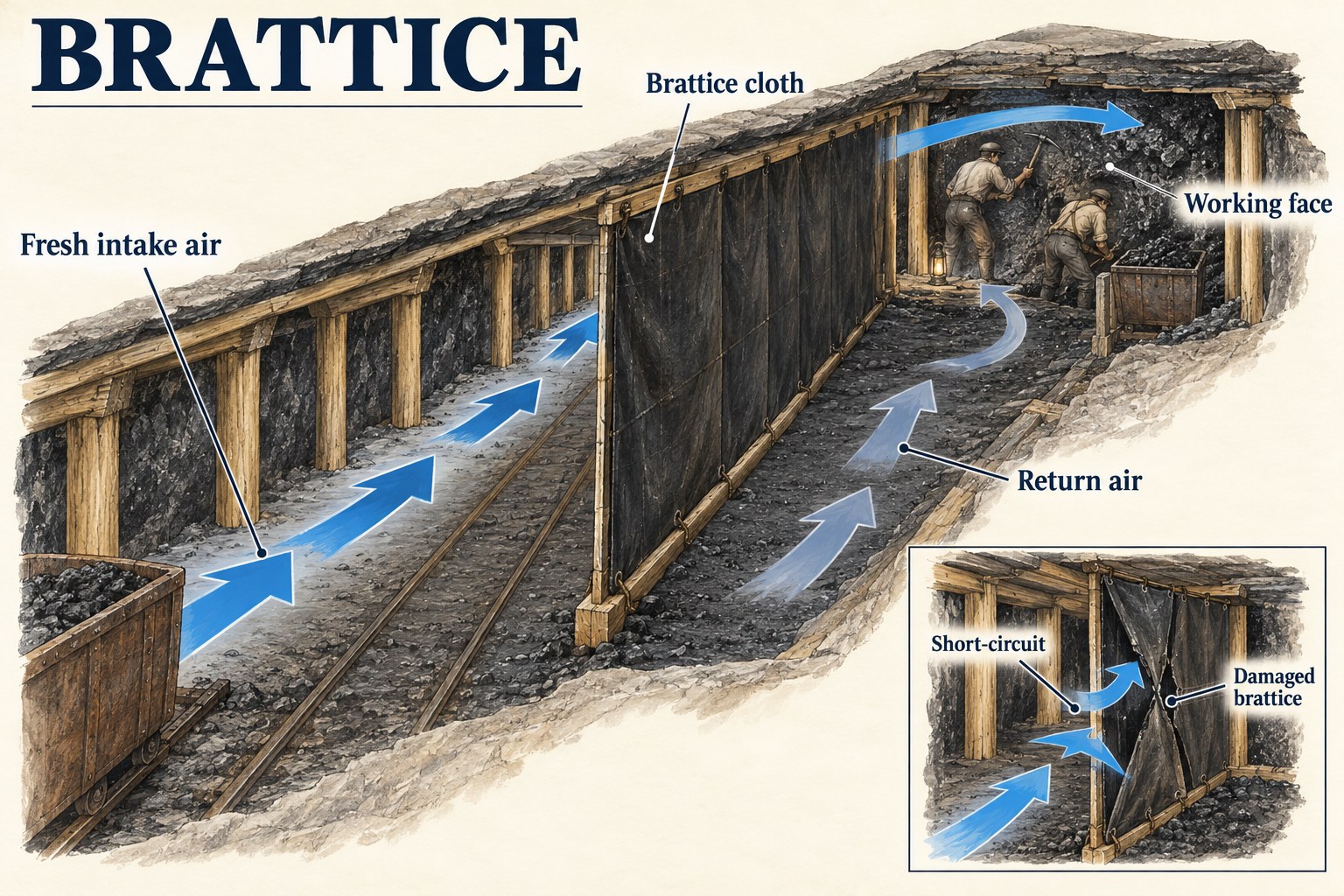
Brattices are a longstanding feature of British mine ventilation, going back to the earliest collieries that relied on a single shaft divided in two, with a furnace kept burning on one side to draw air down the other and up past the fire — the brattice being what physically kept the two air currents apart. Cloth brattice, waxed or tarred jute sacking, came into wide use as a cheaper, movable alternative to permanent timber or masonry partitions.
How it worked
A permanent brattice — built of timber, brick or concrete — divided a shaft or roadway into a downcast side, carrying fresh air down, and an upcast side, carrying stale air and gas back out. Temporary cloth brattice served the same purpose in working areas, hung to direct part of the ventilating current toward or away from a specific working face as needed, and could be repositioned as work advanced.
Why it was used
Brattices let a mine control where its ventilating air actually went, rather than letting it find its own way through the workings — essential for keeping fresh air reaching the working face and clearing gas from it, rather than air simply short-circuiting through the easiest route back to the upcast shaft.
Risks & limitations
A brattice depended entirely on being properly maintained and correctly positioned: a damaged, displaced or badly fitted brattice could let ventilating air bypass the working face altogether, allowing dangerous gas to build up exactly where it was least expected — a failure implicated in more than one British mining disaster.
Regional variation
The word carries a different weight in different coalfields. In the North East, the Coalmining History Resource Centre's glossary applies it both to the main divisions of a shaft and to the partial sheeting set in working places to guide air up to the face, and the deputy's job description there includes placing brattices in the boards. Barrowman's 1886 Scottish glossary reduces it to its function alone — a partition for directing the ventilating current — and Scottish usage distinguishes the structure from brattice cloth, the canvas sheet used to do the same job temporarily. Healey Hero records the specialised air-sollar, a brattice carried beneath the tram rails in a heading so that air could be returned under the floor of a roadway rather than beside it. In metal mining the term is used more loosely again, for any timber-and-cloth division of a shaft or level.
Related terminology
Mines associated with this term
5 examples chosen from 15 linked records — the term page is not an index.
- Edmunds Main Colliery — South Yorkshire (well documented example)
Named in this record’s history: “…coal between them, three-quarters of a mile long and ventilated by brattice and by slits cut between them every twenty yards. The men driving…” - Elemore Colliery — County Durham (well documented example)
Named in this record’s workings: “The George shaft, divided by a brattice into the George and Lady pits, and the Isabella shaft with its 1826…” - Genwen Colliery — Carmarthenshire (well documented example)
Named in this record’s workings: “…headings 17 yards apart, ventilated by a 25-foot Waddle fan and brattice tubes.” - Hartley Colliery (Hester Pit) — Northumberland (well documented example)
A single 12-foot shaft divided by a timber brattice into upcast and downcast sides served the whole mine — the arrangement that killed 204 men when the beam fell. - Harton Colliery — Tyne and Wear (well documented example)
Named twice in this record, first in the history: “…10 May 1841. The shaft was a single one, divided in two by a timber brattice, and needed cast-iron tubbing for 474 feet because of a fault; on 10…”
Disasters associated with this term
5 examples chosen from 57 linked records, most direct relationship first.
- Newbottle Colliery Elizabeth Pit gas disaster, 1821 (direct cause)
The broken brattice let the gas in. - Ripley Colliery explosion, 1857 (direct cause)
The hole through the brattice without a door short-circuited the air. - Sheriff Hill Colliery fire, 1815 (direct cause)
The timber shaft partition caught fire. - Cwmtillery Colliery explosion, 1873 (contributing factor)
Sheets left down cut off the air. - Genwen Colliery explosion, 1907 (contributing factor)
Displacement of the brattice could let gas accumulate.
Sources
- (primary) Glossary of Scotch Mining Terms — James Barrowman (1886), via Scottish Mining Website
- (secondary) A Glossary of Mining Terms — Coal Mining History Resource Centre
- (secondary) Brattice — Wikipedia
- (secondary) Mining Terms — Scottish Mining Website
- (secondary) Pit Terminology — Healey Hero
- (secondary) RI 2872 The Use of Brattice Cloth in Coal Mines — OneMine
Record created: 22 August 2026 · Last researched: 11 September 2026