 MineArchive
Newbottle Colliery Elizabeth Pit gas disaster, 1821
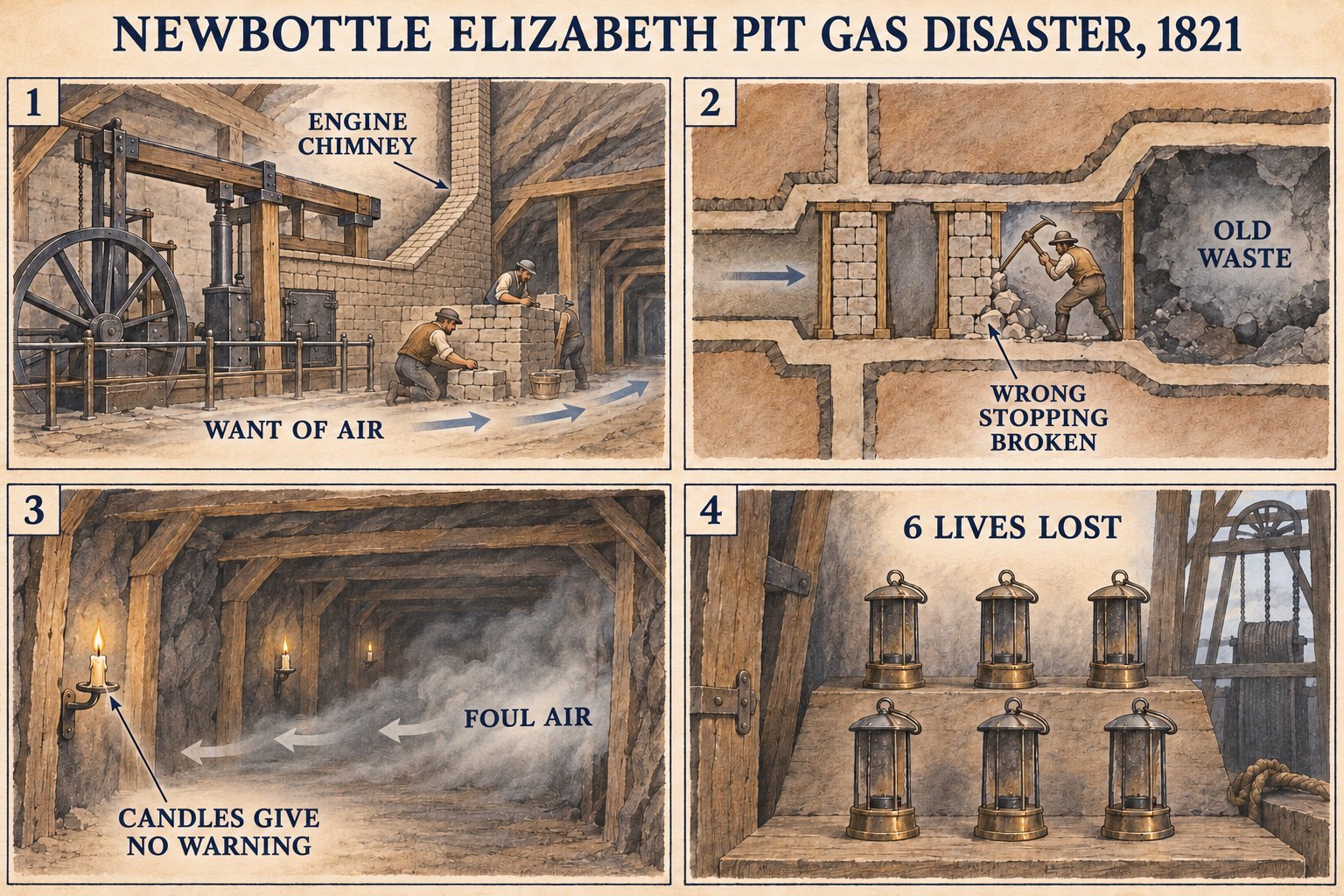
In October 1821 six men died in the Elizabeth Pit of Newbottle (Nesham's) Colliery when a brattice built up against old workings broke and gas came through. Their candles went on burning in it and gave no warning.
| Date | 17 to 19 October 1821 |
|---|---|
| Mine | Newbottle Colliery |
| Region | Tyne and Wear |
| Type | Gas / Asphyxiation |
| Fatalities | 6 (Six. The Durham Mining Museum and the Tyne and Wear HER record an explosion; the NMRS account, from Galloway and Sykes, and the burial register record suffocation.) |
| Context | During active mining |
Location
Plotted at Newbottle Colliery. Recorded location. The large pin is the mine; the small round markers are the nearest mines on record. Click one for its page. View on full map
Cause
Gas from old workings, let in when a brattice erected close up against them was broken.
Contributing factors
The gas was of a kind in which candles continued to burn, so the men had no warning of it. The stopping was broken down to give air to masons working on the chimney of the underground engine, and the wrong one was broken.
What happened
Some masons repairing the chimney of the underground engine complained, at about half past ten on the Wednesday night, of want of air. Robert Curry, a wasteman, broke down a stopping to let more in, but by mistake broke one that led into an old waste. The foul air burst into the pit and fired, a 'standing fire' that soon went out. Curry was suffocated on the spot; the rest escaped to the shaft, some through the fire, badly burnt. When the men came down at midnight to change shifts the accident was found, and several who went into the bad air were overcome. The viewer went down with the overman, George Steel, already weakened by his earlier descents; Steel fell, and the viewer collapsed after him and was carried out apparently lifeless, coming round in the cart that took him away. Steel could not be reached in time.
The burial register records the dead as 'accidentally suffocated in the coal mine called Elizabeth Pit'. They were buried on 20 and 21 October: James Burnip, 36, and Matthew Anderson, 50, of Newbottle; Robert Smith, 47, of Philadelphia; Robert Curry, a wasteman of 45; and George Beaney, 32, of Houghton. The sixth was George Steel, an overman of 31, buried at Lamesley. Steel and Curry left large families.
Rescue & recovery
Several men who went in to save Curry were overcome by the bad air; the overman George Steel died in the attempt, and the viewer was brought out unconscious and recovered.
What's uncertain
Points where sources disagree or the record could not be settled; both accounts are kept. All open questions in the archive.
- The Durham Mining Museum and the HER record it as an explosion, 6 killed, on 19 October 1821. (disputed) 2,3
- The masons complained of want of air at about half past ten on the Wednesday night, 17 October 1821. (disputed) 4
- The accident happened on 18 October 1821. (disputed) 5
- Six workmen died of choke-damp at Nesham's colliery, Newbottle, on 19 October 1821, when a brattice closing an old working was broken into to get more air. (disputed) 6
Recorded claims
Individual factual claims, each attached to the source(s) that support it below. Where sources disagree, both are kept.
- Six men were suffocated by gases in which their candles continued to burn; a brattice close up to an old working was broken. 1
- The Durham Mining Museum and the HER record it as an explosion, 6 killed, on 19 October 1821. (disputed) 2,3
- George Steel, overman, 31, was buried at St Andrew's, Lamesley. 2
- A wasteman, Robert Curry, broke down a stopping to give air to masons repairing the engine chimney, broke by mistake into an old waste, and the foul air burst in and fired briefly. 4
- The overman George Steel died going in with the viewer to search for the men; the viewer was carried out lifeless and recovered. 4,5
- The masons complained of want of air at about half past ten on the Wednesday night, 17 October 1821. (disputed) 4
- The accident happened on 18 October 1821. (disputed) 5
- Six workmen died of choke-damp at Nesham's colliery, Newbottle, on 19 October 1821, when a brattice closing an old working was broken into to get more air. (disputed) 6
Related terminology
Mining terms this disaster is structurally linked to, with the nature of the relationship.
- Bad Air (contextual relationship)
Named 3 times in this record, first in the narrative: “…in, but broke by mistake one that led into an old waste, and the foul air burst into the pit and fired, a 'standing fire' that soon went out.…” - Brattice (direct cause)
The broken brattice let the gas in. - Overman (contextual relationship)
An overman was among the dead. - Stopping (contextual relationship)
Named twice in this record, first in the contributing factors: “…candles continued to burn, so the men had no warning of it. The stopping was broken down to give air to masons working on the chimney of the…” - Viewer (contextual relationship)
Named 3 times in this record, first in the narrative: “…was found, and several who went into the bad air were overcome. The viewer went down with the overman, George Steel, already weakened by his…”
Sources
- (secondary) Neshams Colliery Suffocation - Newbottle - 1821 — Northern Mine Research Society
- (primary) Durham Mining Museum - Newbottle Colliery — Durham Mining Museum
- (primary) Newbottle Colliery, Dorothea Pit (HER 3123) — Tyne and Wear HER (Sitelines)
- (primary) News (The Times, 26 October 1821, from the Tyne Mercury) — Durham Mining Museum
- (primary) Dreadful catastrophes (Westmorland Gazette, 3 November 1821) — Durham Mining Museum
- (primary) Local Records; or, Historical Register of Remarkable Events, vol. 2 (J. Sykes, 1866 edition) — Internet Archive
Record created: 21 September 2026 · Last researched: 3 November 2026