 MineArchive
Overman
| Also known as | Oversman (Scottish) |
|---|---|
| Category | Labour & Roles |
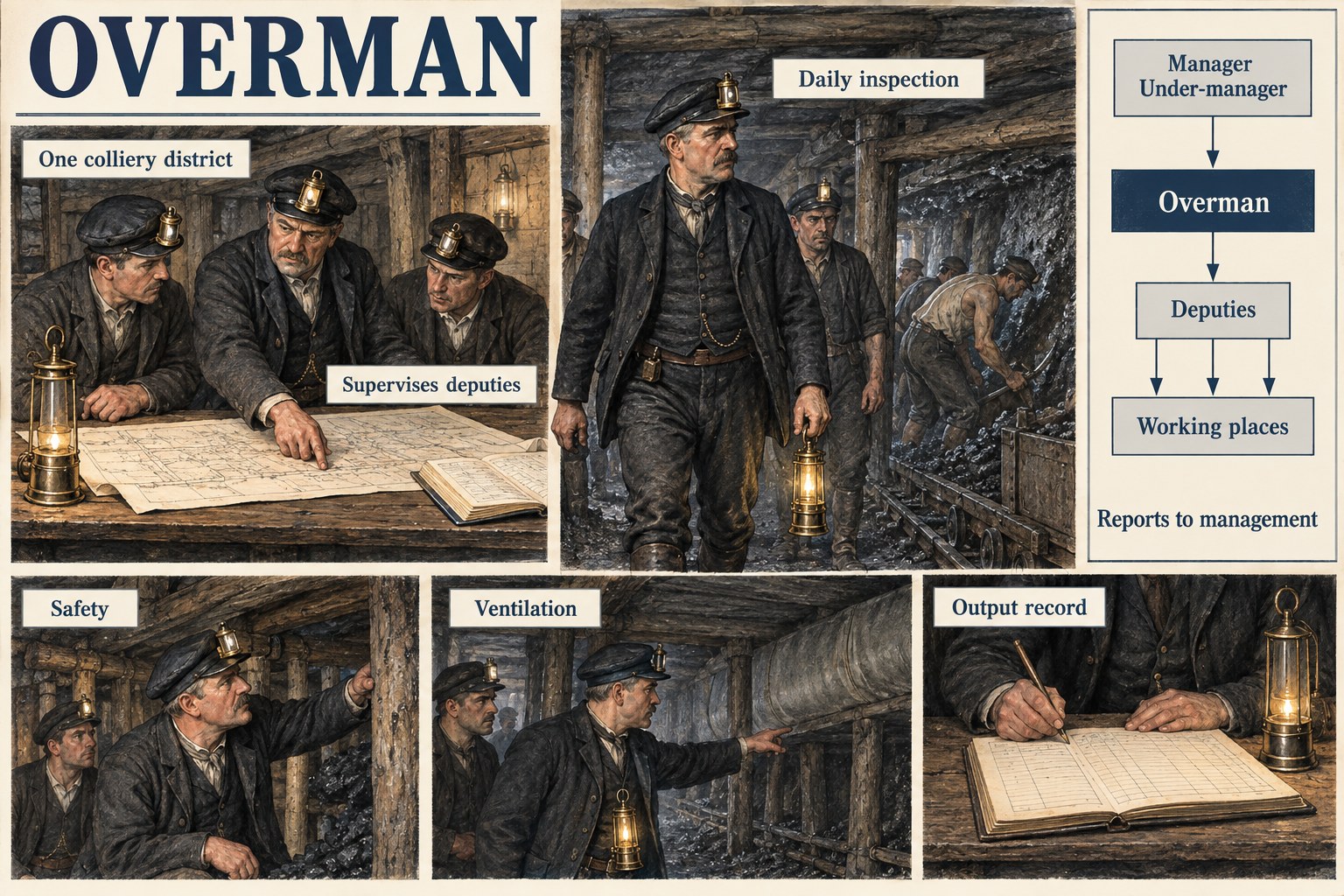
An underground coal-mining official ranking between the deputy and the under-manager, responsible for the day-to-day supervision of one section, or 'district', of a colliery.
Historical usage
Overmen were typically experienced miners promoted on the strength of that experience rather than formal training alone, though by the 20th century the role required a statutory Overman's or Manager's Certificate. Where a colliery company ran several pits under a single viewer, each pit would usually have its own overman.
How it worked
An overman inspected their district's safety each working day, supervised the deputies working within it, recorded output for piece-work purposes, and reported daily to the manager or under-manager in a prescribed form — the working link between a colliery's day-to-day underground operations and its senior management.
Why it was used
As collieries grew larger and were organised into multiple districts or pits, a single manager or under-manager could not personally supervise every working place; the overman provided a dedicated, certificated layer of supervision for each section.
Risks & limitations
The overman carried the legal responsibility for other men's safety without the authority to spend money on it: he inspected, reported and signed, and it was the manager who decided what was done about what he found. That put the grade in an exposed position after an accident, and overmen appear regularly in the inquest and prosecution records of the 19th and 20th centuries, answering for conditions in a district they supervised but did not control. The job also had to be done across the whole shift cycle, which is why the North East pits carried a back-overman to hold the district from the time the overman left until the pit loosed in the evening; the supervision was continuous even where the authority was not.
Regional variation
The National Association of Colliery Overmen, Deputies and Shotfirers (NACODS) organised overmen alongside deputies and shotfirers for some eighty years, reflecting how closely these three supervisory grades worked together underground despite their distinct ranks and duties. The rank itself is a North East invention that spread with North East practice. The Durham Mining Museum's glossary sets out the underground chain as manager, under-manager, overman, deputy, while the older North East glossaries call the man above him the viewer and under-viewer. In the CMHRC's North East glossary the deputy is still given as 'deputy overman', the two grades not yet fully separated, and Healey Hero records the back-overman as a distinct post.
Related terminology
Captain, Deputy, Naked Light, Putter, Stoneman, Viewer
Mines associated with this term
5 examples chosen from 26 linked records — the term page is not an index.
- Abercwmboi Colliery — Rhondda Cynon Taf (notable incident)
James Davies, the overman who found gas in the north return and sent for help, was killed in the 1870 explosion. - Lletty Shenkin Colliery — Rhondda Cynon Taf (well documented example)
Named in this record’s history: “…in 1853 killed three men and badly burned fifteen more, after an overman ordered a collier to work away a pillar of coal with a naked light…” - Acomb Colliery — Northumberland (well documented example)
Named in this record’s history: “…on 8 April and one from a fall of stone on 19 December as the overman drew props. J. Morrison & Co. followed in the 1860s. In 1875, as the…” - Clough Hall Colliery — Staffordshire (well documented example)
Named in this record’s history: “…dismissed the inspector's charge, and in September the same overman sent a man to brush gas out with his waistcoat and he too was killed…” - Clyde Colliery, Hamilton — South Lanarkshire (well documented example)
Named in this record’s history: “…most of them the roof and haulage deaths of a Lanarkshire pit: an overman and a fireman who fell down the shaft in 1891 and 1892, a pithead…”
Disasters associated with this term
5 examples chosen from 99 linked records, most direct relationship first.
- Bryncoch Colliery inundation, 1859 (rescue/recovery concept)
The overman died trying to warn the men. - Tynewydd Colliery inundation, 1877 (rescue/recovery concept)
The overman Richard Howell found the second trapped pair. - Abercrave Colliery roof fall, 1917 (contextual relationship)
Named in this record’s narrative: “…dead, and John Griffith Jones of Onllwyn was injured. The night overman told the inquest he had examined the spot about five minutes earlier…” - Aberpergwm Colliery runaway tram, 1901 (contextual relationship)
Named in this record’s narrative: “…were not found until an hour after the accident. At the inquest the overman, Griffith Lloyd, said safety points might have prevented it, and the…” - Albion Colliery explosion, 1906 (contextual relationship)
The overman was among the dead.
Sources
- (primary) Glossary of Mining and Geordie Words — Durham Mining Museum
- (primary) Glossary of Scotch Mining Terms — James Barrowman (1886), via Scottish Mining Website
- (secondary) A Glossary of Mining Terms — Coal Mining History Resource Centre
- (secondary) Colliery viewer — Wikipedia
- (secondary) Duties and responsibilities of an Overman — My Mining Notes
- (secondary) Pit Terminology — Healey Hero
Record created: 25 August 2026 · Last researched: 11 September 2026