 MineArchive
Shot-firing
| Also known as | Shotfirer (The man qualified to do it), Shot firing (Unhyphenated spelling), Blasting (General term for the same work), Blaster (Modern and American usage) |
|---|---|
| Category | Mine Workings & Access |
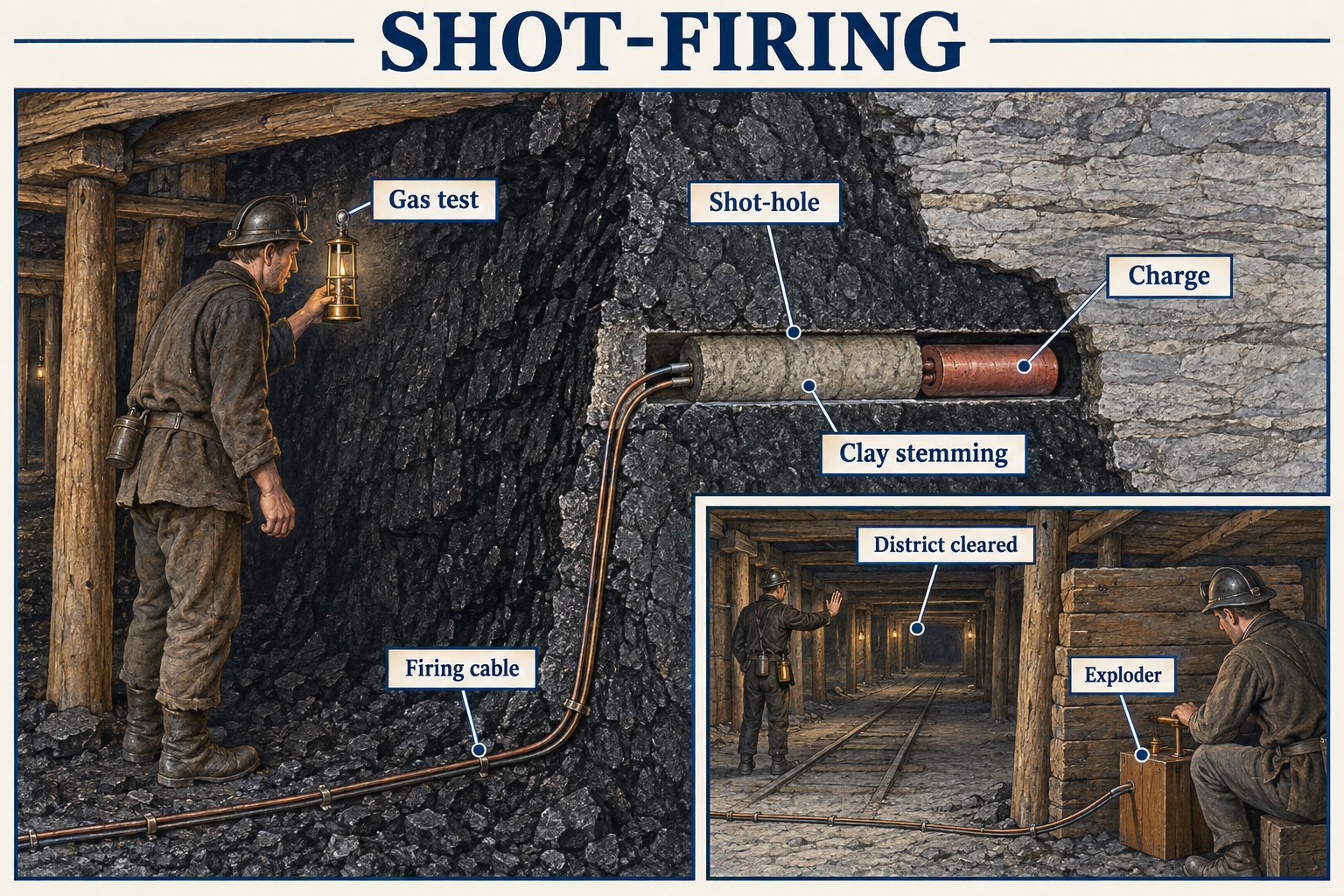
Breaking coal or rock at the face by drilling a hole, charging it with explosive and detonating it. In British collieries the work was reserved by law to a qualified shotfirer, and the procedure surrounding it — testing for gas, clearing the district, stemming the hole — mattered more than the explosive itself.
Historical usage
Gunpowder was used at the face from the seventeenth century onwards, but shot-firing as a regulated occupation belongs to the era of electric detonators and permitted explosives. By the twentieth century the shotfirer held a ticket, drew a fixed number of detonators from the surface explosives store at the start of the shift, and worked ahead of the coal fillers so the face was ready for them. He was on staff pay rather than piece rates, which mattered: a good coal filler on bonus could earn more than the man firing his shots.
How it worked
The regulation procedure, as a Nottinghamshire shotfirer recorded it, ran like this. Holes are bored into the face at about six-foot intervals and six feet deep. Each is scraped clean of loose coal dust and checked with a break finder for cracks; a hole with a break in it is not fired, and a new hole is bored instead. The district is cleared and sentries posted at least twenty-five yards either side, round a corner or behind cover. Gas is tested at the hole and at both sentry points. A pricker opens the soft cartridge, a detonator with seven feet of wire is pushed into it, the charge is rammed to the back of the hole with a wooden rammer, and non-combustible material — clay — is rammed in behind it to stem the hole. The cable is reeled out twenty yards, the sentries and the gas are checked again, the key goes into the exploder, 'Fire' is called, and the key is turned. Only one shot may be stemmed and fired at a time.
Why it was used
Machine cutting undercut the seam but did not bring it down; a round of shots did, and did it fast enough to keep a longwall face advancing on shift cycle. On a face where the coal was hard, there was no practical alternative between explosives and hand tools, and hand tools could not fill a face in a shift.
Risks & limitations
The procedure was the safeguard, and the procedure took too long. A shotfirer was expected to fire around forty shots a shift, starting only two hours ahead of the fillers; done by the book, that was a full day's work and the fillers would have nothing to fill. What actually happened, by that shotfirer's own account, was that all forty holes were charged at once with little or no stemming — an extra cartridge of powder used in lieu — and fired one after another off a short cable, the whole quota gone in an hour. He is explicit that this was unlawful, that management above and below ground knew, and that a blind eye was turned by one and all. The consequences are written across the disaster record: an unfired break in a hole, an untested pocket of firedamp, or an unstemmed shot blowing out into coal dust has been the recorded ignition source for explosions at Millclose in 1887, West Stanley and Bersham in 1909, Valleyfield in 1939, Haig Pit in 1931 and William Pit in 1947, where a single shot in shot-hole No. 3 killed a hundred and four men.
Regional variation
'Shotfirer' is the standard British term and 'blaster' the American one; in many pits the deputy carried the shotfirer's ticket and did both jobs, which is why the inquiry into the William Pit explosion criticised the workload of a single deputy firing forty or more shots a day alongside his other duties.
Related terminology
Afterdamp, Deputy, Firedamp, Longwall, Naked Light, Powder House, Safety Lamp, Stemming
Mines associated with this term
5 examples chosen from 55 linked records — the term page is not an index.
- Bent Colliery — South Lanarkshire (notable incident)
A brusher was killed in 1911 walking back to a shot he believed had already fired, after shots in a neighbouring road were lit first. - Diglake Colliery — Staffordshire (notable incident)
The fireman William Sproston had just fired a shot in the new Ten Feet workings when the water broke in. - Houghton Main Colliery — South Yorkshire (well documented example)
Named twice in this record, first in the history: “…accident on 30 December 1886 that killed 10; an explosion during shot-firing on 12 December 1930 that killed 7; and an explosion in the…” - Swinden Quarry — North Yorkshire (well documented example)
Named twice in this record, first in the history: “…working. Some £15 million later, in June 2001, the quarry began blasting into a 37-million-tonne extension with one of the country's most…” - Aberthaw Limestone Quarry — Vale of Glamorgan (well documented example)
Named 3 times in this record, first in the workings: “…dug by a Ruston Proctor steam excavator of a hundred tons an hour. Blasting was introduced soon after and made the digging much easier: vertical…”
Disasters associated with this term
5 examples chosen from 84 linked records, most direct relationship first.
- Apedale Colliery Sladderhill No. 3 Pit explosion, 1891 (direct cause)
A blown-out shot. - Brandon Colliery explosion, 1899 (direct cause)
A powder shot blew through a parting. - Cortonwood Colliery explosion, 1932 (direct cause)
Shots were being fired on the face. - Cronton Colliery explosion (direct cause)
The explosion followed two shots fired simultaneously in breach of shot-firing regulations. - Glynea Colliery explosion, 1913 (direct cause)
A blown-out shot of Swalite.
Sources
- (primary) Chapter 35 — Shot Firing, Middleton Broom Colliery — Jack Gale, via the Northern Mine Research Society
- (primary) Mining accidents and disasters index — Durham Mining Museum — Durham Mining Museum
Record created: 25 August 2026 · Last researched: 25 August 2026