 MineArchive
Holing
| Also known as | Kirving (North East England), Holing Dirt (A soft band in or under the seam, worked out in preference to the coal itself.), Bossing (Scottish), Undercut (The machine age's word for the same cut, made by a coal cutter), Undercutting, Laying-in, Ligging-in |
|---|---|
| Category | Mine Workings & Access |
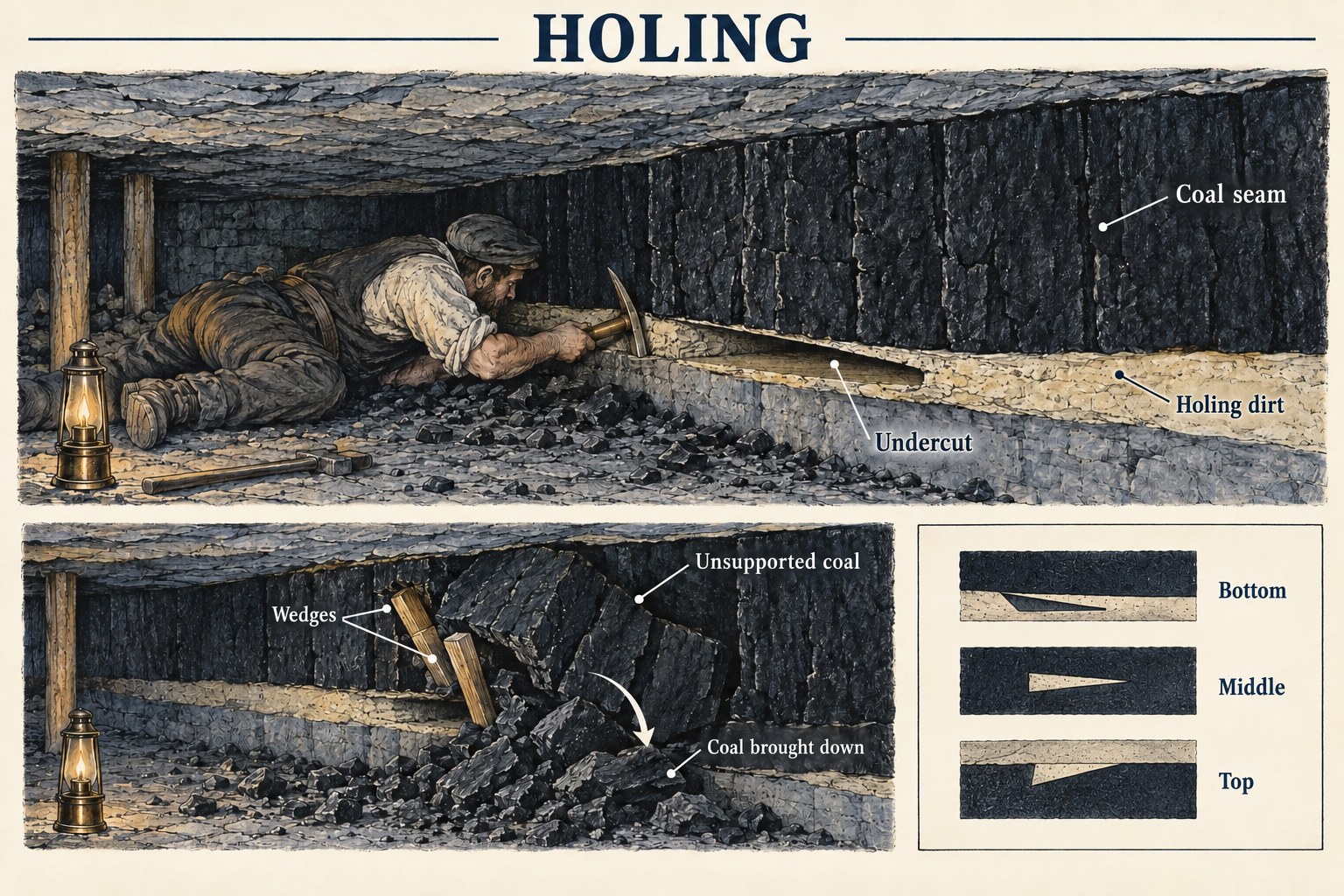
Cutting a wedge-shaped groove into a coal seam — usually along the bottom, sometimes in the middle or the top — so that the coal above it could be broken down. Also the groove itself.
Historical usage
Holing is the oldest and hardest part of a hewer’s work, and it long predates machinery. Barrowman’s 1886 glossary defines "to hole" as "to cut in under or above a seam preparatory to dislodging it from its bed", and holing as "the cutting so made"; dour holing was "difficult undercutting in hard coal or stone". A hewer’s day was undercutting the coal with a hand pick, lying on his side in the space he had made, until mechanical coal cutters took the work over from the late nineteenth century. The 1911 Encyclopaedia Britannica described holing or kirving as cutting a notch in the floor of the seam to a depth of about three feet measured back from the face, so as to leave the overhanging part unsupported, which then either falls of its own accord within a few hours or is brought down by driving wedges along the top or by blasting, and reckoned it one of the severest kinds of human labour. By then the bar and disc coal cutters, Garforth's Diamond among the best known, undercut five and a half to six feet by compressed air or increasingly by electric motor, and by 1940 the electric cutter and the drills for the shots that dropped the face were the only machines on many longwall faces.
How it worked
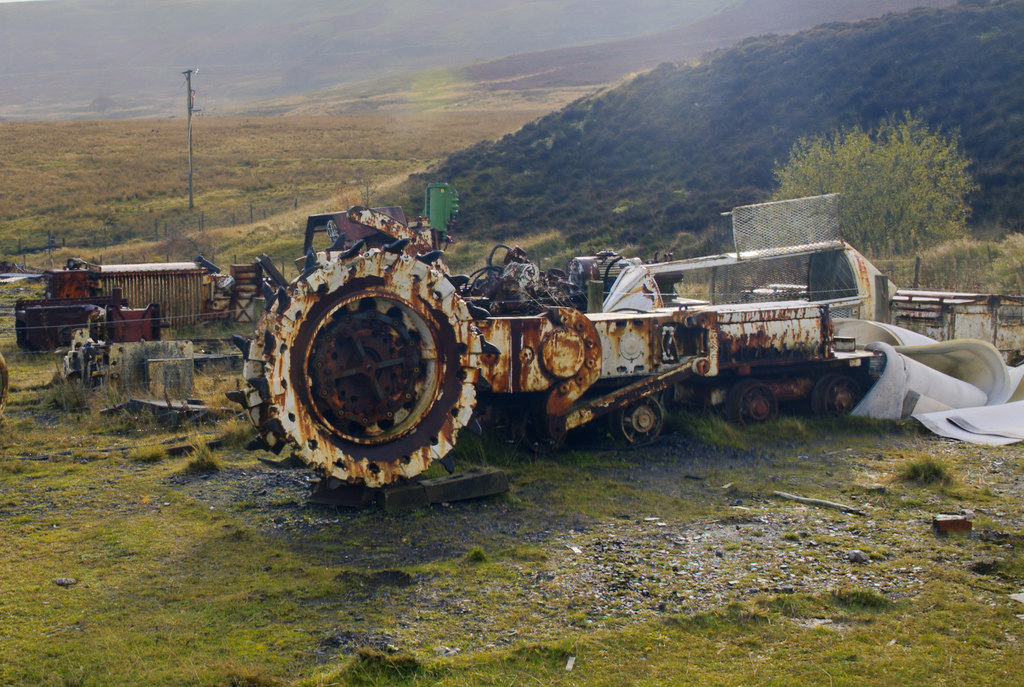
The collier drove a slot under the coal so the seam lost its support and could be brought down with wedges, a pick or a shot. Where a soft band lay in or under the seam — holing dirt — he worked that out instead, because it cut more easily than the coal. The depth of the undercut governed how much coal came down at once. Where the seam met an existing roadway or another working place, the opening made between them was also called the holing. A hand holing had to be cut high enough for the hewer to get his arms and pick into it, so it wasted far more coal as slack than was needed to bring the face down, and the waste was proportionately greater in a thin seam; a machine cut the same groove three inches high at the face and an inch and a half at the back. A Winstanley and Barker machine carried a toothed wheel driven by oscillating engines on a frame running on rails, a bar machine cut into the coal from the end of the block, and either was hauled along the face by a chain winding on a drum.
Why it was used
Coal will not simply fall. Undercut it and the weight of the seam works for you, so that wedges or a modest charge bring down far more coal than they could from a solid face — and bring it down in larger, better-paying lumps than blasting alone. With machinery, seams too thin to hole by hand could be worked at a profit: a cannel seam of ten to fourteen inches was made payable by a machine.
Risks & limitations
The hewer worked under coal he had deliberately deprived of support, and the roof of his own undercut was the seam itself. Falls of coal onto men who were holing are among the commonest single fatalities in the nineteenth-century record. Mechanisation changed the hazard rather than removing it: machine cutting produced far more fine coal dust than hand holing, and that dust made explosions worse — a point made directly in the evidence after the Pretoria Pit disaster of 1910.
Regional variation
Kirving is the North East word for the same thing — Apedale’s glossary says plainly that "kirving was the same as holing", applied particularly to the shorter undercuts of pillar and stall working — with nicking the matching vertical cut at the side of the place. In Scotland "to boss" was to hole or undercut, and bossing the holing of a thick seam. Laying-in and ligging-in are other names for the hand cut, and undercut is the machine age's word for the same groove made by a coal cutter.
Related terminology
Coal Cutter, Coal Seam, Hewer, Longwall, Ripping, Shearer
Mines associated with this term
5 examples chosen from 67 linked records — the term page is not an index.
- Combe Down Stone Mines — Somerset (well documented example)
Named in this record’s closure notes: “The central underground quarries were worked out and undercut by the Wiltshire freestone opened up by the Box Tunnel in the 1830s;…” - Kimmeridge Oil Shale Workings — Dorset (well documented example)
Named in this record’s closure notes: “…to win and heavily sulphurous, and every product made from it was undercut by the coal-derived equivalents that James Young's patent had opened…” - Maenofferen Quarry — Gwynedd (well documented example)
Named in this record’s history: “…in the 1970s-80s. Post-war decline, as synthetic roofing materials undercut demand for slate, reduced the workforce to just 60 by 1972,…” - Neston Colliery — Cheshire (well documented example)
Named in this record’s history: “…John Stanley's Ness Colliery each dug workings that threatened to undercut the other, and Stanley's men resorted to outright sabotage —…” - Stonesfield Slate Mines — Oxfordshire (well documented example)
Named in this record’s closure notes: “…and cheaper mass-produced roofing materials had long since undercut the market for hand-split stone slate.”
Disasters associated with this term
5 examples chosen from 18 linked records, most direct relationship first.
- Aberaman Colliery fall of coal, 1862 (contextual relationship)
Named 4 times in this record, first in the summary: “A fall of coal killed two colliers holing in the Nine Feet seam at Aberaman Colliery on 21 June 1862.” - Brayton Domain Colliery Explosion, 1915 (contextual relationship)
Named in this record’s narrative: “…being taken off a pillar. The coal at the face of the lift had been undercut on the loose side right through to an old bord, and on the fast side…” - Cefn Slip Colliery fall of coal, 1902 (contextual relationship)
Named in this record’s narrative: “…Cribbwr seam. One account has them killed by a fall of coal while holing out; the inspector's description is of a fall of side at the face, a…” - Crigglestone Colliery explosion, 1941 (contextual relationship)
Named in this record’s narrative: “…loaded coal, the afternoon shift dismantled the face conveyors, undercut the seam to 5 ft 6 in, bored shotholes and fired ripping shots, and…” - Delabole Slate Quarry fall, 1869 (contextual relationship)
Named in this record’s narrative: “…the part called Landwork a cliff face some 250 feet high, slightly undercut, carried at its top the largest poppet head on the works, a staging…”
Sources
- (primary) Glossary of Scotch Mining Terms — James Barrowman (1886), via Scottish Mining Website
- (secondary) Coal, 1911 Encyclopaedia Britannica — Wikisource
- (secondary) Glossary of mining terms (H) — North Staffordshire Miners’ Group, Apedale
- (secondary) Glossary of mining terms (K) — North Staffordshire Miners’ Group, Apedale
- (secondary) Longwall mining — Wikipedia
- (secondary) Pit Terminology — Healey Hero
Record created: 8 September 2026 · Last researched: 8 September 2026