 MineArchive
Ripping
| Also known as | Brushing (Scottish), Brusher (Scottish), Roof Brushing (Scottish), Pavement Brushing (Scottish), Reddsman (Scottish), Ripper (The man doing the work), Ripping Lip (The step between face height and roadway height) |
|---|---|
| Category | Mine Workings & Access |
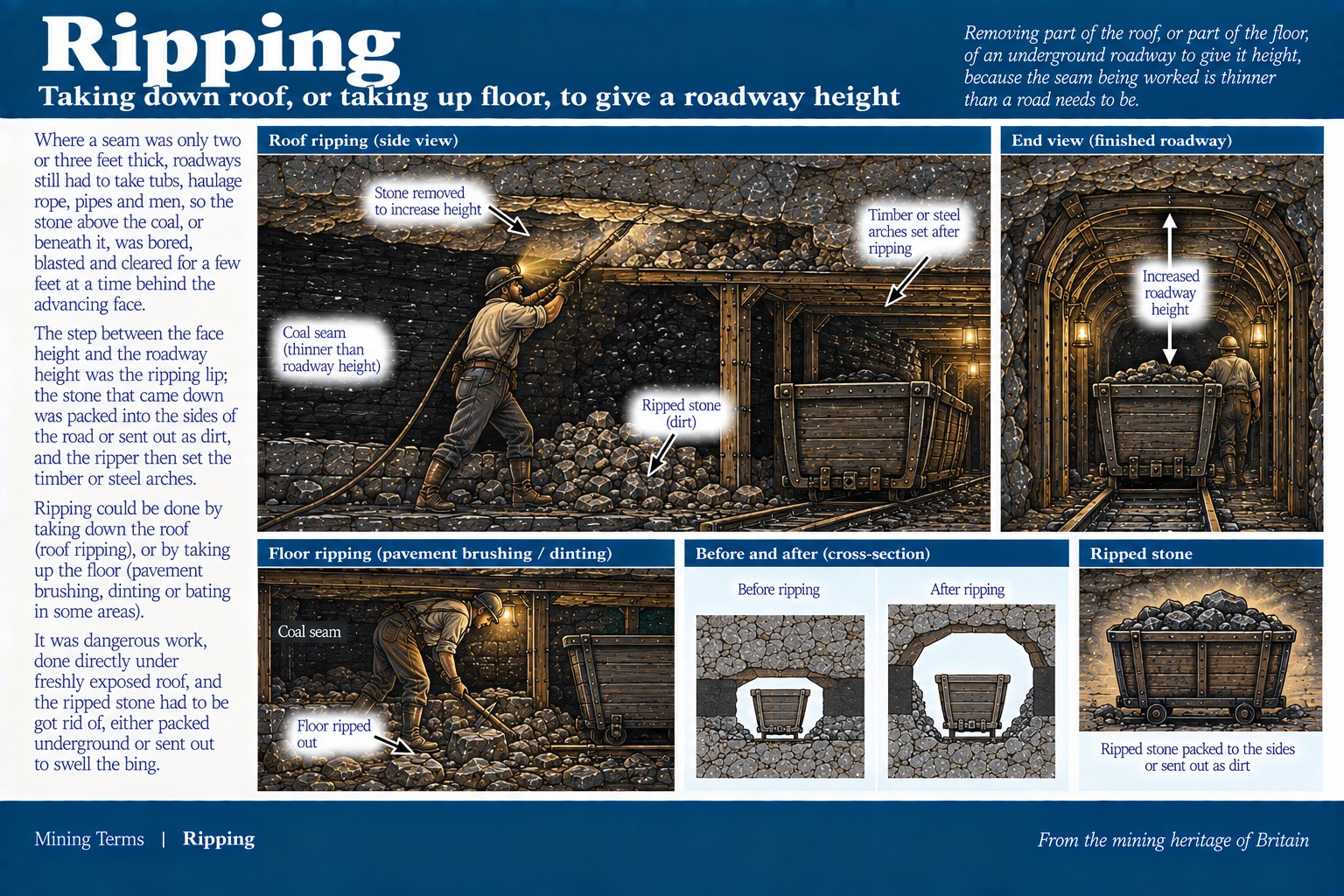
Taking down part of the roof, or taking up part of the floor, of an underground roadway to give it height, because the seam being worked is thinner than a road needs to be. The North Staffordshire glossary defines it as 'a section of roof or roadway that has to be removed by blasting or machine; or to blast or bring down the roof of a roadway. Also called a brushing (Scots)'.
Historical usage
Gresley's 1883 glossary records 'brushing-bed' as the Scottish word for the stratum 'brushed or ripped', so both words were in use by then. On the Scottish shale field the brusher, also called a reddsman, was a recognised grade with its own rate: 24s 11d a week in the Board of Trade's 1886 census of wages, up to 6s a shift by the 1912 agreement, the work often done at night when the face was idle. With longwall working and steel arches in the twentieth century ripping became a team job at each end of the face, done with the face's advance, and latterly by machine.
How it worked
Where a seam was only two or three feet thick the roadways still had to take tubs, haulage rope, pipes and men, so the stone above the coal, or beneath it, was bored, blasted and cleared for a few feet at a time behind the advancing face. The step between the face height and the roadway height was the ripping lip; the stone that came down was packed into the sides of the road or sent out as dirt, and the ripper then set the timber or steel arches. Barrowman's 1886 glossary gives the Scottish form: to brush is 'to remove part of the roof or pavement by blasting or otherwise in order to heighten the roadway', the brushing is 'that part of the roof or pavement of a seam removed to form roadways', and the brusher is the man who does it 'and puts up side-buildings of roadways'. Taking up the floor rather than the roof was pavement brushing in Scotland and dinting or bating elsewhere.
Why it was used
A roadway that stayed at seam height in thin coal was useless for haulage and ventilation, and ripping was the only way to make height without leaving coal in the roof. Ripping the roof also let the road be arched in stone rather than coal, which stood better.
Risks & limitations
It was blasting and bar work directly under freshly exposed roof, on the road everyone used. Barrowman records the 'second brushing' that longwall subsidence made necessary, and the danger shows in this archive's records: Samuel Berkley, a brusher of twenty, was killed by a fall of roof at Aitkenhead Colliery in 1874. Ripping dirt also had to be got rid of, either packed underground or sent out to swell the bing.
Regional variation
Ripping is the general and official term. In Scotland the same operation and the man doing it are brushing and brusher, the roof version roof brushing and the floor version pavement brushing; on the shale field the brusher was also the reddsman. Floor ripping alone is dinting, bating or picking up in the English coalfields.
Related terminology
Holing, Longwall, Roadman, Roof Fall
Mines associated with this term
5 examples chosen from 47 linked records — the term page is not an index.
- Abernant No. 9 Pit — Rhondda Cynon Taf (well documented example)
Named in this record’s history: “…was 10 feet 3 inches across and 390 feet deep. An explosion killed a ripper and a haulier on 16 May 1890, and falls of roof most of the other…” - Aitkenhead Colliery — Glasgow (well documented example)
Named in this record’s history: “…are named, and they are almost all the same death. Samuel Berkley, a brusher of twenty, was killed by a fall of roof in 1874; Robert Steel, a…” - Allanton Colliery — South Lanarkshire (well documented example)
Named in this record’s history: “…the late train from Larkhall as he came off his shift in 1918; two brushing contractors died in an explosion of firedamp on 2 December 1923; and…” - Baads Colliery — West Lothian (well documented example)
Named in this record’s history: “…year and the main mine renovated in 1925. Two deaths are recorded, a brusher under a stone in 1913 and a drawer of twenty-one in 1924 whose…” - Bailliesmuir Colliery — North Lanarkshire (well documented example)
Named twice in this record, first in the history: “…of stone at the face and one shot-firing accident: in August 1909 a brusher, Patrick Rafferty, went back towards the face believing all three…”
Disasters associated with this term
5 examples chosen from 39 linked records, most direct relationship first.
- Backworth Colliery explosion, 1928 (contextual relationship)
Named twice in this record, first in the summary: “A shot fired by a deputy in a ripping canch at Backworth's Eccles pit on 23 November 1928, after he had…” - Bardykes Colliery Roof Fall, 1936 (contextual relationship)
Named in this record’s narrative: “The fall struck at around 7:30pm on Saturday 21 March 1936. Seven 'brushers' -- men widening and preparing a roadway roughly 9 feet high and 12…” - Blaenhirwaun Colliery explosion, 1955 (contextual relationship)
Named 4 times in this record, first in the summary: “…Hands was drawn through a small compressed-air fan ventilating a ripping lip, and sparks from its blades striking pieces of stone set it off.…” - Blairadam Colliery roof fall, 1908 (contextual relationship)
Named in this record’s narrative: “Two brushers on the level road heard what sounded like a heavy fall a few minutes…” - Bug and Wink Colliery roof fall and rescue attempt, 1910 (contextual relationship)
Named in this record’s narrative: “…a gate-road. They had taken out a low bar and set a new one after ripping about half a yard of roof, and had ripped far enough to make room…”
Sources
- (primary) A Glossary of Terms Used in Coal Mining, by William S. Gresley, 1883 — Internet Archive
- (primary) Glossary of Scotch Mining Terms — James Barrowman (1886), via Scottish Mining Website
- (secondary) Brusher — Scottish Shale occupations — Museum of the Scottish Shale Oil Industry
- (secondary) Glossary of mining terms (B) — North Staffordshire Miners' Group — Apedale Heritage Centre
- (secondary) Glossary of mining terms (P) — North Staffordshire Miners' Group — Apedale Heritage Centre
- (secondary) Glossary of mining terms (R) — North Staffordshire Miners' Group — Apedale Heritage Centre
- (secondary) Pit Terminology — Healey Hero
Record created: 12 September 2026 · Last researched: 12 September 2026