 MineArchive
Roof Fall
| Also known as | Fall of ground (The formal term in inspectors' reports), Fall of roof (Statistical usage), Roof collapse (Modern general usage), Fall of ground or roof (Full statistical form) |
|---|---|
| Category | Ground Conditions & Hazards |
The collapse of the rock above a working place. Roof falls killed more British miners than any other single cause — more than explosions, flooding and winding accidents put together — and they did it a few men at a time, almost every working day, which is why they are far less remembered than the disasters.
Historical usage
Between 1920 and 1929 falls of ground from the roof or the coal face killed 5,193 people in British mines, out of some 10,440 mining deaths in total — roughly half. Between 1896 and 1907 the proportion was much the same. A pit explosion killing a hundred men made national news and prompted an inquiry; the same hundred deaths spread over a year of roof falls at collieries across the country prompted very little. The 1930 Commons debate on mine accidents is one of the moments when the scale of it was set out plainly, and it is striking how much of the discussion is about the spacing of props rather than about any dramatic failure.
How it worked
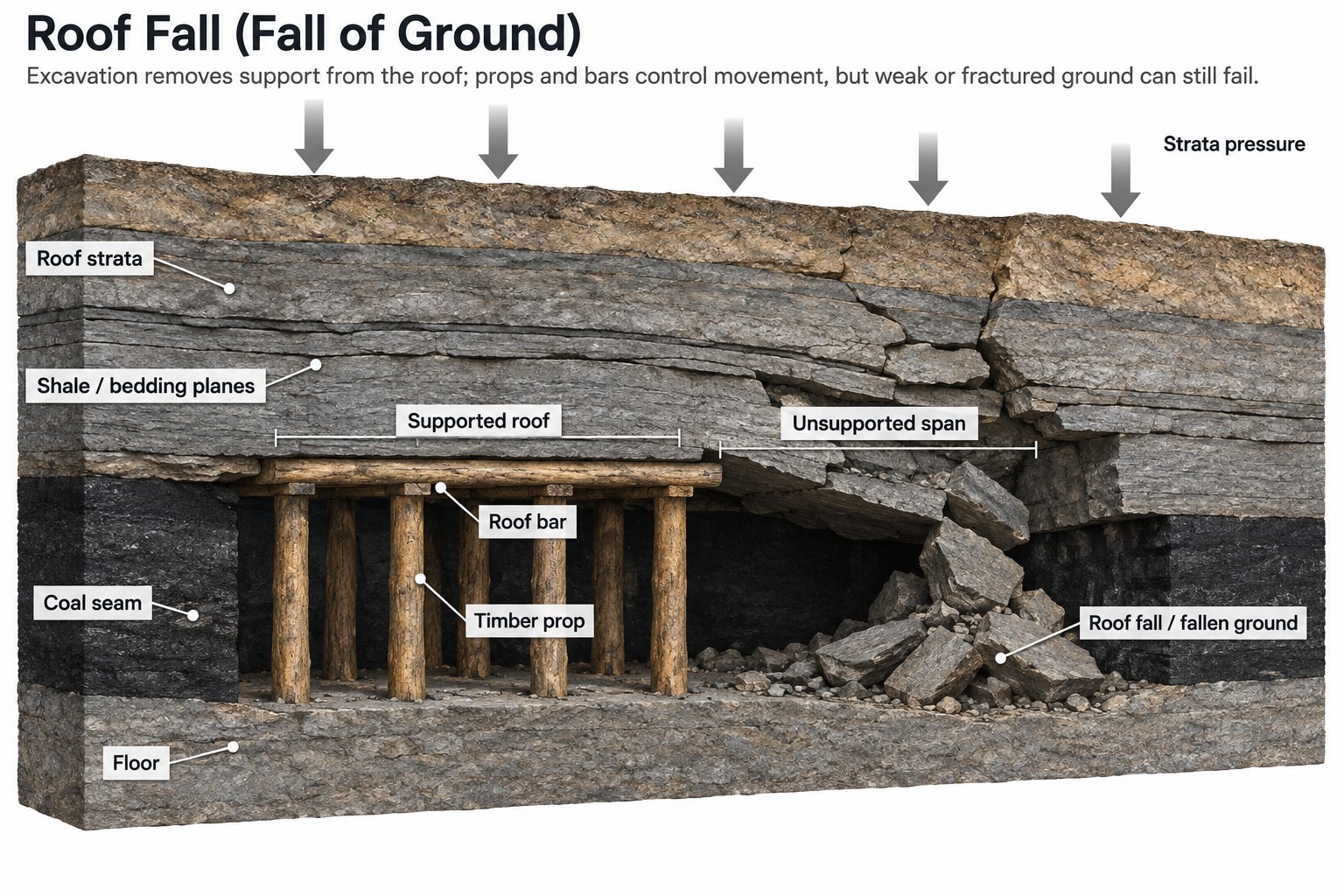
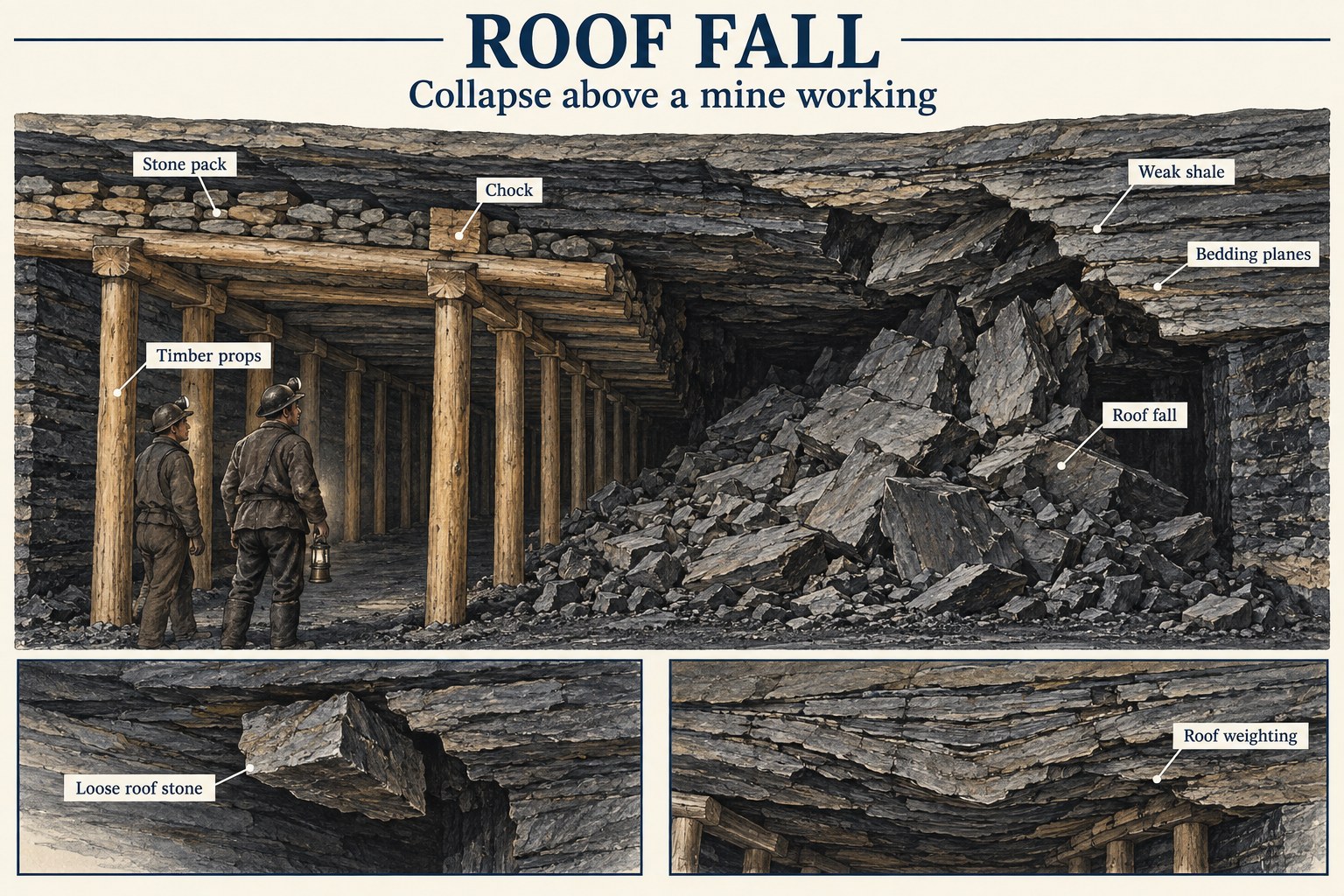
When coal is taken out of a seam the roof above the void immediately begins to lower, trying to close the space. Supports do not stop that; they control it, holding the immediate roof long enough for men to work under it and letting the ground settle behind them into the waste. Coal-measure roofs are often shale, which is weak in tension and shear, and which parts along bedding planes. A fall can be a single stone dropping out between props, or the whole face weighting and coming in at once. The greatest danger was at the face itself and at the junctions of face and roadway, where the ground carries the concentrated pressure of the undisturbed strata ahead.
Why it was used
Not a technique but a hazard — the one every system of underground support exists to manage. The historic answer was systematic timbering: wooden props sized roughly an inch of diameter to a foot of length and reckoned good for twenty tons, set on a proper foundation with a wooden lid on top to spread the load and to crush before the prop broke; bars of wood or steel from four and a half to seven feet carried on two or more props to hold a wider area; nogs, sprags, chocks built up in timber, and packs of stone built on the natural floor to carry the waste. Steel props in H-section and tubular forms displaced timber from the 1930s, being stronger and reusable, and self-advancing hydraulic supports eventually took over the longwall face entirely.
Risks & limitations
What made roof falls so hard to legislate away is that the rules were about distances and the ground was not. The Coal Mines Act required every colliery to post a support notice near the mine entrance specifying maximum spacings — holing props or sprags no more than six feet apart, rows no more than four feet apart or six where bars were used, props no more than four feet apart in a row, temporary supports within three feet of the nearest row. Inspectors found repeatedly that men set props at exactly the maximum permitted spacing in ground that plainly needed closer work, having complied with the notice to the letter. Evidence given in 1930 showed that on a 120-foot longwall face, 24 of every 26 accidents happened in the centre of the face — a pattern known, and still not designed out.
Regional variation
Fall of ground and fall of roof are the formal terms in inspectors' reports and statistics, and cover falls from the sides as well as the roof. A weight or a bump is a fall driven by strata pressure rather than a loose stone; in metal mines a fall from the back of a stope is more often called a run or simply loose ground. The Deputy was the man responsible for examining and setting supports at the face.
Related terminology
Barricading, Blaes, Deputy, Mine Tremors, Powered Roof Supports, Ripping, Stoneman, Subsidence
Mines associated with this term
5 examples chosen from 87 linked records — the term page is not an index.
- Browns Folly Mine — Somerset (well documented example)
Named twice in this record, first in the history: “…stone stacked along the sides of the passages, and there are few roof falls, the pillars having been left strong and at regular…” - Fremington Edge Quarry — North Yorkshire (well documented example)
Named in this record’s history: “…Michael Hillery, a miner aged 30, died on 25 April 1907, killed by a fall of roof which came down at a clay back next the face and broke down the…” - Kinglassie Colliery — Fife (well documented example)
Named in this record’s summary: “…faulted ground for sixty years, and lost four men to two separate roof falls a generation apart — in 1912 and 1927 — before closing in 1966.” - Abergwawr Colliery — Rhondda Cynon Taf (well documented example)
Named in this record’s history: “…surface in 1869 killed four men. Boys of thirteen and ten died in roof falls there in 1866 and 1875. It stopped in the trade slump of 1875;…” - Aitkenhead Colliery — Glasgow (well documented example)
Named 3 times in this record, first in the summary: “…sixty to a hundred people. Seven deaths there are named, six of them falls of roof or coal at the face — the ordinary arithmetic of a small pit rather…”
Disasters associated with this term
5 examples chosen from 149 linked records, most direct relationship first.
- Brynlliw Colliery roof fall, 1963 (direct cause)
A fall of roof at the face gate end. - Cossall Colliery Roof Fall, 1888 (direct cause)
The roof of a disused gateway fell on the two boys as they sat eating. - Garngoch Colliery roof fall, 1888 (direct cause)
A fall of roof killed the two repairers. - Holmewood Colliery Entombment and Rescue, 1920 (direct cause)
A heavy fall of roof cut the two men off from the rest of the workings, and further falls came down during the rescue. - Hoyland Silkstone Colliery boiler house accident, 1907 (direct cause)
The girder's collapse brought down a large quantity of stone on the men.
Sources
- (primary) Accidents in Mines, House of Commons, 3 December 1930 — Hansard
- (primary) Regulations Regarding the Roof Supports at the Coal Face — Durham Mining Museum
- (primary) Support of the coal face: old methods — Durham Mining Museum
Record created: 24 August 2026 · Last researched: 24 August 2026