 MineArchive
Blaes
| Also known as | Blaize (Scottish), Blaise (Scottish), Bleeze (Scottish), Red Blaes (Scottish) |
|---|---|
| Dialect | Scottish |
| Category | Place-names & Language |
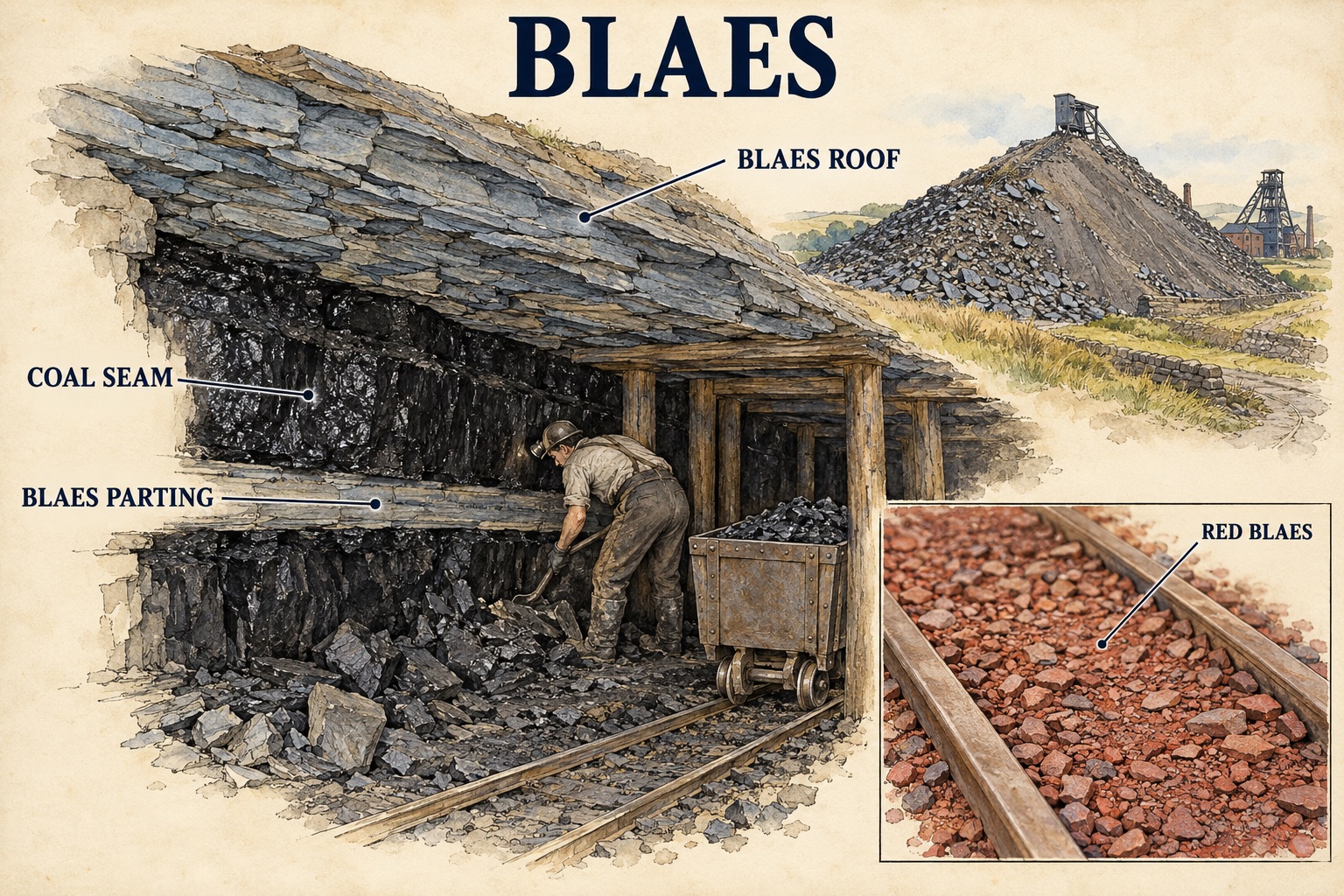
The Scots word for the soft, laminated, bluish-grey shale and mudstone that lies between the workable seams — Barrowman's 1886 glossary gives it as 'shale; laminated clay; indurated mud'. It is grammatically a plural, from the adjective blae, blue-grey, and it names the rock a Scottish miner spent most of his working life looking at: the roof over his head, the parting in a dirty seam, and the bulk of what went up the pit as waste.


Historical usage
The word is recorded from at least 1724, when a survey of Culross reported that 'the mettals I discovered were a coarse free stone and blaes', and it stayed in general Scottish use through the whole industrial period. The Edinburgh Statistical Account of 1845 has limestone 'called by the workmen blaes' alternating with bituminous shale; Barrowman fixed it in the standard 1886 glossary; the Memoirs of the Geological Survey of Scotland were still defining it in 1920 as 'mudstone, or shale in the geological sense, not containing much bituminous matter'. It spread out of the pit and into ordinary speech: by 1920 the Glasgow Herald could report a committee costing the levelling of 'the blaes heaps' without explaining the term to anybody.
It appears in this archive's own material in the Lists of Mines returns, where a colliery selling blaes alongside its coal is selling brick clay, and in accident reports, where a man taking down roof blaes is doing the most routine and most lethal job underground.
How it worked
Blaes is what most of a Scottish coal or ironstone measure actually consists of. Where it forms the roof it is taken down deliberately as the face advances, because a laminated shale roof left in place will come down on its own; where it runs as a parting inside a seam it has to be picked out at the screens or washed out, and a seam with thick partings of it is what Barrowman calls dirty coal. Where a colliery had a brickworks the blaes stopped being waste and became the raw material, which is why some collieries returned it in the Lists of Mines as an output alongside the coal.
Everything else went on the bing. Burnt or heated — in an oil-shale retort, in a blazing ironstone waste heap — blaes turns from blue-grey to a hard red, and the red kind found the afterlife the material is now best known for: crushed as red blaes, it surfaced running tracks and football pitches across Scotland for most of the twentieth century. A generation of Scottish footballers learned the game on the ground their grandfathers had sent up the shaft.
Why it was used
Nobody used blaes on purpose underground; it was the rock that had to be got through or got out of the way. It earned its place in the vocabulary because it needed naming constantly — in the roof, in the seam, at the screens, on the bing — and because Scotland's coal, ironstone and oil-shale fields all sat in it.
Risks & limitations
A blaes roof is the classic Scottish killer. It parts along its laminations, and a slab that has looked sound for a shift will come away without warning, especially where the joints are glazed — a lype, in the same glossary. The Durham Mining Museum's list for Riddochhill Colliery records John Walker, aged fifty-four, taking down some roof blaes in March 1907 when a piece fell and threw him against a prop; he died eight days later. Above ground the blaes bings brought their own hazards: unstable, sometimes still burning, and quarried away for hardcore until they became, as one photographer of a crumbling West Lothian bing put it, a danger to livestock.
Regional variation
General Scots, and unusual among Scottish mining words in being understood across all the coalfields rather than one district. It is spelled Blaize, Blaise, blaze, blaies and bleeze in different sources and pronounced to rhyme with blaze. English mining vocabulary has no single equivalent: the nearest are bind, batt and metal, none of which carries the colour sense the Scots word starts from. Barrowman records compounds — 'blaes and balls' for blaes with ironstone nodules in it, 'cashy blaes' for the soft coaly kind with little coherence, and 'maggie-blaes' for an inferior sulphurous ironstone — and Ayrshire used blaise by 1928 for the refuse of burnt ironstone specifically.
Related terminology
Mudstone, Roof Fall, Spoil Heap
Mines associated with this term
5 examples chosen from 23 linked records — the term page is not an index.
- Balgonie Colliery — Fife (well documented example)
Named 3 times in this record, first in the summary: “…It raised manufacturing and steam coal, with clay in 1896 and blaes — the Scots word for the shale and mudstone between the seams —…” - Blairadam Colliery — Fife (well documented example)
Named 3 times in this record, first in the summary: “…Company in 1902. Its No. 1 pit fed the Blairadam brickworks with blaes; in February 1908 a long stretch of hard freestone roof fell on a…” - Calderhead Colliery — North Lanarkshire (well documented example)
Named twice in this record, first in the history: “…in 1947. It raised gas, household, manufacturing and steam coal, and blaes; recorded employment was small in the 1890s — seventeen in 1894 and…” - Callendar Colliery — Falkirk (well documented example)
Named 4 times in this record, first in the summary: “…of Falkirk, which fed the company's brickworks with fireclay and blaes. The last, the Policy Pit, closed in November 1959.” - Craigend Colliery, Maddiston — Falkirk (well documented example)
Named in this record’s history: “…pits in 1937-38, on land leased from Carron, and worked the pit blaes into bricks until the bing was exhausted in 1964; the works became…”
Disasters associated with this term
Included only where MineArchive's own research gives a reasonable evidential basis, with the nature of the relationship stated — not every disaster where this term might plausibly apply.
- Callendar Brickworks pit roof fall, 1915 (contextual relationship)
Named in this record’s narrative: “…at Glen Village, south of Falkirk, made its building bricks from pit blaes. On the afternoon of Wednesday 23 June 1915, while men were at work…” - Hill of Beath Colliery fire, 1901 (contextual relationship)
Named in this record’s changes to practice: “…and he supposed them due to the heating of the overlying coal and blaes after it had fallen, and he was adopting barriers of solid coal…” - Little Raith Colliery overwinding, 1883 (contextual relationship)
Named in this record’s narrative: “…off. James Adams and his brother John were thrown on to a bing of blaes eighty feet from the pit mouth; James was killed outright and John…” - Loanhead Colliery roof fall, 1893 (contextual relationship)
Named 3 times in this record, first in the summary: “…at Loanhead were killed on 13 February 1893 when 20 tons of coal and blaes swept down it.” - Lochgelly Colliery roof fall, 1894 (contextual relationship)
Named twice in this record, first in the cause: “The soft blaes roof over a stoop of coal came away and swung the timber on a…”
Sources
- (primary) Glossary of Scotch Mining Terms — James Barrowman (1886), via Scottish Mining Website
- (secondary) Blaes — Scottish Shale glossary — Scottish Shale
- (secondary) Blaes, n.2, pl. — Scottish National Dictionary — Dictionaries of the Scots Language
Record created: 10 September 2026 · Last researched: 10 September 2026