 MineArchive
Brick Clay
| Also known as | Common Clay (The older trade name, used before 'brick clay' became the statistical category), Clay and Shale (How extractors' sales were recorded in the Annual Minerals Raised Inquiry) |
|---|---|
| Category | Commodities |
| Commodity page | Brick Clay → |
Not a single mineral but a working category: 'clay, shale, mudstone and other such materials' worked for structural clay products — facing and engineering bricks, pavers, roof tiles and vitrified clay pipes. The materials range from soft plastic clays to hard mudstones of wholly different geological ages, and what unites them is fitness for purpose rather than composition. Brickmaking is by far the largest use, taking around 95% of the clay extracted in this sector.
Historical usage
Britain built in whatever its local ground provided, which is why the vernacular changes county by county. The Carboniferous Etruria Formation of the west Midlands and north-east Wales, kaolinite-rich and low in carbon, gave the hard Staffordshire 'blue' brick fired in reduced oxygen that faced so much railway engineering. The Cretaceous Weald Clay of Surrey, Sussex and Kent holds too much moisture for dry pressing and was worked soft-mud by hand, giving deep red, sometimes blue-mottled bricks with rounded, sanded edges. Brickearth around the Thames estuary — a wind-blown silt, mixed with chalk and ash — produced the yellow London stock. The change came in 1881, when the Lower Oxford Clay beneath the ordinary brickearth at Fletton, near Peterborough, was found to be oil-bearing: enough carbonaceous material in the clay itself to carry a brick to firing temperature with little added fuel. That single property turned a local clay into the cheapest brick in the country and built much of 20th-century London.
How it worked
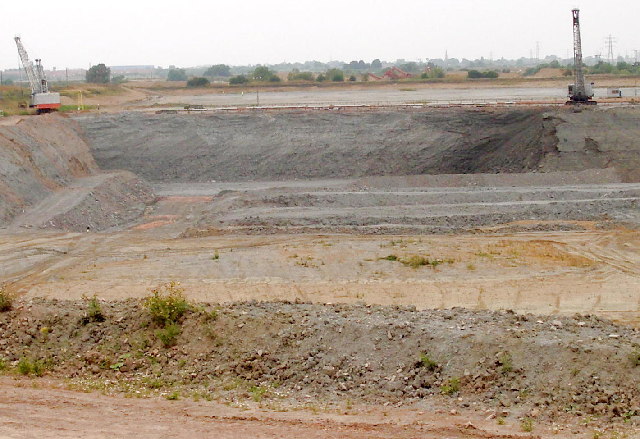
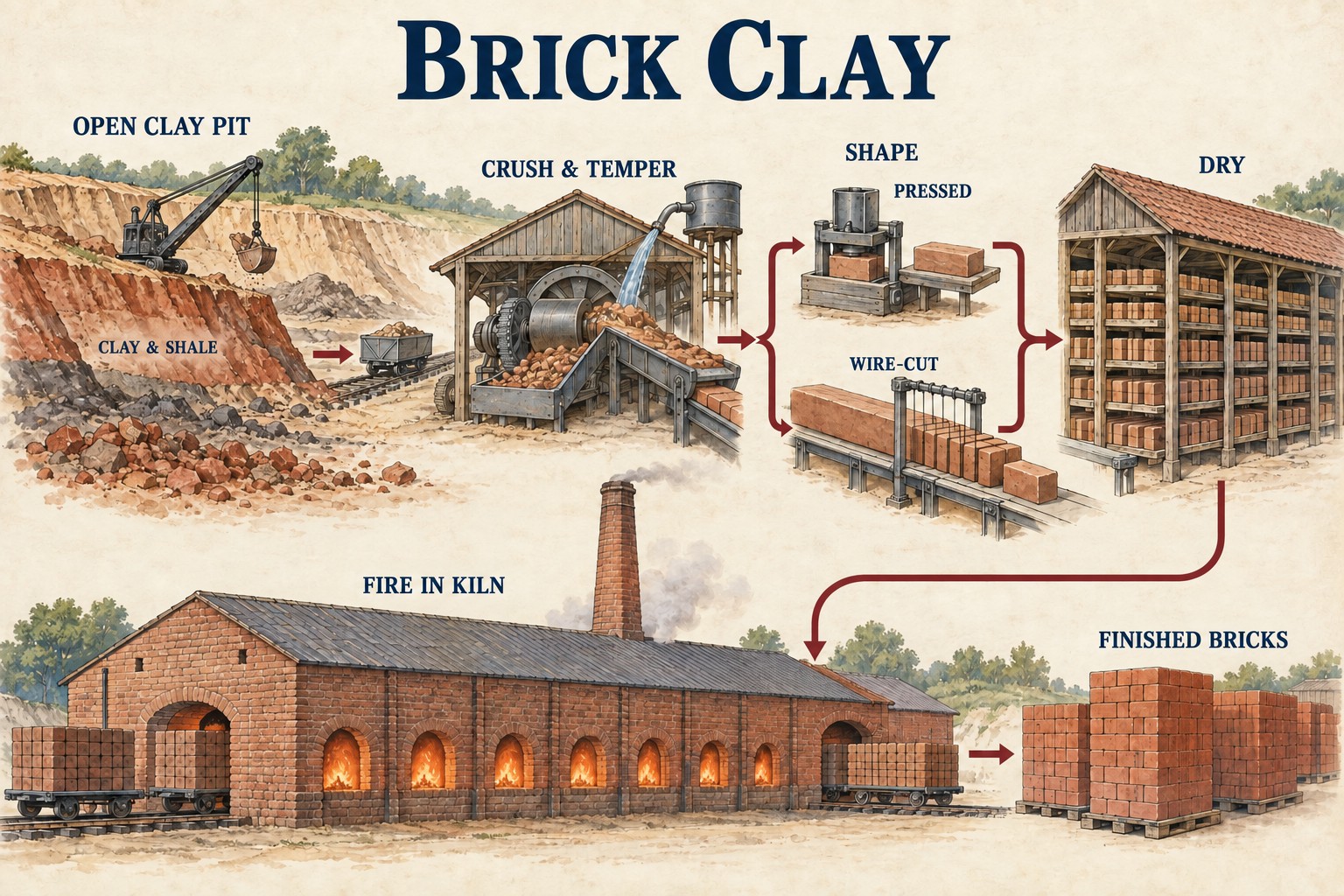
The clay is dug from open pits rather than mined, historically by hand from ladders and later by travelling shale planers cutting directly off the face, which is what leaves the sheer near-vertical cliffs at old workings. It is then ground, tempered, and either pressed, wire-cut or hand-thrown to shape, dried, and fired. Roughly 3 tonnes of clay or shale make 1,000 bricks. Historically the pit and the works stood together — the material is bulky and low-value, so haulage ate the margin — but modern practice moves significant tonnages between sites for blending, because large automated plants need raw material with predictable and consistent firing behaviour to keep yields up.
Why it was used
Because the properties that matter are physical and chemical rather than a question of grade: grain size governs how the clay forms and dries, and mineralogy governs what comes out of the kiln. Iron minerals give the familiar reds and browns; carbonates such as calcite give paler bricks. Clay bricks are durable enough to be one of the most visible and long-lived components of the built environment, and Great Britain is reported to be one of the largest markets in western Europe for facing bricks.
Value over time
Demand for brick clay has fallen from over 16 million tonnes in 1974 to some 4 million tonnes by 2019 — a collapse driven not by the price of clay but by the disappearance of the common brick, replaced inside walls by concrete block and plasterboard. Facing bricks, now well over 90% of demand, held up better, and clay brick production has run at roughly 1.5 to 2 billion a year through the past decade, with over 94% of all bricks still clay-based. The 2008 recession did the sharpest damage: between 2008 and 2013 some 30% of UK clay construction product sites closed permanently, and around 70 remain operational. Imports filled part of the gap, building-brick imports rising from 548,000 tonnes in 2016 to 1,068,000 tonnes in 2019 against exports never above about 107,000 tonnes. The scale that has been lost is easier to grasp at Stewartby in Bedfordshire, once the largest brickworks in the world: 32 chimneys each 70 metres tall, over 2,000 employed, and a peak of around 500 million bricks in 1936.
Hazards & challenges
Brick clay is dug, not mined, so it avoids the classic underground hazards — but the pits are deep, wet and steep-faced, and the near-vertical cliffs left by mechanised planing are unstable ground long after work stops. The distinctive hazard belongs to the material itself: the carbonaceous Lower Oxford Clay that made the Fletton brick so cheap is also the reason those brickworks were among the hardest in Britain to bring within air-quality limits, because the sulphur burns off with the fuel. Stewartby struggled for years to meet emissions standards for sulphur oxides and closed in 2008. Where a brick clay carries free silica, the ordinary dust risk of any quarrying applies to the grinding and handling of dry material.
Risks & limitations
Brick clay is worked where the brickworks are, and the industry has consolidated into fewer, larger plants since 2007 — extraction is now overwhelmingly in England, with the Midlands alone accounting for over half of Great Britain's production. Tightening durability standards constrain which clays can be used at all. The material also loses on substitution rather than on price: common bricks were displaced from cavity-wall inner leaves by concrete blocks and from internal walls by blocks and plasterboard, clay roof tiles by concrete tiles, and clay pipes by concrete and plastic.
Regional variation
Regional variation is the whole point of this commodity, and it is legible in any old high street. The Midlands and north-east Wales gave engineering blue; the Weald gave soft red stock; the Thames estuary gave London yellow; Peterborough and Whittlesey gave the pale Fletton with its deep frog. Blending across sources is now common, which makes new work less regionally distinctive than old.
Related terminology
Ball Clay, Colliery Brickworks, Fireclay, Mudstone
Mines associated with this term
Included only where MineArchive's own research gives a reasonable evidential basis — not every mine where this might plausibly apply.
- Bursledon Brickworks — Hampshire (surviving physical example)
A surviving example of the other end of the trade: Weald-type brick clay worked and fired on the same site, preserved as a working brickworks museum rather than an industrial pit. - Kings Dyke and Must Farm Clay Pits — Cambridgeshire (well documented example)
The Lower Oxford Clay worked here is the brick clay that made the Fletton process possible — carbonaceous enough to help fire its own bricks, and the reason this district carried the largest brickmaking industry in the world. - Watcombe Clay Pits — Devon (well documented example)
Named in this record’s geology: “…the wider formation was also worked more generally for ordinary brick clay, particularly around nearby Hele.”
See every mine that worked brick clay →
Sources
- (observational) Bradley Fen clay pit in Lower Oxford Clay (September 2005) — Geograph Britain and Ireland
- (primary) Brick Clay: Mineral Planning Factsheet (April 2022) — British Geological Survey / NERC
- (secondary) The Leaning Chimneys of Stewartby — The Open University
- (secondary) The influence of geology on English brickmaking — Designing Buildings
Record created: 25 August 2026 · Last researched: 26 August 2026