 MineArchive
Iron
| Category | Commodities |
|---|---|
| Commodity page | Iron → |
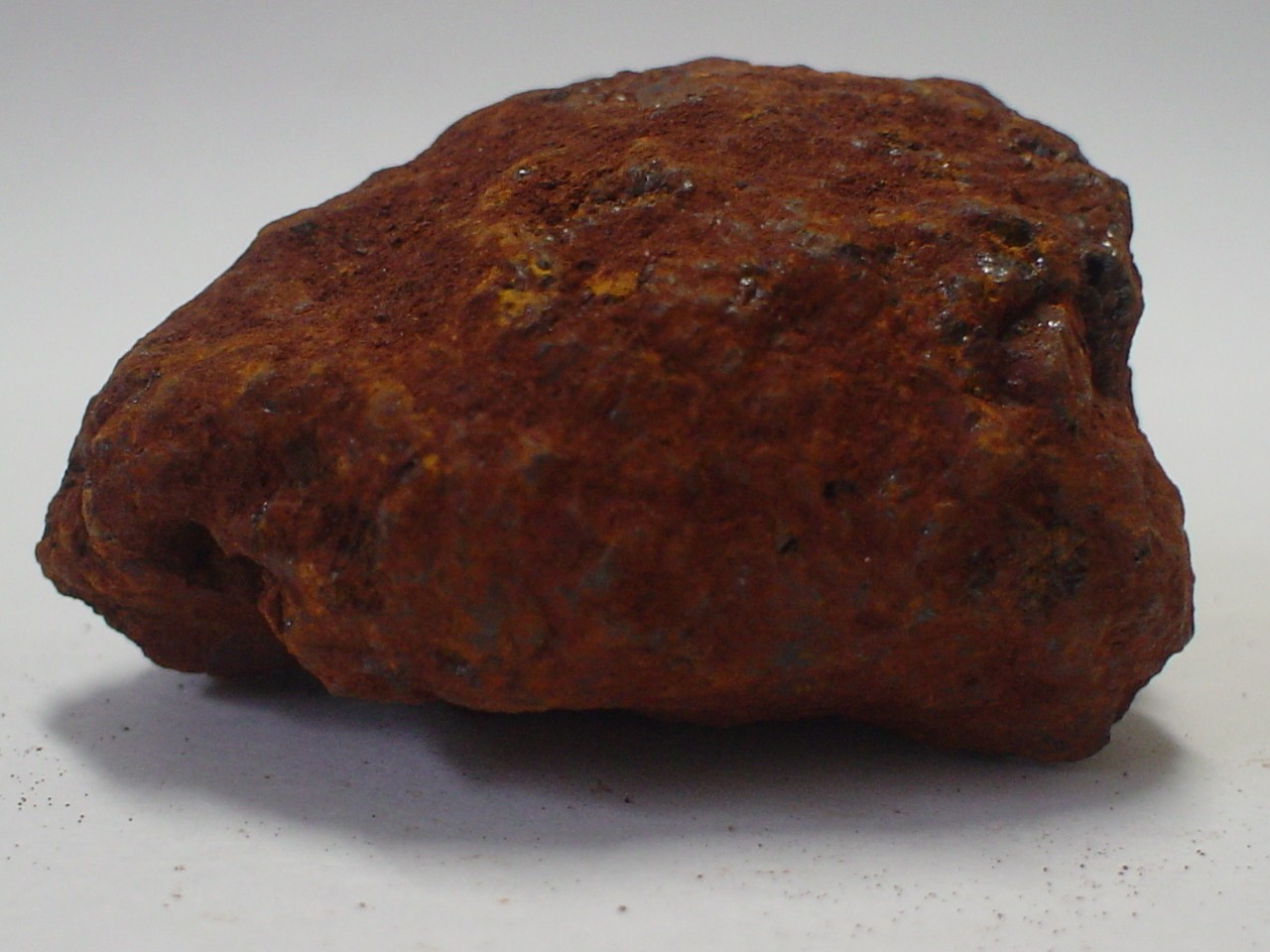
Britain's most industrially important metal (Fe), mined chiefly as haematite in Cumbria and as ironstone in the Forest of Dean and the Weald, and the raw material that underpinned the Industrial Revolution and, later, the steel industry.
Historical usage
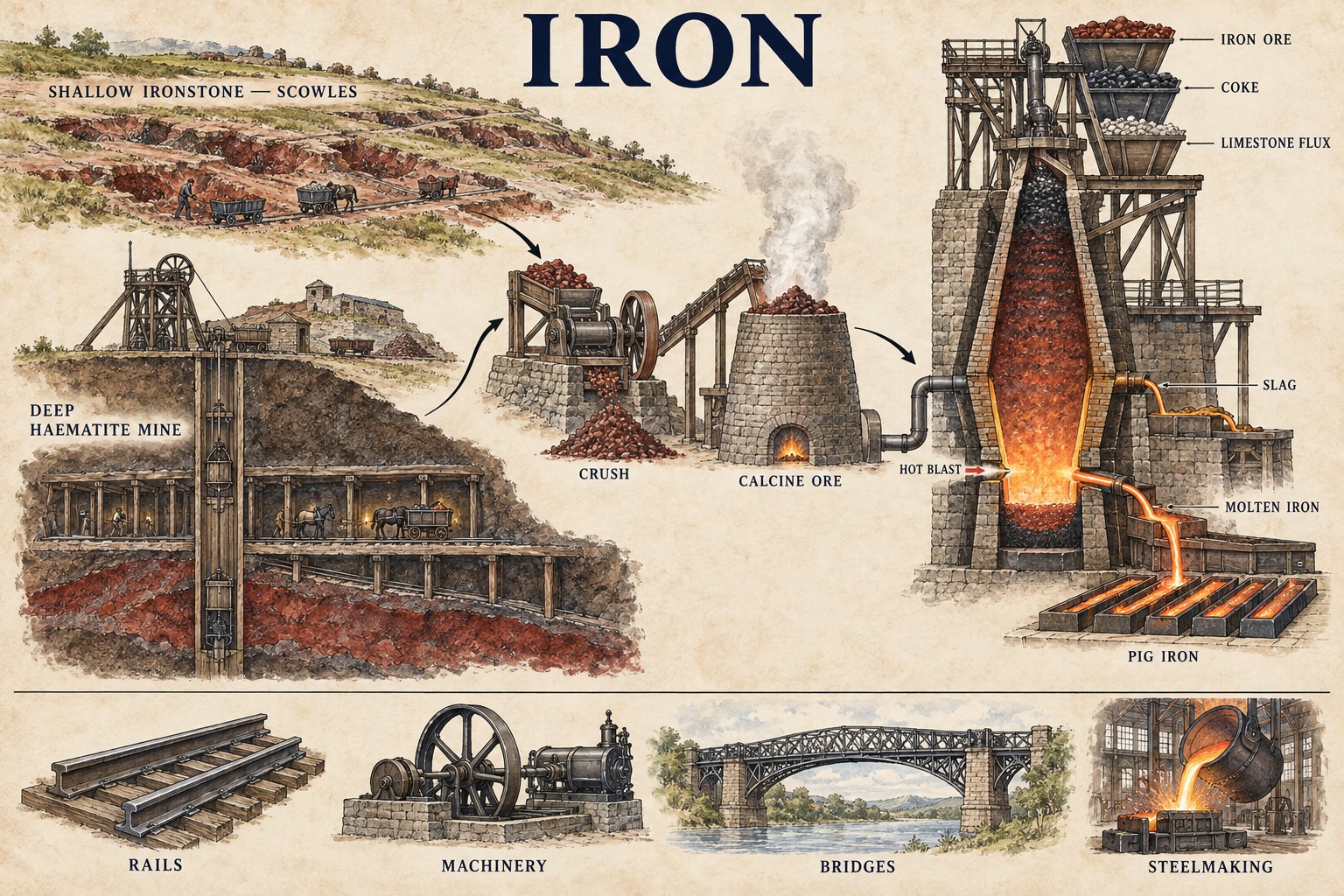
Iron working in Britain has prehistoric origins, with the Forest of Dean's shallow surface workings ("scowles") exploited by the Romans and Wealden ironstone worked from the Iron Age onward, both areas chosen for their combination of ore and abundant charcoal-producing woodland. Large-scale mechanised mining developed in west Cumbria from the 19th century, where exceptionally rich and pure haematite deposits around Frizington, Cleator Moor and Egremont fed the region's own steelworks; Florence Mine at Egremont, kept open by its own workforce after British Steel withdrew, was the last deep iron ore mine working in England before it finally closed.
How it worked
Cumbrian haematite was reached by deep shaft mining much like other metal ores, while Wealden and Forest of Dean ironstone was often worked from shallow pits or surface "scowles" close to outcrop. Ore was crushed and roasted (calcined) to drive off moisture and impurities before being smelted with coke or charcoal in a blast furnace to produce pig iron.
Why it was used
Iron's combination of strength, workability and (once alloyed as steel) hardness made it the structural material of the Industrial Revolution — rails, ships, machinery, bridges and buildings — while Cumbria's unusually pure, low-phosphorus haematite was particularly prized for producing high-grade steel by the Bessemer process.
Value over time
British iron ore was never a nationally priced commodity in the way tin or copper were — value came instead from grade and proximity to fuel and furnaces. Cumbrian haematite commanded a premium for its purity and low phosphorus content, ideal for Bessemer steelmaking, but from the mid-20th century the calculus shifted decisively: cheaper, richer imported ore (60-70% iron against home ore's 24-30%) undercut domestic mining, and Britain's home iron ore industry wound down through the 1960s-80s.
Hazards & challenges
Haematite dust causes siderosis, a generally benign pneumoconiosis in which iron oxide particles accumulate in the lungs without the severe scarring associated with silicosis — but iron miners were commonly exposed to silica-bearing rock alongside the ore itself, producing the more serious combined condition siderosilicosis, and mortality studies have linked heavy iron-dust exposure to increased lung cancer risk.
Risks & limitations
British iron ore is generally low-grade compared with deposits developed elsewhere in the 20th century — UK ores typically ran at 24-30% iron content against 60-70% for the imported ores that came to dominate from the 1960s — and once cheap, high-grade ore could be shipped in from Sweden, Australia and elsewhere, domestic mining could not compete.
Regional variation
West Cumbria (haematite, the richest British deposits) is the standout region; the Forest of Dean and the Weald represent much older, shallower workings tied to Britain's earliest iron industry.
Related terminology
Bauxite, Gale and Gaveller, Ironstone
Mines associated with this term
5 examples chosen from 94 linked records — the term page is not an index.
- Beauport Park Roman Iron Mine — East Sussex (well documented example)
Named twice in this record, first in the workings: “…in a small shaft furnace fired with charcoal, at temperatures below iron's melting point, producing a solid, spongy 'bloom' of iron that was…” - Bonawe Iron Furnace — Argyll and Bute (well documented example)
Named in this record’s workings: “Haematite iron ore was shipped in from Cumbria and Lancashire, and limestone flux…” - Dunaskin Ironworks — South Ayrshire (well documented example)
Named twice in this record, first in the history: “…Dunaskin, near Dalmellington, was completed by 1850, with the first iron made there in September 1848; the site was later served by Waterside…” - Eston Ironstone Mines — North Yorkshire (well documented example)
Named 3 times in this record, first in the summary: “…ironstone mine in the world. Middlesbrough grew from a village to an iron town on the back of it. The last drift closed in September 1949.” - Glenariff Iron Ore Mines — County Antrim (well documented example)
Named 3 times in this record, first in the summary: “Iron ore workings high in Glenariff, one of the Glens of Antrim,…”
See every mine that worked iron →
Disasters associated with this term
Included only where MineArchive's own research gives a reasonable evidential basis, with the nature of the relationship stated — not every disaster where this term might plausibly apply.
- Eskett Pit Fall of Roof, 1873 (contextual relationship)
Named in this record’s summary: “…and Peter Hughes, were killed by a single fall of roof at the Eskett iron ore workings on 16 September 1873. The Durham Mining Museum files…” - Wheal Jane acid mine water discharge, 1992 (contextual relationship)
Dissolved iron is what gave the discharge its colour and much of its notoriety, picked up as groundwater rose through metal-rich waste and oxidising rock faces once dewatering stopped.
Sources
- (primary) Haematite deposits of Cumbria — BGS Earthwise
- (primary) Respiratory diseases in iron ore miners and millers — PMC / NIH
- (secondary) Iron and Ironstone — National Association of Mining History Organisations
- (secondary) Mining — Forest of Dean Local History Society
Record created: 22 August 2026 · Last researched: 22 August 2026