 MineArchive
Bauxite
| Category | Commodities |
|---|---|
| Commodity page | Bauxite → |
A sedimentary rock rich enough in aluminium to be worth smelting, made of gibbsite, boehmite and diaspore with iron oxides and clay, and coloured reddish-brown, white or tan. Named after Les Baux in southern France, where it was identified in 1821. It is a weathering product rather than a vein mineral: lateritic bauxites form where silicate rocks like granite and basalt weather intensely under good drainage, concentrating aluminium hydroxide beneath an iron-rich surface layer.
Historical usage
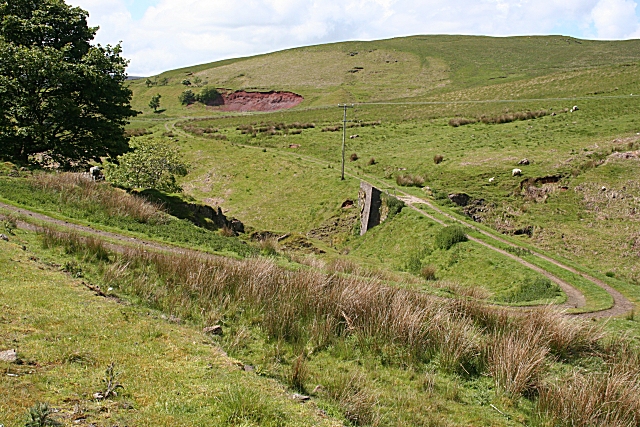
The Antrim glens are the British Isles' bauxite district, and they came to it sideways. Glenravel was opened for iron ore from 1866 and grew fast enough to build its own village; the aluminium-bearing rock lay in the same ground, and was worked twice more afterwards — once out of scientific curiosity and once, during the Second World War, because Britain needed aluminium for aircraft. That is an unusual pattern for a British extractive industry: a deposit reopened not because the price rose but because the alternative was not being able to build aeroplanes.
How it worked
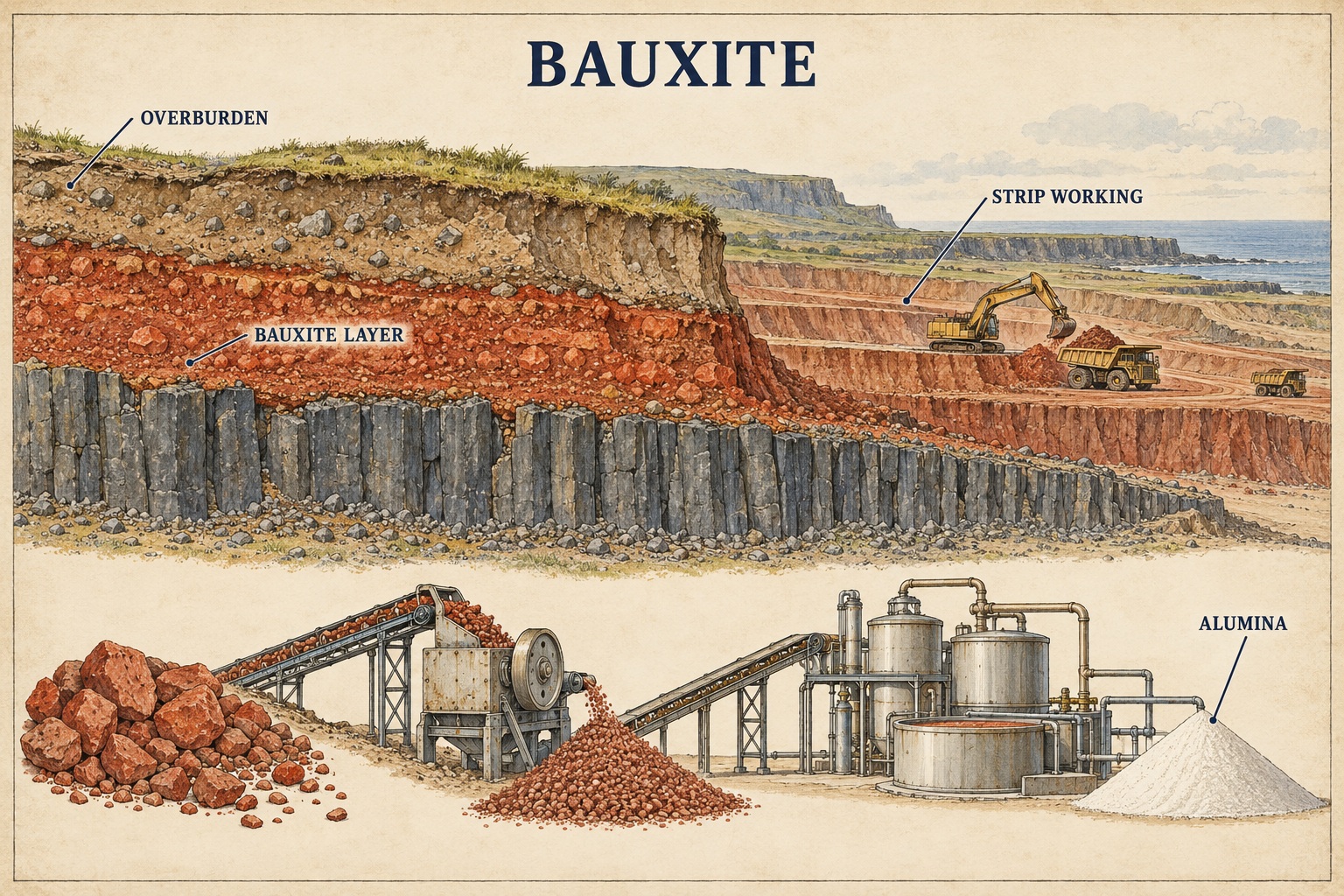
Bauxite lies within one to twenty metres of the surface, so it is strip mined almost everywhere, with minimal overburden to shift. Turning it into metal is where the work is: the Bayer process dissolves the aluminium in hot sodium hydroxide at 150-200°C and precipitates gibbsite, which is calcined above 1,000°C to alumina; the alumina is then dissolved in molten cryolite at 960°C and electrolysed to aluminium by the Hall-Héroult process. Between 70 and 80% of world dry bauxite production goes this route.
Why it was used
Because it is the practical ore of aluminium and there is no real alternative. It is also the main source of gallium, which accumulates in the Bayer liquor and can be recovered by ion exchange, though only about 15% is recoverable at typical concentrations and the rest goes to waste.
Value over time
Antrim's bauxite has been worked only when circumstances made it worth working, which is the whole of its value history: incidental to the 19th-century iron trade, then curiosity, then wartime necessity when aluminium for aircraft mattered more than cost. Globally the pattern is the opposite — a bulk commodity produced at enormous scale by Guinea, Australia and China, where the money is made in the smelter rather than the pit, and where the constraint is the price of electricity rather than the price of rock.
Hazards & challenges
The mining is strip mining, with the land-use consequences that implies — lost biodiversity, altered hydrology, soil degradation and dust — and bauxite mining has driven protest and violent conflict in Guinea, Ghana, Vietnam and India, often on indigenous and tribal land. The severe hazard is the waste rather than the ore: red mud, the alkaline residue of the Bayer process at around pH 13, does not degrade, and dries to a dust reported to cause lung disease, cancer and birth defects. A 2010 reservoir failure in Hungary killed all aquatic life in the Marcal river. Bauxite is also a Group A bulk cargo, liable to liquefy if shipped too wet — the loss of the MS Bulk Jupiter in 2015 is the case usually cited.
Risks & limitations
Bauxite is cheap, bulky and abundant, and the value is added downstream in smelting, which needs enormous electrical power. That makes a small, remote deposit like Antrim's marginal except when supply is cut off for other reasons. World production is dominated by Guinea, then Australia and China, against which a British Isles deposit has no case at all in ordinary conditions.
Regional variation
In the British Isles bauxite means the Antrim plateau, where it occurs with the iron ore in the basalt weathering profile — a lateritic origin, unlike the carbonate bauxites of southern Europe and the Caribbean that form above dissolving limestone.
Related terminology
Mines associated with this term
Included only where MineArchive's own research gives a reasonable evidential basis — not every mine where this might plausibly apply.
- Glenravel Iron and Bauxite Mines — County Antrim (well documented example)
Glenravel is the archive's record of bauxite worked in the British Isles — from the same Antrim rock as the iron ore, taken up again for aluminium when Britain needed aircraft.
See every mine that worked bauxite →
Sources
- (primary) The Iron Mines of Glenravel — Glens of Antrim Historical Society
- (secondary) Bauxite — Wikipedia
- (secondary) Mid-Antrim Iron and Bauxite Mines — geology and industrial history — Belfast Geologists' Society
Record created: 24 August 2026 · Last researched: 26 August 2026