 MineArchive
Overburden
| Category | Mine Workings & Access |
|---|
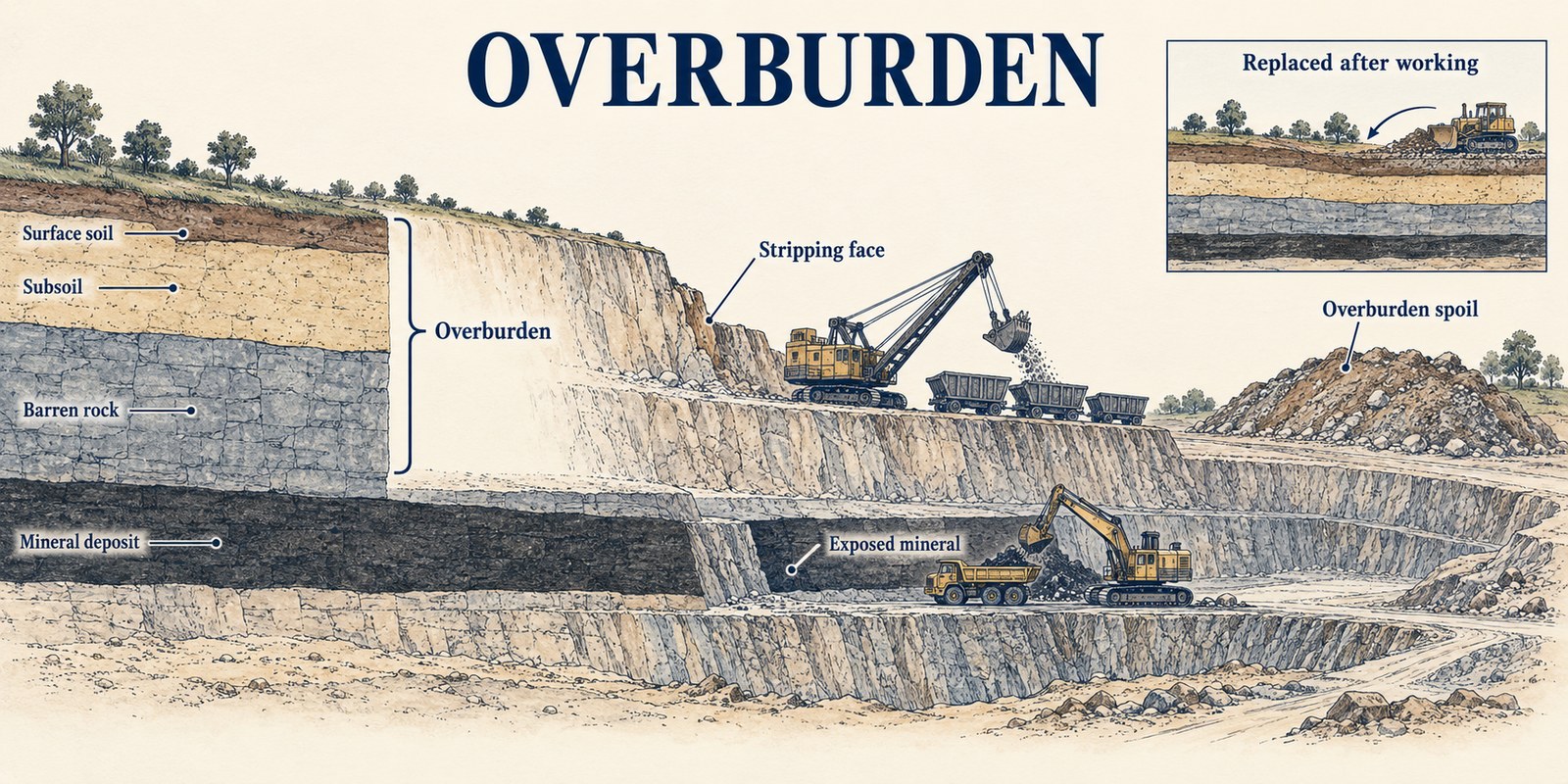
The layer of soil, subsoil and barren rock lying above a mineral deposit that has to be removed before opencast or quarry working can reach the ore, coal or stone beneath it.
Historical usage
Stripping overburden has been a basic first step of surface mineral working for as long as opencast and quarry methods have existed in Britain, from the simple hand-dug and hushed workings of early lead and tin mining through to large-scale 20th-century strip mining for coal and ironstone. Its removal was traditionally the most labour-intensive and least rewarding part of an opencast operation, since overburden itself has no value and simply has to be moved out of the way before any actual mineral can be won.
How it worked
Overburden was traditionally stripped by hand — pick, shovel and barrow — or, where a site allowed it, by directing a controlled flood of water across the surface in the technique known as hushing; from the 19th and 20th centuries onward, mechanical excavators, draglines and, eventually, heavy earth-moving trucks took over the work on larger sites. Once removed, overburden was generally piled to one side as waste, to be replaced over the worked-out ground once extraction moved on or finished, or left as permanent spoil where restoration was never attempted.
Why it was used
Removing overburden was never optional where a deposit lay close enough to the surface to be worked as an opencast rather than sunk as a shaft mine — the overburden simply had to come off first, however unrewarding the work, before any ore, coal or stone could be reached and extracted.
Risks & limitations
The volume and depth of overburden directly limited how deep an opencast working could economically go: once the cost of stripping ever-thicker overburden outweighed the value of the mineral beneath it, a site had to convert to underground working via a shaft or adit, or stop altogether. Loose, freshly stripped overburden piled at the edge of a working could also be unstable, a hazard both during active working and long after a site was abandoned.
Related terminology
Mines associated with this term
5 examples chosen from 21 linked records — the term page is not an index.
- Alexandra Quarry — Gwynedd (well documented example)
Named in this record’s history: “…W. Owen, backed by government funding of £15,000-£18,500 to strip overburden and channelled through the newly formed Caernarvonshire Crown Slate…” - Double Arches Pit — Bedfordshire (well documented example)
Named in this record’s workings: “…1927 recorded about fifteen men working, untopping — the removal of overburden — then about twelve feet and increasing, and sand taken out in…” - Magheramorne Quarry — County Antrim (well documented example)
Named in this record’s geology: “…Formation of the Antrim Lava Group, about 70 m thick in total — the overburden the quarry had to remove to get at the chalk.” - Bantycock Quarry — Nottinghamshire (well documented example)
Named twice in this record, first in the geology: “…inside about 11.5 metres of interburden, under some 27 metres of overburden; the base of the deposit lies about 42 metres down. The highest…” - Caradon Hill Medieval and Post-Medieval Mines — Cornwall (well documented example)
Named in this record’s history: “…into the valley floor, using controlled flows of water to flush away overburden and expose the heavier ore beneath. As it extended west, the…”
Sources
- (secondary) 4.3.1: Surface Mining Methods — Penn State University (Mining Engineering course notes)
- (secondary) Understanding Overburden in Mining: A Comprehensive Guide — Flyability
Record created: 23 August 2026 · Last researched: 23 August 2026