 MineArchive
Bantycock Quarry
| Location | Balderton, south of Newark-on-Trent, Nottinghamshire — 53.0365, -0.7900 (approximate) |
|---|---|
| Commodity | Gypsum |
| Type | Quarry |
| Worked | 1982–Still active |
| Maximum depth | 43 m below ground level (2018) |
| Operators | British Gypsum, Banks Group (2021–?) |
Overview
An opencast gypsum quarry at Balderton, south of Newark-on-Trent, working thin seams of unusually pure gypsum in the Triassic Mercia Mudstone. Owned by British Gypsum, part of Saint-Gobain, and worked since 2021 by Banks Mining as contractor, it covers 225 hectares, reaches 43 metres below ground and sends its best white rock to the Jericho Works for specialist plasters used in ceramics, dentistry, medicine and food. First worked from 1982 to 1993, it lay dormant until it reopened in October 2007 as the successor to Kilvington Quarry, and a southern extension is intended to carry working to 2044.
History
Gypsum has been dug around Newark for well over a century, and Bantycock is the working that carries that industry today. The quarry lies on Staple Lane at Balderton, between the A1 and Fernwood, and was opened as an opencast pit in 1982. It closed in 1993, or by 1991 in the county's reckoning, when the Nottinghamshire Minerals Local Plan recorded the dormant quarry as the successor to Kilvington Quarry: production was expected to transfer to Bantycock once Kilvington was exhausted in about 2004, with high-purity reserves for a further eleven years. Working resumed in October 2007 under British Gypsum, by then part of the French group Saint-Gobain, and its Formula division. In 2017 the quarry raised about 300,000 tonnes, employed around fifty people and was worked with eight excavators, twenty-six dumper trucks and three bulldozers under sixty-nine planning conditions, blasting the thin seams with small charges in 5.5-metre boreholes so that the rock lifted and fractured rather than shattered. Permission then ran to the end of 2027, with restoration by 2029, and in 2018 British Gypsum applied for the phasing of the remaining extraction and put forward a southern extension, Bantycock South, to the county's minerals plan. In 2021 Banks Mining took over as principal contractor; its first full year produced more than half a million tonnes, the most the quarry had ever raised, and Saint-Gobain then had it open deeper seams. In 2022 the quarry's 204-million-year-old gypsum served as a test bed for the DEEPER project, a European Space Agency and University of Glasgow drill designed to reach water beneath the surface of Mars. Because the clay lands around Newark were densely settled in the Iron Age and Roman periods, each new area is surveyed geophysically and its settlement sites stripped and recorded before mining.
Geology
The gypsum occurs as a series of thin seams in the Newark Gypsum of the Triassic Mercia Mudstone, laid down between 204 and 216 million years ago as evaporites, and is overlain by the Scunthorpe Mudstone, Westbury Mudstone and Blue Anchor formations; the Blue Anchor Formation is well exposed in the quarry, one of the few good inland sections of it. Seven seams provide most of the recovered rock, with a cumulative thickness averaging 3.5 metres inside about 11.5 metres of interburden, under some 27 metres of overburden; the base of the deposit lies about 42 metres down. The highest grades are the Grey Rock, Top Rock, Bottom White and Blue Rock seams, and it is the purity of the white gypsum that gives the quarry its national importance; the thicker but less pure pink and grey rock of the Cocks and Grey Rock seams goes to building plasters.
Workings
An opencast working over 225 hectares, at its deepest 43 metres below ground level. The seams are too thin and too close to the surface to mine underground, so overburden is stripped, the gypsum is loosened by small contained blasts and dug out by excavator, and the rock is broken, crushed and hand-sorted on site, the highest grade going to the Jericho Works to be ground for specialist plasters and the rest to plaster and plasterboard manufacture at East Leake and Barrow. Silt washed from the gypsum goes to cement.
Closure
Still active. The quarry was worked from 1982 to 1993 (dormant by 1991 in the county's minerals plan) and reopened in October 2007 as Kilvington Quarry was exhausted; current permission runs to the end of 2027 with restoration by 2029, and the Bantycock South extension proposed to the county's minerals plan would extend working to 2044.
What remains
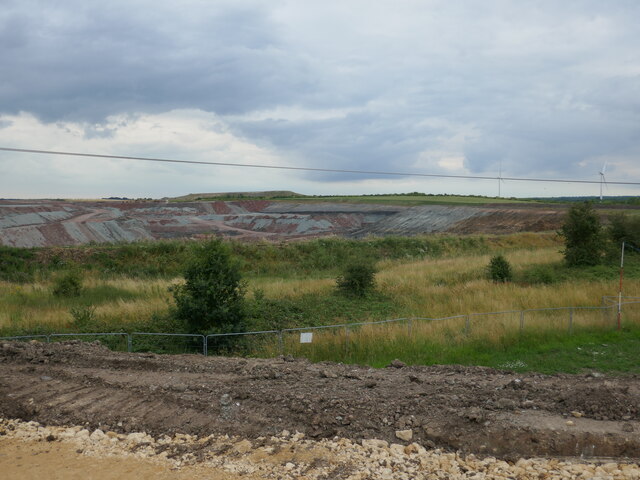
A working opencast quarry. Restored ground on the Kilvington side already carries three lakes where 180 species of birds have been recorded, and the worked-out northern areas have been returned to fields; the active workings and their spoil heap remain prominent from the surrounding countryside and from the Newark Southern Link Road, under construction beside the quarry in 2024.
The active quarry, its processing plant and a large spoil heap; restored fields and lakes on the worked-out ground.
Redevelopment
The approved restoration returns most of the land to agriculture with nature-conservation corridors, tree planting, wildflower meadows and lakes.
Recorded claims
Individual factual claims, each attached to the source(s) that support it below. Where sources disagree, both are kept.
- The quarry was dormant from 1991; the county's minerals plan expected production to transfer to Bantycock once Kilvington Quarry was exhausted in about 2004, with high-purity reserves sufficient for about eleven years. 1
- Bantycock covers 225 hectares, reaches 43 metres below ground level, employed around fifty people and raised about 300,000 tonnes in 2017; permission ran to 2027 with restoration by 2029. 2,3
- The seams lie too close to the surface and are too thin to mine underground; 15 kg charges in 5.5-metre boreholes lift and fracture two layers of gypsum at a time for excavation. 2
- Seven thin seams in the Newark seams of the Mercia Mudstone, averaging 3.5 metres cumulative thickness under about 27 metres of overburden, with the base at about 42 metres; the Grey Rock, Top Rock, Bottom White and Blue Rock seams are the highest grade, and the southern extension holds an estimated 7.5 to 8.5 million tonnes. 4
- Banks Mining became principal contractor in 2021; its first full year raised more than half a million tonnes, the most ever mined at the quarry, and Saint-Gobain then instructed it to open deeper seams. 5
- In 2022 the quarry's gypsum served as a test bed for the DEEPER drill, a European Space Agency and University of Glasgow project for reaching water beneath the surface of Mars. 6
- A good section of the Blue Anchor Formation was exposed in the opencast at SK 8123 4949 in 2005, one of few inland exposures of the formation. 7
- The BGS mine-plans catalogue holds a cross-section of a slope failure in the quarry's waste tip (KP17983). 8
- Iron Age and Roman settlement sites on the clay lands around the quarry are identified by geophysical survey and stripped and recorded before mining. 9
- A 2024 photograph shows the working quarry beside construction of the Newark Southern Link Road; 2021 views show most of the older workings restored to fields with the spoil heap standing over them. 10
- The quarry was originally worked between 1982 and 1993 and reopened in October 2007; its gypsum goes mainly to special plasters for industrial uses, while pink and grey gypsum from the thicker but less pure Cocks and Grey Rock seams is used in building plasters. 11
Photographs & further reading
The contractor's own account of the working since 2021, with interviews with the site manager and supervisor.
View sourceA reporter's visit to a blast, with the quarry's size, plant, output and planning conditions.
View sourceThe county's gypsum chapter, with Bantycock's dormancy from 1991 and its intended succession to Kilvington Quarry.
View sourceSources
- (secondary) Nottinghamshire Minerals Local Plan, chapter 10: Gypsum — Nottinghamshire County Council
- (secondary) Behind the scenes at quarry with plans to expand — Newark Advertiser, 10 March 2018
- (secondary) Plans for more gypsum to be extracted at Bantycock Quarry at Balderton — Newark Advertiser, 17 September 2018
- (secondary) Nottinghamshire Minerals Local Plan call for sites 2017/18: Bantycock Quarry extension, Bantycock South — British Gypsum, via Nottinghamshire County Council
- (secondary) Bantycock Quarry — Banks Group
- (secondary) Newark's Saint Gobain Bantycock gypsum quarry could hold key to whether there was life on Mars — Newark Advertiser, 20 October 2022
- (primary) Blue Anchor Formation — British Geological Survey, Earthwise
- (primary) BGS mine plans: Bantycock Quarry waste tip slope failure cross section (KP17983) — British Geological Survey
- (secondary) Bantycock (case study) — PCAS Archaeology
- (observational) Bantycock gypsum quarry (photographed July 2024) — Geograph Britain and Ireland, Jonathan Thacker
- (secondary) Bantycock opencast gypsum mine (Bantycock quarry), Newark — Mindat
Record created: 23 September 2026 · Last researched: 24 September 2026