 MineArchive
Borehole
| Also known as | Bore hole, Bore-hole, Bore |
|---|---|
| Category | Prospecting & Exploration |
A narrow hole bored into the ground, from the surface or underground, to prove what strata and seams lie ahead, to tap water or gas before a face reaches it, or to hold a charge of explosive.
Historical usage
Deep boring is older than any British mine: the Chinese were drilling by the Han dynasty, with a team of men jumping on and off a beam to drive the bit, and Europe caught up only in the 19th century. The 1849 glossary of the Northumberland and Durham coal trade describes the borer's kit of that day in full. The rods were the best iron, seven-eighths or an inch square, in three- and six-foot lengths screwed end to end, with a chisel in the box-rod at the bottom; wimbles brought up the borings from shale, sludgers with a clack did the same in a wet hole and brought up samples of coal when the chisel cut a seam, and a beche recovered the bottom of a broken set of rods. Two or four men on a bracehead could put a hole down twenty fathoms; beyond that a brake, a lever eight to twelve feet long, lifted the rods and let them drop, while the master of the shift stood at the bracehead turning them a little at each stroke to keep the hole round and reading the stratum by touch. The rods were drawn and the hole cleaned every six inches. The cost rose at a very rapid rate with depth, and an experienced borer's rule was that a few fathoms at the top means a few fathoms at the bottom: it paid to lower the top of a deep hole by sinking a small staple first. To prove was to find a seam thrown up or down by a slip, or the nature of a district's strata, by boring or sinking.
How it worked
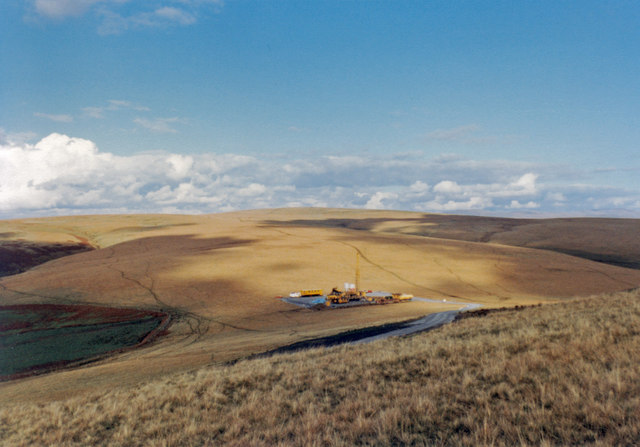
Boring went from percussion, the chisel on its rods, to rotary drilling with a rig that cuts a core, and the core is the point: a continuous sample of every bed the hole passes through, logged in order, from which the depth and thickness of a seam or the position of a fault can be read before a shaft is sunk. Underground, a borehole is bored horizontally or at an angle ahead of a heading approaching old workings, front and flank holes, to tap the water or gas before the coal is holed into; and a shot hole is a borehole of a few feet drilled in the face for its charge. The 2019 Ceunant Borehole on the South Wales coalfield, drilled by a rotary rig on open moorland, is the modern form of the same proving.
Why it was used
A borehole is the cheapest way to know what is underground. Sinking a shaft to find out costs a fortune and takes years; a bore proves the seam, its depth and what lies above it for a fraction of either, and underground it is the only safe way to approach water or gas that cannot be seen.
Risks & limitations
A bore proves one point. A fault, a washout or a thinning seam a few yards from the hole is not in the core, and a heading advanced behind boreholes can still miss old workings they were meant to find. The old rod-and-chisel method was slow and its holes small, and a broken set of rods could cost the hole.
Regional variation
Bore and boring in the North East glossaries, bore hole in the Midlands, borehole in geology. The men were borers, the machine a borer too, and the Burnside was the coalfield machine for boring into old workings.
Related terminology
Abandonment Plan, Coal Measures, Costean, Ground Freezing, Inrush, Old Workings, Rock Drill, Shaft Sinking, Shot-firing
Mines associated with this term
5 examples chosen from 71 linked records — the term page is not an index.
- Abernant Colliery — Neath Port Talbot (well documented example)
Named in this record’s history: “Amalgamated Anthracite Collieries put down exploratory boreholes here in 1926-28, but the depression stopped any further work. In the…” - Kimmeridge Oil Shale Workings — Dorset (well documented example)
Named twice in this record, first in the closure notes: “…was still being paid to the landowner at Smedmore. A series of test boreholes was sunk around Kimmeridge and Portesham in 1917-18 to establish the…” - Little Garth Mine — Cardiff (well documented example)
Named in this record’s history: “…the top surface level — a capstone recovered from its portal in 1930 bore the inscription "June 30th 1842". The tunnel gave an easier and…” - Poynton Collieries — Cheshire (well documented example)
Named in this record’s workings: “…two could not pass, until about 1866 the viewer Greenwell had the bore widened at the halfway point and fitted with iron conductors so that…” - Rosemanowes Quarry — Cornwall (well documented example)
Named 7 times in this record, first in the summary: “…but never reached rock hot enough to raise steam, and its deep boreholes are now a commercial seismic test facility.”
Disasters associated with this term
5 examples chosen from 25 linked records, most direct relationship first.
- Auldhouseburn Colliery inundation, 1898 (contextual relationship)
Named twice in this record, first in the narrative: “…of water a quarter of a mile away. Four or five months earlier a bore had been put through to it and the water drained into Auldhouseburn…” - Barrow Colliery gas outburst, 1911 (contextual relationship)
Named 3 times in this record, first in the summary: “A sudden outburst of gas through a borehole overcame the manager and three men driving a roadway to release an…” - Birchgrove Colliery inrush, 1889 (contextual relationship)
Named in this record’s aftermath: “…Rule 13 of the 1887 Mines Regulation Act with failing to keep boreholes ahead of a working approaching a likely accumulation of water. His…” - Blaenclydach Colliery dam burst, 1910 (contextual relationship)
Named 3 times in this record, first in the summary: “…on the mountainside above Clydach Vale burst out as men drove a borehole through the barrier. Some 800,000 gallons of water and slurry swept…” - Carr House Colliery inrush, 1913 (contextual relationship)
Named 6 times in this record, first in the summary: “…Car House Colliery, Rotherham, on 16 June 1913, drowning eight men. Boreholes had been drilled ahead of the face, but the plans were a few feet…”
Sources
- (primary) Mining Terms (B): glossary of the Northumberland and Durham coal trade, 1849 — Durham Mining Museum
- (primary) Mining Terms (P): glossary of the Northumberland and Durham coal trade, 1849 — Durham Mining Museum
- (secondary) Borehole — Wikipedia
- (secondary) Pit Terminology — Healey Hero
Record created: 16 October 2026 · Last researched: 16 October 2026