 MineArchive
Rosemanowes Quarry
| Location | Herniss, between Rame and Longdowns, north of the A394 near Penryn, Cornwall — 50.1679, -5.1727 (exact) |
|---|---|
| Commodity | Granite |
| Type | Stone |
| Worked | from 19th century |
| Maximum depth | As a quarry, not established. As a research site the deepest borehole reaches 2,800 m; the deepest well of the HDR programme itself, RH15, was drilled to 2,600 m. |
| Operators | Camborne School of Mines (1977–1997) |
Overview
A granite quarry at Herniss near Penryn that supplied stone for Cornish viaducts and for building work in Britain and abroad, and then had a wholly unexpected second life: from 1977 it was the site of the United Kingdom's hot dry rock geothermal experiment, the first project of its kind in Europe. The quarry proved that Cornish granite could be fractured at depth by water pressure alone, but never reached rock hot enough to raise steam, and its deep boreholes are now a commercial seismic test facility.
History
In the nineteenth century the quarry provided granite for building projects in Britain and abroad, and for the Ponsanooth viaduct near Penryn and the Carnon Valley viaduct between Truro and Falmouth. During the Second World War the quarry was used for storage by US forces preparing for the invasion of Europe in June 1944.
In the wake of the 1973 oil crisis, and following an earlier American trial at Fenton Hill, Rosemanowes was chosen for a hot dry rock (HDR) geothermal research programme because the granite here has the highest heat flow in England, at 120 milliwatts per square metre. Work began in 1977 with several 300 m test wells drilled to try out fracture-initiation techniques. Three deep wells followed during the first half of the 1980s — two to about 2,000 m and a third, RH15, to 2,600 m — and years of injection, production and circulation tests were run alongside measurements of the in-situ stress field. Funding came from the Department of Energy and the European Commission.
The programme ran until the early 1990s under the Camborne School of Mines, whose staff and facilities transferred to Camborne School of Mines Associates Ltd in 1992. Rosemanowes and the CSMA assets, intellectual property included, were bought by Asea Brown Boveri in 1997; in 2004 Schlumberger acquired the intellectual property and the staff most closely associated with microseismic monitoring, and the quarry was sold. It passed to 3K Facilities in 2006, was offered for sale in March 2013, and was bought in February 2014 by Avalon Sciences, a borehole seismic instrumentation company.
Geology
The quarry lies in the Carnmenellis granite, one of the plutons of the Cornubian batholith. What made the site scientifically valuable was not its mineralisation but its heat: the radioactive decay of uranium, thorium and potassium in this granite gives a heat flow of about 120 milliwatts per square metre, the highest in England. The rock is also relatively homogeneous, with a natural joint and fracture system whose behaviour under injection became the central finding of the research.
Workings
An open granite quarry of about 20 acres, later reused as a drilling site. Several 300 m test wells were put down from 1977, followed by three deep deviated wells in the 1980s. The site now carries three deep boreholes of 2,350 m, 2,180 m and 2,800 m, four uncased holes of 300 m and one of 150 m inclined at 30 degrees, together with microseismic testing facilities.
Closure
No source gives a date at which granite working ceased. Quarrying had ended before the geothermal programme began in 1977, and the site has been in continuous industrial and research use since — HDR research to the early 1990s, then commercial borehole and seismic testing.
What remains
In use as a borehole seismic test and development facility. Avalon Sciences bought the site in February 2014 to develop it for testing downhole seismic and logging instrumentation, the extensively characterised wells in homogeneous granite being well suited to it; the deep boreholes are available to hire, and the site has also been used as a wind turbine test environment. It is among the best-logged sites of its kind in the world.
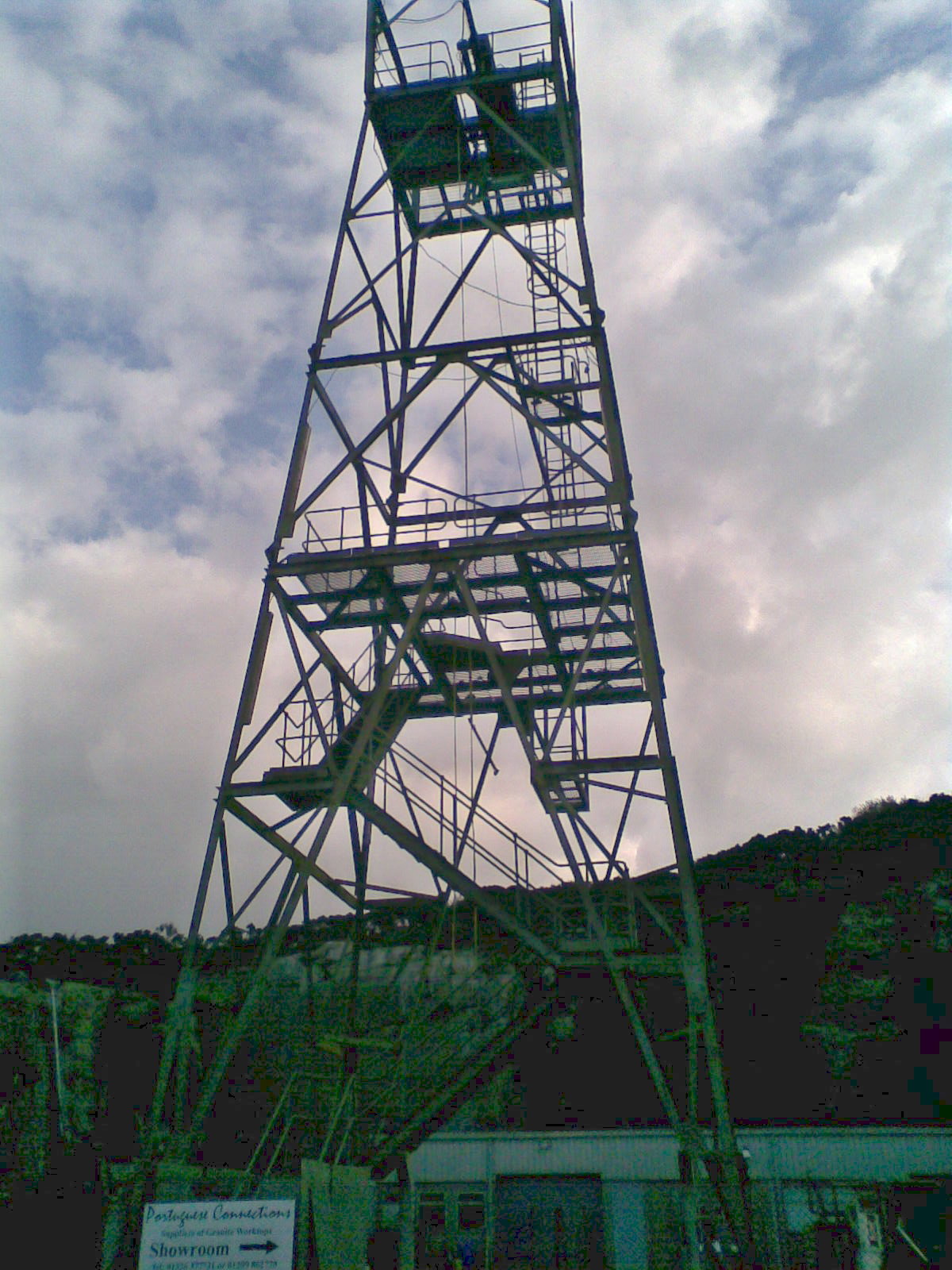
The quarry faces survive, along with the drilling tower, winches and other plant from the hot dry rock programme.
Redevelopment
Converted from a granite quarry to a geothermal research station in 1977, and from there to a commercial borehole and microseismic test facility.
Nearby mines
- Medlyn Moor Mine — 1.8 miles (2.9 km) SW
- Polhigey Mine — 1.9 miles (3.1 km) W
- Basset and Grylls Mine — 2.8 miles (4.5 km) SW
- East Wheal Lovell — 2.9 miles (4.7 km) SW
- Tresavean Mine — 3.1 miles (5.1 km) NW
Straight-line distance, within 9 miles (15 km). Show on the map.
What's uncertain
Points where sources disagree or the record could not be settled; both accounts are kept. All open questions in the archive.
- Wikipedia dates the trials to 1977–1980 with studies continuing to 1991; Law et al. (2019) describe the Camborne School of Mines programme as running from the late 1970s to the early 1990s, with three deep wells drilled during the first half of the 1980s. (uncertain) 1,2
Recorded claims
Individual factual claims, each attached to the source(s) that support it below. Where sources disagree, both are kept.
- In the nineteenth century the quarry supplied granite for building projects in Britain and abroad and for the Ponsanooth and Carnon Valley viaducts. 1
- Rosemanowes was chosen for hot dry rock research because the granite here has the highest heat flow in England, at 120 milliwatts per square metre. 1
- Wikipedia dates the trials to 1977–1980 with studies continuing to 1991; Law et al. (2019) describe the Camborne School of Mines programme as running from the late 1970s to the early 1990s, with three deep wells drilled during the first half of the 1980s. (uncertain) 1,2
- Three deep wells were drilled in the first half of the 1980s, two to approximately 2,000 m and a third to 2,600 m, followed by years of injection, production and circulation testing alongside in-situ stress measurement. 2
- The project showed that Cornish granite could be fractured at depth by water pressure alone, without explosives, but did not reach rock hot enough to raise steam for a turbine; doing so would have needed a further kilometre or more of drilling, too expensive to pursue at the time. 1
- The project made a significant contribution to understanding hot dry rock reservoir development, particularly the importance of permeability enhancement by shear stimulation of favourably aligned natural joints and fractures, and the dataset fed the European geothermal project at Soultz-sous-Forêts. 1,2
- Avalon Sciences bought the quarry in February 2014 to develop it as a facility for testing downhole seismic and logging instrumentation, using boreholes of 2,350 m, 2,180 m and 2,800 m in homogeneous granite. 1,3
Photographs & further reading
A peer-reviewed conference paper whose account of Cornwall's later geothermal drilling opens by setting out what the Rosemanowes programme drilled, tested and established about fracturing granite at depth.
View sourceTrade coverage of the 2013 sale, describing the boreholes and instrumentation left on the site after the research programme ended.
View sourceSources
- (secondary) Rosemanowes Quarry — Wikipedia
- (primary) Ledingham, Cotton and Law, 'The United Downs Deep Geothermal Power Project' (44th Workshop on Geothermal Reservoir Engineering, 2019) — Stanford University
- (secondary) Site of the first EGS project in the 1970s for sale in the UK — ThinkGeoEnergy
Record created: 3 September 2026 · Last researched: 3 September 2026