 MineArchive
Medlyn Moor Mine
| Location | Medlyn Moor, Wendron, about four miles from Helston, Cornwall — 50.1574, -5.2106 (approximate) |
|---|---|
| Commodity | Tin |
| Type | Metal |
| Worked | 1846 (earlier as stream ground)–1879 |
| Maximum depth | At least 10 fathoms (1873) |
Overview
A Wendron tin mine on a Duchy of Cornwall lease, whose lodes were found by tin streamers in the bed of the River Cober and followed into the hillside. In 1873 a cost-book company was working two of its seven lodes with a small steam engine and five heads of stamps; its engine house still stands.
History
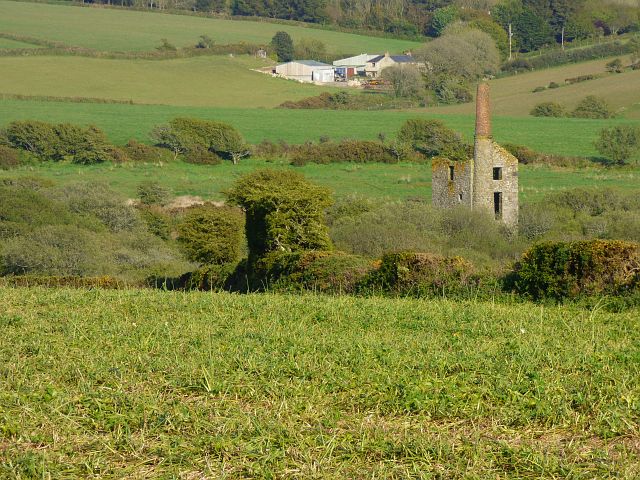
Medlyn Moor was tin ground before it was a mine: the Cornish mining historian A. K. Hamilton Jenkin believed its lodes, like those of the nearby Basset and Grylls and Wendron Consols mines, were found by tin streamers working the bed of the River Cober and then followed into the hillside. In 1873 Kelly's Directory described Medlyn Moor Tin Mine, in Wendron parish four miles from Helston, as worked for tin by a cost-book company of 6,000 shares, on a 21-year lease from the Duchy of Cornwall granted in 1872 at a royalty of one-twentieth. The country was granite, with seven known lodes in the sett running east and west and underlying to the north; two of them were being worked, from two shafts, one 10 fathoms deep and the other being sunk. A horizontal rotary steam pumping engine with a 16-inch cylinder drove five heads of stamps. The purser was Oliver Matthews of St Day, the manager James Rowe of Camborne and the resident agent Charles Rowe. Underground working had begun in 1846, when a waterwheel was used to sink a shaft 10 fathoms on the old stream ground; 15 tons of tin were returned, but water forced the erection of a 30-inch steam engine that year, and the mine closed in 1854. It restarted in 1873, the Kelly's year, when the engine house that survives was built for a 40-inch engine, and it finally closed in 1879; the only output on record is 80 tons of black tin between 1847 and 1880. Its tin workings are recorded on abandonment plans. By 2011 the engine house had been turned into a hay store, and it still stood in 2019, seen across the fields at Dacum.
Geology
Granite country with several tin lodes: Kelly's (1873) counts seven running east and west with a northward underlie, Mindat has them coursing about E.30°N, the chief being No. 1 South, No. 1 North, No. 2 North, New North and Great North. The lodes were first found by streamers in the bed of the River Cober.
Geological setting: Veins and Lodes (well documented example)
Workings
Developed underground from 1846 from the old stream ground, a waterwheel sinking the first shaft to 10 fathoms, then a 30-inch steam engine (1846-54). In 1873 two of the lodes were worked from two shafts, one 10 fathoms deep and the other being sunk, with a 16-inch horizontal rotary steam engine driving five heads of stamps, and an engine house was built that year for a 40-inch engine.
Closure
Closed in 1854 after water forced it onto steam power; restarted in 1873 with a new engine house for a 40-inch engine, and finally closed in 1879.
What remains
In 2011 the engine house had been crudely converted into a hay store and the rest of the site was heavily overgrown; the engine house still stood in 2019.
The engine house and its chimney.
Nearby mines
- East Wheal Lovell — 2.2 km S
- Rosemanowes Quarry — 2.9 km NE
- Poldark Mine — 3.0 km SW
- Tresavean Mine — 5.9 km N
- United Mines — 6.5 km N
Straight-line distance, within 15 km. Show on the map.
People
- Oliver Matthews · official, 1873 — Purser of the cost-book company in 1873, of St Day, Gwennap.
- Charles Rowe · agent, 1873 — Resident agent in 1873.
- James Rowe · manager, 1873 — Manager in 1873, of Camborne.
Recorded claims
Individual factual claims, each attached to the source(s) that support it below. Where sources disagree, both are kept.
- In 1873 Medlyn Moor Tin Mine was worked for tin by a cost-book company of 6,000 shares, on a 21-year lease from 1872 granted by the Duchy of Cornwall at a royalty of one-twentieth. 1
- The country was granite with seven known lodes bearing east and west with a north underlie; two were being worked from two shafts, one 10 fathoms deep and the other being sunk, with a 16-inch horizontal rotary steam pumping engine and five heads of stamps. 1
- The purser was Oliver Matthews of St Day, Gwennap, the manager James Rowe of Camborne and the resident agent Charles Rowe. 1
- A. K. Hamilton Jenkin believed that Medlyn Moor's lodes, like those of Wheal Roots, Basset and Grylls and Wendron Consols, were discovered by tin streamers in the bed of the River Cober and mined into the hillside from there. 1
- Abandonment plans of Medlyn Moor for tin ore survive, one set on three sheets at 10 yards to the inch. 2
- Medlyn Moor was formerly an important stream ground, developed underground from 1846 with a waterwheel used to sink a shaft 10 fathoms deep; 15 tons of tin were returned, but water problems led to a 30-inch steam engine in 1846, used until the mine closed in 1854. It recommenced in 1873, when the existing engine house was built for a 40-inch engine, and finally closed in 1879. 3,4
- Several lodes course about E.30°N, the chief being No. 1 South, No. 1 North, No. 2 North, New North and Great North; the only output recorded is 80 tons of black tin between 1847 and 1880 (Dines). 4
- In April 2011 the engine house had been crudely converted into a hay store and the rest of the site was heavily overgrown. 4
Photographs & further reading
Kelly's Directory's 1873 account of the mine and Hamilton Jenkin on its discovery by streamers.
View sourceSources
- (secondary) Medlyn Moor Mine, Cornwall — Cornwall Calling
- (primary) Medlyn Moor (Mining Remediation Authority abandonment plan OMR259, via BGS catalogue item 21864931) — British Geological Survey / Mining Remediation Authority
- (observational) Farmland and chimney, Wendron (Geograph photo 6156833, Andrew Smith, 2019) — Geograph Britain and Ireland
- (secondary) Medlyn Moor Mine, Porkellis, Wendron, Cornwall, England, UK — Mindat.org
Record created: 18 September 2026 · Last researched: 18 September 2026