 MineArchive
Stamps
| Category | Ore Processing |
|---|
Heavy iron-shod timber (later steel) hammers, raised and dropped mechanically in sets to crush lumps of ore into sand-sized material ready for further dressing — the standard first stage of ore crushing in British metal mining from the 16th century into the 20th.
Historical usage
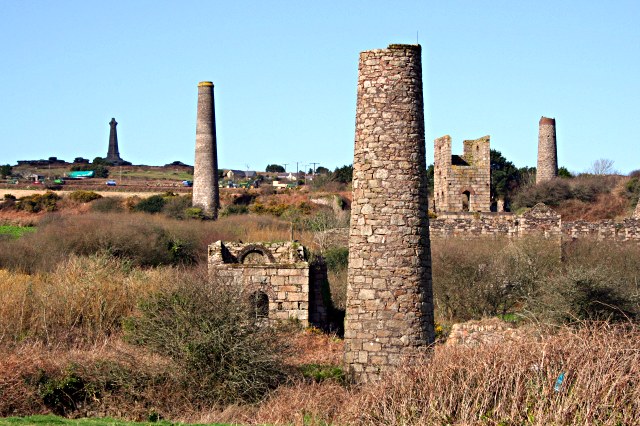
Stamp mills are recorded in mining use in continental Europe by the 16th century and were well established in Cornwall by the following century; the specifically 'Cornish stamps' design, refined through the 18th and 19th centuries for the county's tin and copper mines, became the standard type across the British non-ferrous mining districts. Small water-powered stamps gave way through the 19th century to larger steam-driven batteries as mines grew deeper and processed more ore, with installations like the 1875 West Basset stamps engine, built by Tuckingmill Foundry, representative of the technology at its peak. More efficient crushing and grinding machinery displaced stamps in most large operations by the early 20th century, but their mechanical simplicity meant sets of stamps remained in use at smaller and more remote mines for decades afterward.
How it worked
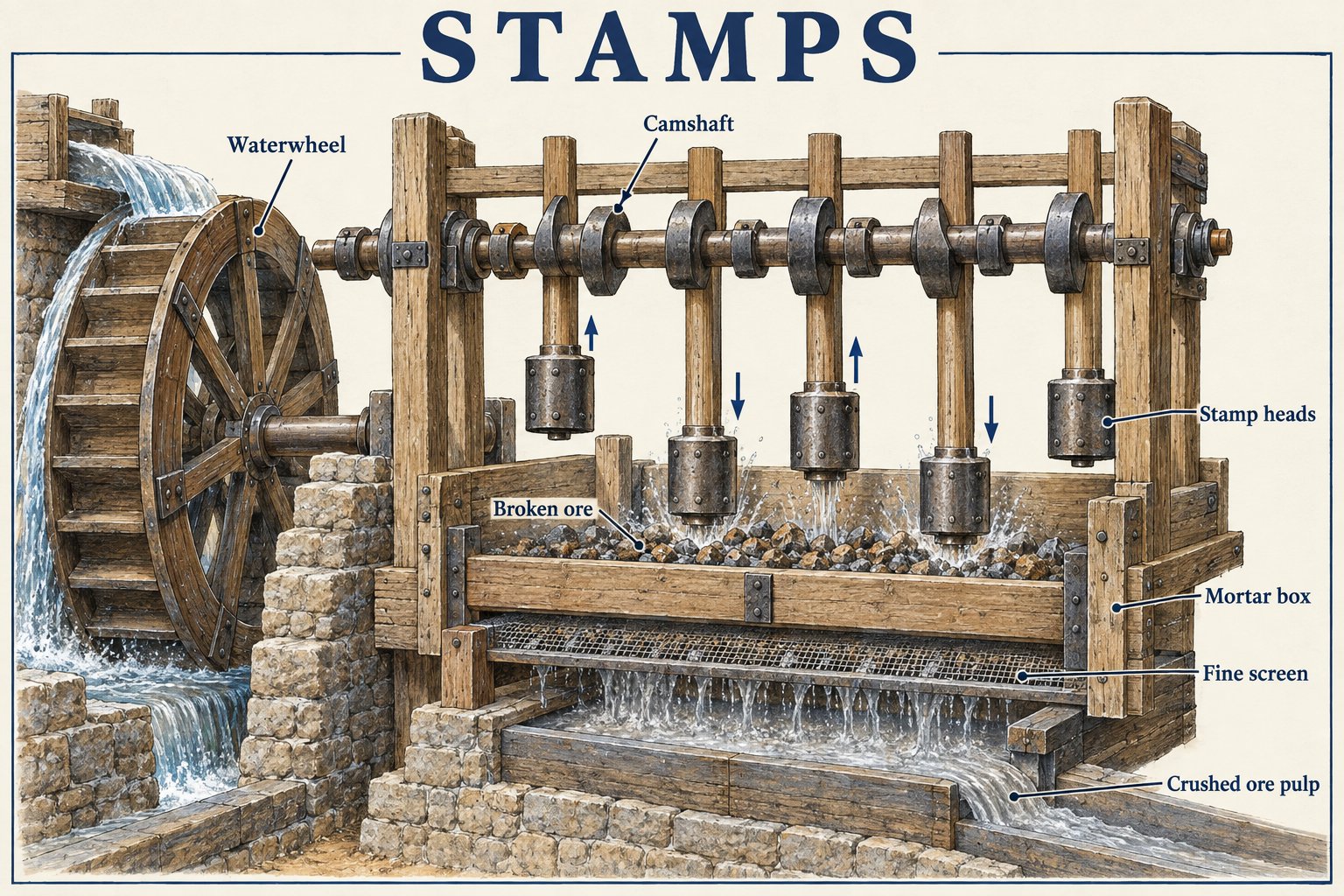
A set of stamps — usually four heads sharing one timber frame — sat over a mortar box fed with broken ore and water. Each stamp head, typically weighing 4-8 hundredweight, was lifted by a cam on a rotating shaft (driven by a waterwheel or steam engine) and released to fall freely onto the ore below; a continuous, heavy, rhythmic pounding crushed the rock as the cam shaft kept turning. Water flowing through the mortar box carried the crushed material out through a fine mesh screen, so that only sufficiently fine material passed on for further dressing (see Buddle) while larger fragments stayed to be stamped again.
Why it was used
Hand-breaking ore small enough for effective dressing was slow and labour-intensive; a battery of stamps, once built, could crush far more rock per day than any practical number of hand workers, and — crucially — worked continuously and mechanically once powered, making it the natural first step once a mine's output grew beyond what hand-dressing alone could handle.
Risks & limitations
Stamps were noisy, and the constant pounding of a working battery — audible for a considerable distance — was one of the defining sounds of a working mine district; the machinery was also relatively crude by later standards, over-crushing some material to waste-sized dust while under-crushing other lumps, losses that more modern crushing and grinding technology later reduced.
Regional variation
Cornish stamps, sized and built for tin and copper ore, are the best-documented British type and gave their name to the wider design; broadly similar stamps were used wherever British hard-rock ore needed crushing, including at Welsh gold mines like Gwynfynydd and Clogau and at copper and lead mines in the Lake District and Wales — the same basic cam-and-hammer mechanism scaled to whatever ore the mine was working.
Related terminology
Mines associated with this term
5 examples chosen from 33 linked records — the term page is not an index.
- Wheal Coates — Cornwall (surviving physical example)
Surviving stamping engine house, alongside the separate winding and pumping engine houses, dating from the mine's mid-to-late 19th-century layout. - West Chiverton Mine — Cornwall (well documented example)
Named in this record’s current condition: “…building remains survive across the wider mine site. The former stamps house was demolished by controlled demolition in 1952 and no longer…” - Bagtor Mine — Devon (well documented example)
Named twice in this record, first in the history: “…waterwheel -- reputedly the largest on Dartmoor -- to drive the stamps. Three lodes were worked, from the Quickbeam, Prosper and Western…” - Greenhead Gill Mine — Cumbria (well documented example)
Named 3 times in this record, first in the summary: “…inventory of 1586 describes its stamphouse with a waterwheel, twelve stamps and a loft where the workmen slept, and the site is one of the few…” - Kelly Mine — Devon (well documented example)
The processing sequence is what survives here: a waterwheel driving stamps at first, and the ore dressed at surface rather than smelted.
Sources
- (secondary) Cornish tin stamps — Engole
- (secondary) Stamp mill — Wikipedia
- (secondary) West Bassett Stamps Engine House — British Listed Buildings
Record created: 21 August 2026 · Last researched: 21 August 2026