 MineArchive
Bachelor's Hall Tin Mine
| Also known as | Bachelors Hall Mine |
|---|---|
| Location | Bachelor's Hall, east of Princetown, Dartmoor, Devon — 50.5448, -3.9792 (approximate) |
| Commodity | Tin |
| Type | Metal |
| Worked | 1795–1862 |
| Operators | Thomas Gray (1795–?, lessee) — 31-year licence; built the smelting house and stamping mill Thomas Tyrwhitt (1825–?, lessee) — took the lease in 1825; said to have had difficulty running the mine |
Overview
A Dartmoor tin mine east of Princetown, opencast at first and then worked from three shafts on five lodes, licensed to Thomas Gray of Exeter in 1795 and closed in 1862.
History
Tin was found here in the late 1790s, when the Dock leat, later the Devonport Leat, was being cut across the area; its first weir, on the Blackbrook just north of the mine, was finished in 1797. In 1795 a licence for 31 years was granted to Thomas Gray of Exeter to develop a mine, and about sixteen men were employed, two of them at the windlass or whim. Gray set up a smelting house and a stamping mill beside the stream now called Bachelor's Hall Brook, and between 1798 and 1804 the smelting house turned out 223 blocks of tin weighing 27 tons.
The mine began as an opencast working before three shafts, Footway, Engine and Ann's, were sunk on five tin lodes running north-north-east to south-south-west. Although the Dock leat ran past it, its three waterwheels, which drove the stamps and the flat rods to the pump at Engine shaft, took their water from two other leats: the Prison Leat, which carried the effluent of Dartmoor Prison, and the Blackbrook Leat.
In 1825 the lease passed to Sir Thomas Tyrwhitt, who is said to have had difficulty running the mine. It changed hands several times in the years that followed and closed in 1862.
Geology
Five tin lodes running north-north-east to south-south-west.
Workings
Opencast at first, then three shafts (Footway, Engine and Ann's) and three adits (Shallow, Middle and Deep). Two dressing floors, each with a stamps waterwheel and buddle platforms, and a main waterwheel driving flat rods up a gully to a pumping engine at Engine shaft, all fed by the Prison and Blackbrook leats.
Closure
Closed in 1862 after several changes of hands; the reason is not recorded.
What remains
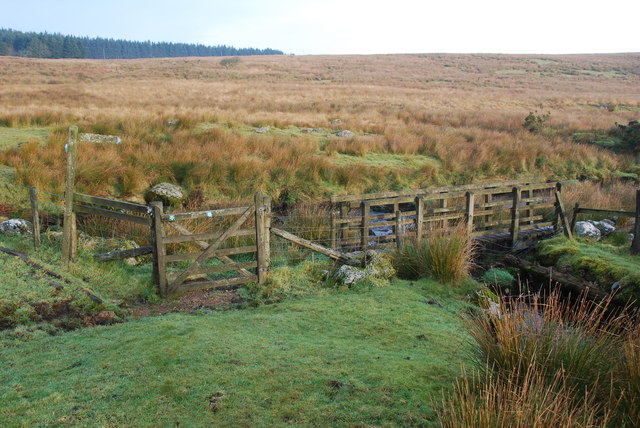
Stripped of most of its stonework and fittings; the main features survive as well-defined turf-covered earthworks and scarps.
Collapsed and capped shafts, the tree-lined gully of the flat rods, two tiers of dressing floors with their wheelpits, the overgrown main wheelpit, the banks of the Prison and Blackbrook leats, and the mouth of the shallow adit, which drains into the Devonport Leat.
Nearby mines
- Whiteworks Mine — 0.6 miles (1.0 km) SW
- Foggintor Quarry — 2.1 miles (3.3 km) W
- Swelltor Quarry — 2.4 miles (3.9 km) W
- Keaglesborough Mine — 2.6 miles (4.2 km) SW
- Eylesbarrow Mine — 3.3 miles (5.3 km) S
Straight-line distance, within 9 miles (15 km). Show on the map.
Recorded claims
Individual factual claims, each attached to the source(s) that support it below. Where sources disagree, both are kept.
- In 1795 a 31-year licence to develop a mine here was granted to Thomas Gray of Exeter. 1
- Between 1798 and 1804 the smelting house produced 223 blocks of tin weighing 27 tons. 1
- The mine closed in 1862. 1
- Bachelor's Hall was worked for tin ore. 1,2
Photographs & further reading
A walk round the mine's shafts, leats, dressing floors and wheelpits with sketch maps, drawing on John Robins's 'Follow the Leat'.
View sourceSources
- (secondary) Bachelor's Hall Tin Mine — Dartmoor Explorations
- (primary) Mine plan: Bachelors Hall (tin ore) — British Geological Survey (Mining Remediation Authority mine plans catalogue)
Record created: 2 November 2026 · Last researched: 2 November 2026