 MineArchive
Foggintor Quarry
| Also known as | Royal Oak Quarry |
|---|---|
| Location | West of Princetown, beside the B3357 east of Merrivale, Devon — 50.5436, -4.0266 (approximate) |
| Commodity | Granite |
| Type | Quarry |
| Worked | c.1820–1906 |
| Maximum depth | Unknown. |
| Operators | Haytor Granite Company (1840–1863), Pethicks (?–1906) |
Overview
One of Dartmoor's three great granite quarries, near Princetown, worked from about 1820 to 1906; it supplied granite for Nelson's Column and employed some 300 men in the 1840s, and is now a cliff-ringed pool beside the ruins of its workers' settlement.
History
Foggintor, recorded as Vokketorre in 1408, was a tor west of Princetown that was almost entirely quarried away in the nineteenth century; the quarry was known at first as Royal Oak Quarry. Stone is supposed to have been taken from about 1785 for Tor Royal, Princetown and the prison, and the lease from Sir M. M. Lopes was held by the Plymouth and Dartmoor Railway Company, whose horse tramway of 1823 carried the granite to Plymouth. In 1823 the lease passed to Johnson and Brice, then owners of the Haytor quarries; in the early 1840s, having closed Haytor, they formed the Haytor Granite Company to work Foggintor and sold its stone under the Haytor name.
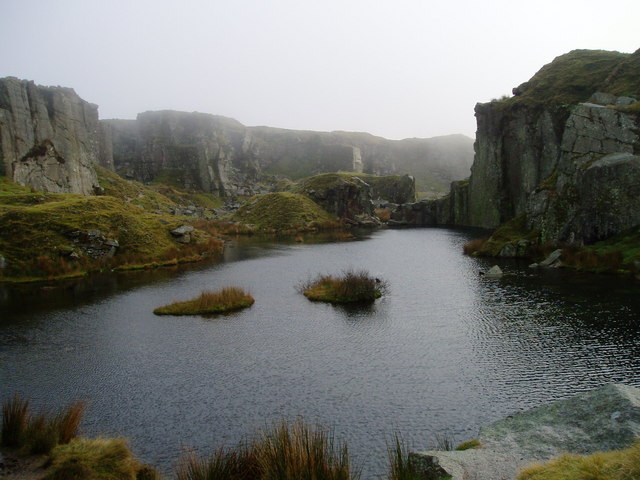
In 1833 a single year yielded 8,374 tons, and in the 1840s at least 300 men worked here, with a foundry, smithy, stables, offices, a powder store, a manager's house, workers' cottages and later a chapel and school; in 1858 a ten-pound powder blast brought down a block of over 1,000 tons. Foggintor granite went into Nelson's Column, whose building was delayed in 1842 when supply fell short and the quarry's masons struck in support of London colleagues. The Haytor Granite Company went into liquidation in 1863 and the quarry was offered for sale in 1864. In the early 1900s it belonged to Pethicks of Plymouth, who in 1906 stopped work in favour of nearby Swelltor. The flooded quarry, a basin of sheer faces round a large pool with ruined buildings nearby, has since been used for filming, climbing and military training.
Geology
Dartmoor granite, prized for its even colour and fine texture in the deep beds.
Workings
An open granite quarry worked to a deep basin, served first by the 1823 horse tramway and later by the Princetown railway; workshops, smithy, stables and a powder store.
Closure
Quarrying stopped in 1906 in favour of Swelltor quarry.
What remains
A flooded, cliff-lined basin with ruined buildings and workers' cottages nearby.
Quarry faces and pool, ruined quarry buildings and cottages.
Redevelopment
Used for rock climbing, military training and as a film location.
Related mines
- Haytor Granite Quarry — Both worked by Johnson and Brice and the Haytor Granite Company, which sold Foggintor stone under the Haytor name.
- Merrivale Quarry — Neighbouring granite quarries on the Princetown road; with Haytor the three major granite quarries of Dartmoor.
- Swelltor Quarry — Neighbouring Princetown granite quarries; work moved from Foggintor to Swelltor in 1906.
Nearby mines
- Swelltor Quarry — 0.4 miles (0.6 km) SW
- Merrivale Quarry — 1.5 miles (2.5 km) NW
- Whiteworks Mine — 1.8 miles (2.8 km) E
- Keaglesborough Mine — 2.2 miles (3.5 km) S
- Eylesbarrow Mine — 3.9 miles (6.2 km) SE
Straight-line distance, within 9 miles (15 km). Show on the map.
What's uncertain
Points where sources disagree or the record could not be settled; both accounts are kept. All open questions in the archive.
- Operated from around 1830 to the early 20th century. (disputed) 3
Recorded claims
Individual factual claims, each attached to the source(s) that support it below. Where sources disagree, both are kept.
- The extensive quarries at Foggintor provided granite for Nelson's Column in the early 1840s. 1,2
- At least 300 men were employed at Foggintor in the 1840s. 2
- Operated from around 1830 to the early 20th century. (disputed) 3
- Quarrying stopped in 1906 in favour of the nearby Swell Tor Quarry. 2
- In November 1858 a ten-pound powder blast removed a single block of over 1,000 tons. 2
- The Haytor Granite Company, which worked Foggintor, went into liquidation in 1863 and its assets were offered for sale in 1864. 2
Sources
- (secondary) Industrial archaeology of Dartmoor — Wikipedia
- (secondary) Foggintor — Legendary Dartmoor
- (observational) Foggintor Quarry and King's Tor — UK Southwest
Record created: 17 October 2026 · Last researched: 17 October 2026