 MineArchive
Waggonway
| Also known as | Wagonway (US/general spelling variant), Tramway (Later term for broadly the same kind of rail-borne haulage, typically on iron rather than wooden rails), Tramroad (South Wales and the Forest of Dean) |
|---|---|
| Dialect | North East England |
| Category | Mine Workings & Access |
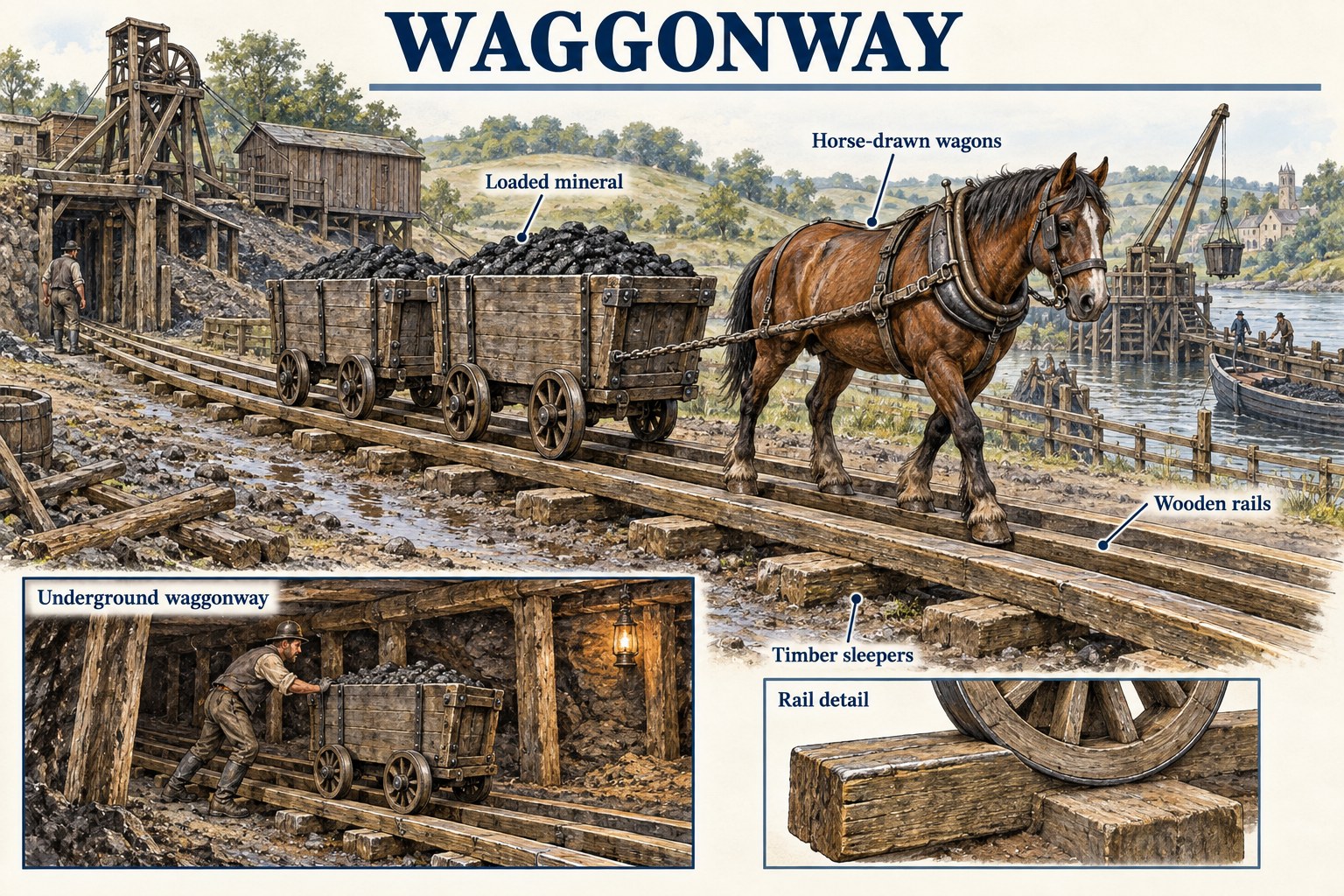
An early railway of parallel wooden rails, laid on timber sleepers underground or at the surface, along which horse- or hand-drawn wagons hauled ore, waste and materials far more easily than could be managed on bare rock or mud.
Historical usage
Wooden waggonways were introduced to England by German miners working for the Company of Mines Royal, the Elizabethan state mining monopoly established in 1564 — the earliest documented depictions appear in Georgius Agricola's De Re Metallica (1556), showing German 'Hund' carts running on grooved timber rails. From the late 16th century the technique spread into English mining, most famously the coalfields of Northumberland and Durham, where surface waggonways hauled coal to river staithes for shipment; some historians credit these lines as a direct ancestor of the modern railway. Wood gave way to iron from the 1760s onward, when cast-iron plates were first fixed to the upper surface of wooden rails to cut wear; the fully cast-iron plateway followed in 1787, when John Curr, manager of Sheffield Park Colliery, introduced L-shaped iron plates whose raised flange guided plain, unflanged wagon wheels -- a design suited to underground use, where a protruding wheel flange would have fouled loose rock. Joseph Butler produced a similar design near Chesterfield the following year, and Benjamin Outram became the leading advocate of iron plateways generally, building lines from Derbyshire quarries to canal wharves. Plateways found particular favour in the South Wales and Forest of Dean coalfields, where they moved coal and ironstone from pit to canal or tramroad for roughly the next fifty years. A rival design -- the iron edge rail, on which a flanged wheel rather than a flanged rail kept the wagon on track -- was developed alongside plateways by William Jessop from 1789; edge rails eventually won out as the standard for main-line railways, but plateways remained common in mining districts well into the 19th century before steel rails and, eventually, powered haulage replaced horse-drawn waggonways of every kind.
How it worked
Parallel wooden rails were laid on timber sleepers, either underground along a level or adit, or on the surface between a mine and its nearest navigable water. A wagon's wheels ran along the rails' upper surface or within an L-shaped groove, sharply reducing the friction and effort needed to haul a loaded wagon compared with a cart on ordinary ground. Where a mine upgraded from wood to iron, the principle stayed the same but the rail itself changed shape: a wooden rail was a plain running surface needing a wagon with its own guiding flange or pin, while John Curr's 1787 iron plateway inverted this, casting the flange into the rail plate itself so an ordinary flat-wheeled wagon would track along it without slipping off.
Why it was used
Even a single horse, or a man alone, could haul a far heavier load along rails than was possible on rough ground — underground, that meant getting ore and waste out of deep, awkward workings without a small army of bearers; on the surface, it meant a mine could move its output to a river or port cheaply enough to make otherwise marginal ground worth working.
Risks & limitations
Wooden rails wore quickly under repeated heavy loads and needed constant maintenance and replacement, and wagons could derail on worn or damaged track — problems that iron, and later steel, rails would eventually solve, but only after wood had done the job for the best part of two centuries.
Regional variation
Underground waggonways survive from as early as the medieval period at a handful of exceptional sites, but the term is more commonly associated with the surface coal waggonways of Northumberland and Durham, radiating out from collieries to the Tyne and Wear from the 17th century onward.
Related terminology
Blondin, Fishbelly Rail, Journey, Lime Kiln
Mines associated with this term
5 examples chosen from 244 linked records — the term page is not an index.
- Cann Quarry — Devon (well documented example)
Named 7 times in this record, first in the summary: “…hauled out first by a canal surveyed by John Smeaton and later by a tramway connecting to a railway on which Isambard Kingdom Brunel himself…” - Charlestown Limeworks — Fife (well documented example)
Named twice in this record, first in the history: “…were served by Charlestown harbour and by the Elgin Railway, a horse tramway, and later by a North British Railway branch since lifted. The…” - Combe Down Stone Mines — Somerset (well documented example)
Named 3 times in this record, first in the history: “…more than 10 hectares underground. Allen built a horse-drawn tramway down to the Kennet & Avon Canal to move stone into Bath, and used…” - De Lank Quarries — Cornwall (well documented example)
Named in this record’s surface remains: “The turbine house and pipework, and the course of the incline and its tramway connection to Wenfordbridge; the quarry itself is in use rather than…” - Eastern Quarry — Kent (well documented example)
Named in this record’s history: “…chalk reached tidal water and could be loaded straight into ships. Tramways in the nineteenth century let quarrymen work deposits further…”
Disasters associated with this term
Included only where MineArchive's own research gives a reasonable evidential basis, with the nature of the relationship stated — not every disaster where this term might plausibly apply.
- Fatfield Colliery explosion, 1825 (contextual relationship)
Named in this record’s narrative: “…his son-in-law John Solsbey and Edward Ranson, stoneworkers; the waggonway wright Joseph Harrison; the hewer George Hambling; the brothers…” - Nash and Sprinkle Colliery shaft accident (contextual relationship)
Named in this record’s narrative: “…Hook, Haverfordwest, on the Cleddau estuary in Pembrokeshire, with a tramway running to a quay at Sprinkle. On 25 March 1861, four men entered a…” - Newbottle Colliery boiler explosion, 1815 (contextual relationship)
The engine drew waggons up the colliery railway. - Seaton Burn Colliery boiler explosion, 1860 (contextual relationship)
Named in this record’s narrative: “…stones riddled the roofs of nearby houses, and a labourer on the tramway, William Chevil, was struck on the head.” - Thomas Chapel Colliery inrush, 1838 (contextual relationship)
Named in this record’s narrative: “…between the Reynalton and Bramble Hill faults, its coal carried by tramway to Saundersfoot. On 16 June 1838 the workings broke into old flooded…”
Sources
- (secondary) Plateway — Wikipedia
- (secondary) Silver Gill, Roughton Gill, Caldbeck, Allerdale, Cumbria, England, UK — Mindat
- (secondary) The Wooden Wagonways of Britain — Amusing Planet
Record created: 22 August 2026 · Last researched: 22 August 2026