 MineArchive
Flockton Collieries
| Also known as | Flockton Colliery, Lane End Colliery, Emroyd Colliery, New Flockton Colliery |
|---|---|
| Location | Flockton and Sitlington, West Yorkshire — 53.6320, -1.6310 (exact) |
| Commodities | Coal, Ironstone |
| Type | Coal |
| Worked | 1515–1894 |
| Maximum depth | Shallow: shafts had reached about 300 feet by the 1700s, and the Emroyd pits worked seams at 61 and 104 yards. |
| Operators | Milnes family of Flockton (1764–1815), Stansfield family of Flockton (1815–1894) |
Overview
Shallow pits on the outcropping seams north of Flockton, worked from before 1700 and built into a substantial business by the Milnes family, who laid a three-mile wooden waggonway to the Calder and Hebble Navigation in 1772. Their owners were Unitarians whose 'Flockton system' of schools, library and allotments was singled out by the 1841 child-labour commissioners. The company gave up in 1894.
History
A coal pit at Flockton is recorded in 1515, and by the 1700s its shafts had reached three hundred feet. In the seventeenth century Richard Carter, who died around 1700, made his fortune from the coal and paid for the village's first church, its almshouses and its school. Until 1758, when the Calder and Hebble Navigation made the river navigable above Wakefield, Flockton coal was sold locally.
Richard Milnes, a timber merchant and maltster renting Flockton Manor by 1764, started the family's coal business on the Wortleys' New Hall estate in Dial Wood. In 1772 he began a wooden waggonway — a 'Newcastle road', three miles of it, reputedly costing £6,000 — from his pits down to staithes on the navigation at Horbury Bridge, worked by horses with a self-acting incline on the steep section north from Middlestown. It ran over a twenty-arch viaduct across boggy ground and through a tunnel some three hundred feet long. The line was relaid with cast-iron rails on stone blocks after 1816 and part of it with flat-bottom rail by 1878, when a Manning Wardle locomotive worked the lower section on an unusual three foot nine inch gauge. The tunnel and its portal are now a listed structure.
After Richard Milnes died in 1779 his son James and three brothers inherited. James worked the Flockton Thick from shallow pits at what is now Caphouse, on rights leased from Mary Wortley, Countess of Bute; by 1791 that colliery had seventeen shafts about two hundred yards apart, and it was worked out by 1803. He leased coal at Emroyd Common in 1796 with the right to make railways, took the ironstone rights two years later, and a plan of 1801 shows nine ironstone pits and a furnace there. By 1799 the brothers employed more than two hundred men and boys. Lane End Colliery, sunk before 1803, became the largest of the pits, with eight seams and five hundred men and boys in 1843.
James Milnes died in 1803 leaving more than £39,000 and a family quarrel; his widow Mary Ann took control after buying the brothers out at £300 each. Her daughters married William Stansfield and Henry Briggs, both of whom came into the business, and after Briggs left in the 1840s the Stansfields ran it alone. These families were Unitarians who housed and paid their workers well and provided Sunday schools, a library, allotments and sport — the 'Flockton system'. When the commissioners on the employment of children visited in 1841 and found boys and girls hauling tubs underground, they singled out the company for its civilising efforts; the Mines and Collieries Act of 1842 ended the practice.
What finished the business was the railway it never got. The Leeds and Manchester line opened through Horbury Bridge in 1840 but lay on the far side of the river and the navigation from the waggonway, and a later request to the Lancashire and Yorkshire Railway for a connection came to nothing. Emroyd was nearly worked out by the 1880s. Captain Stansfield died early in 1893; later that year the men joined the national strike against a twenty-five per cent pay cut, hardened by the Combs pit disaster in neighbouring Thornhill and by the Featherstone riot, where troops fired on strikers. Mrs Stansfield gave up the leases in January 1894. The manager John Wood tried to keep the company going and failed; the plant was auctioned in 1895 and the last of it advertised in 1904.
Geology
Flockton sits at the transition from the Lower to the Middle Coal Measures, on the Birstall Rock sandstone, in a Carboniferous sequence of sandstones, mudstones, siltstones and coals laid down about 310 million years ago in the deltas of a shallow tropical sea. Six seams were accessible at the surface for drift mining and at shallow depth for bell and ladder pits. Two of them take their names from where they crop out here: the Flockton Thick, up to forty-eight inches and used for gas, oil and coke, and the Flockton Thin, about fifteen inches and an excellent house coal. The pits also had the Joan, Old Hards, Green Lane, New Hards, Wheatley and Blocking coals. Some streams in the area run orange where water has passed through siderite and leached iron into the shallow groundwater.
Geological setting: Sedimentary Beds and Seams (well documented example)
Workings
Small and shallow, and many of them: bell and ladder pits from the surface, drifts into the outcrops, and later shafts. James Milnes's colliery at Caphouse had seventeen shafts about two hundred yards apart by 1791. At Emroyd the pits worked the Old Hards at sixty-one yards and the New Hards at a hundred and four. The waggonway of 1772 is the works that survives best: three miles, horse-worked, with a self-acting incline, a twenty-arch viaduct and a tunnel three hundred feet long, eighty inches wide and ninety high.
Closure
The Stansfields gave up the leases in January 1894 after the national strike of 1893; an attempt by the manager to continue failed, and the plant was auctioned in 1895 with the remainder advertised in 1904.
What remains
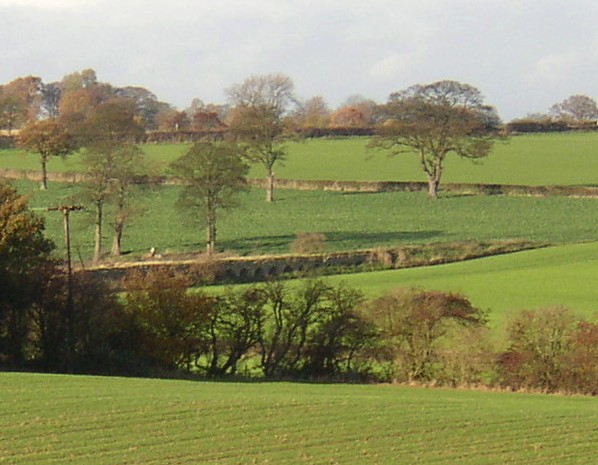
The waggonway's vaulted tunnel and its entrance portal with rubble flanking walls are a Grade II listed structure. The Old Flockton Colliery's railway viaduct at Midgley survives with some of its twenty arches. The Emroyd ironworks ruins stood until 1958, when the site was opencasted.
The listed waggonway tunnel and portal, and the Midgley railway viaduct.
Redevelopment
Emroyd Common was opencasted in 1958.
Nearby mines
- Denby Grange Colliery — 0.7 miles (1.2 km) NE
- Caphouse Colliery — 0.9 miles (1.4 km) NE
- Grange Ash Colliery — 1.0 miles (1.6 km) W
- Emley Moor Colliery — 1.3 miles (2.2 km) S
- Shuttle Eye Colliery — 1.4 miles (2.2 km) W
Straight-line distance, within 9 miles (15 km). Show on the map.
What's uncertain
Points where sources disagree or the record could not be settled; both accounts are kept. All open questions in the archive.
- The BGS mine-plans catalogue holds a Mining Remediation Authority abandonment plan titled 'Flockton' (catalogue GCR222, Flockton Thin, dated 1849); the catalogue gives no location and the plan's details do not clearly tie it to this working, so it may belong to another of the same name. (uncertain) 3
Recorded claims
Individual factual claims, each attached to the source(s) that support it below. Where sources disagree, both are kept.
- The Flockton Thick, up to forty-eight inches and used for gas, oil and coke, and the Flockton Thin, about fifteen inches and an excellent house coal, are named from where they outcrop here. 1,2
- In the seventeenth century the coal master Richard Carter, who died around 1700, made his fortune from these pits and financed the village's first church, its almshouses and its school. 1,2
- Richard Milnes began a three-mile wooden waggonway, described as a Newcastle road, from his pits at Dial Wood to the Calder and Hebble Navigation at Horbury Bridge in 1772, reputedly at a cost of £6,000; it was horse-worked with a self-acting incline, ran over a twenty-arch viaduct and through a tunnel about three hundred feet long. 2
- James Milnes leased the mineral rights from Mary Wortley, Countess of Bute, and his colliery had seventeen shafts about two hundred yards apart by 1791, worked out by 1803; No. 17 shaft was on the site of Caphouse Colliery. 2
- The Milnes, Briggs and Stansfield families were Unitarians who provided decent housing and wages, Sunday schools, a library, allotment land and sport; the commissioners on the employment of children singled the company out in 1841 for its civilising influences while recording boys and girls hauling tubs underground. 2
- Captain Stansfield died early in 1893; the men joined that year's national strike against a twenty-five per cent pay cut, and Mrs Stansfield gave up the leases in January 1894. The manager John Wood failed to keep the business going and the plant was auctioned in 1895, the remainder advertised in 1904. 2
- The BGS mine-plans catalogue holds a Mining Remediation Authority abandonment plan titled 'Flockton' (catalogue GCR222, Flockton Thin, dated 1849); the catalogue gives no location and the plan's details do not clearly tie it to this working, so it may belong to another of the same name. (uncertain) 3
Photographs & further reading
A full account of the pits, the Milnes and Stansfield families, the 1772 waggonway and its tunnel and viaduct, the Flockton system, and the collapse of the business in 1894.
View sourceSources
- (secondary) Flockton Collieries — Wikipedia
- (secondary) Flockton Collieries — Engole
- (primary) BGS / Mining Remediation Authority mine plans: FLOCKTON — British Geological Survey / Mining Remediation Authority
Record created: 9 September 2026 · Last researched: 9 September 2026