 MineArchive
Incline
| Also known as | Self-acting Incline (The general British term for an incline worked by gravity, where the descending loaded wagons haul the empties up.), Cousie (Scottish), Gravity Incline (Another general form of the same thing.) |
|---|---|
| Category | Mine Workings & Access |
A shaft, tunnel or surface tramway driven at a steady angle rather than vertically or level, laid with rail track so that wagons or skips could be hauled up and down it by rope rather than carried by a vertical winder — a practical option wherever the ground itself, or the material being moved, suited an angled route better than a true shaft.
Historical usage
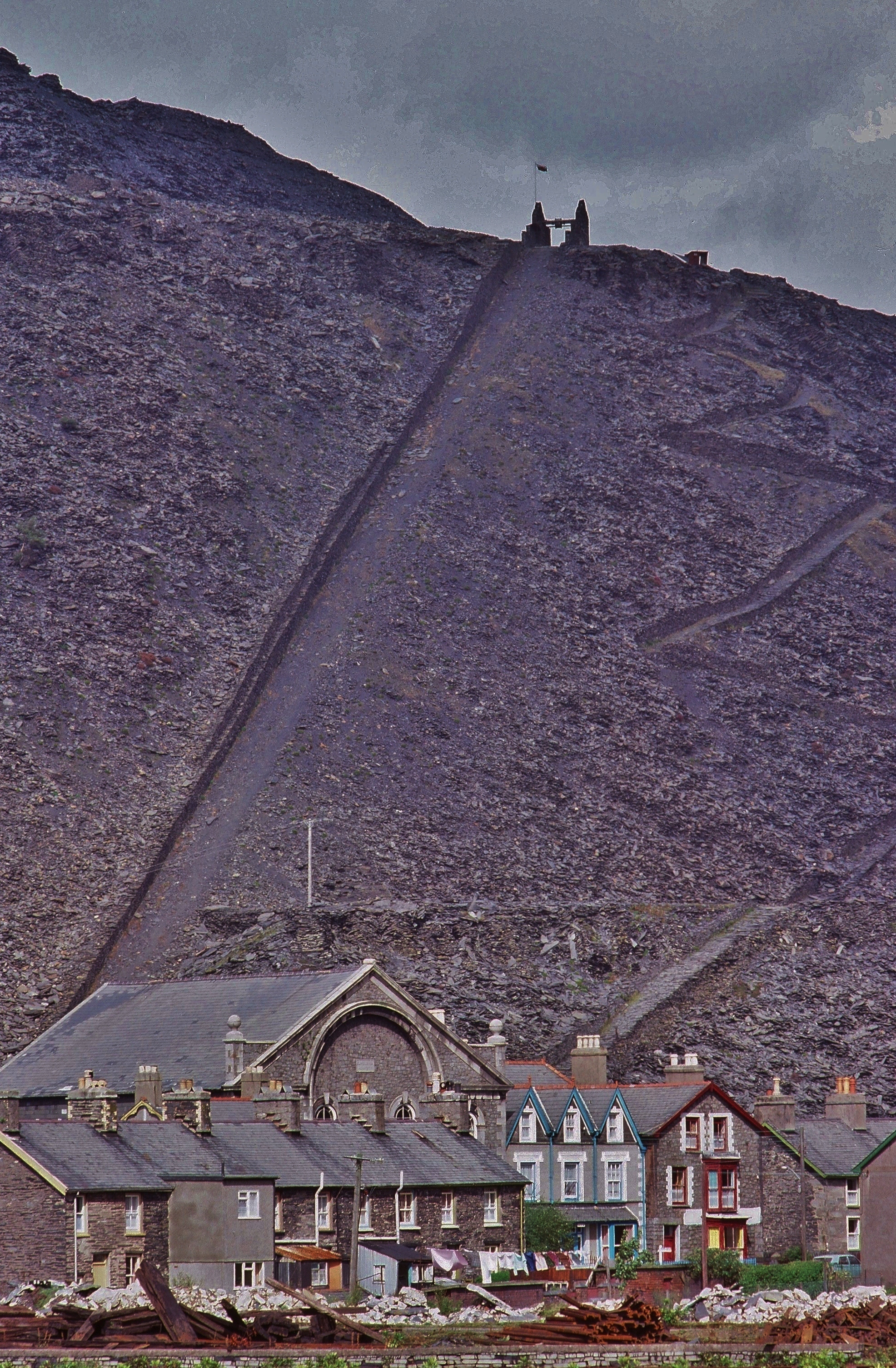
Inclines are recorded across British mining and quarrying from the 18th century onward, especially common in Welsh slate quarries, where huge tonnages of rock and waste had to move between terraced workings at very different levels, and in collieries and metal mines linking underground workings to a surface tramway or railway. Some remained in industrial use remarkably late: Kilmersdon Colliery's 1877 gravity incline was, by the time of its closure, the last gravity-worked rope incline still operating industrially anywhere in the United Kingdom.
How it worked
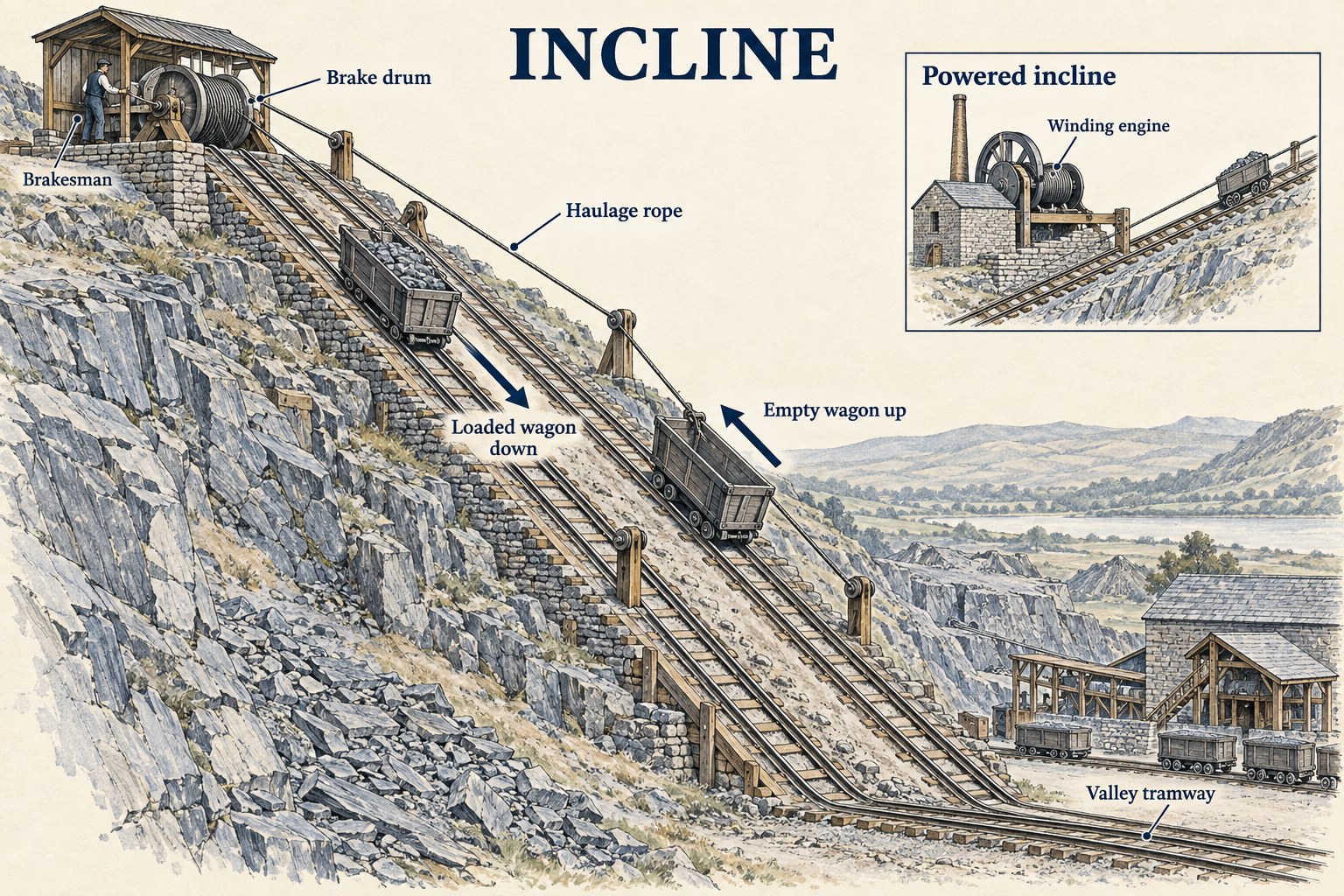
Rail track was laid at a fixed, often steep gradient, and wagons or skips ran on it connected by a continuous rope to a winding drum or, on a self-acting or gravity incline, simply to each other — a loaded wagon descending under its own weight hauled an empty wagon back up on a parallel track, needing no external power at all beyond gravity and a brakesman to control the speed. Powered inclines instead used a steam, and later electric, winding engine at the top or bottom to haul wagons in both directions.
Why it was used
An incline let a mine or quarry move heavy, bulky material — ore, coal, slate, waste rock — over a change in level far more cheaply than building a full vertical shaft and winder would have cost, particularly useful for connecting underground or hillside workings to a valley-floor railway, tramway or processing site, and self-acting gravity inclines needed no fuel at all for the descending, laden side of the run.
Risks & limitations
An incline's wagons relied entirely on the rope, its attachment and its braking system remaining sound — a broken rope or a runaway wagon on a steep gradient was a serious, sometimes fatal hazard, as the 1863 shaft accident at Botallack demonstrates, where a carriage ran back down an incline out of control after its safety mechanism failed.
Regional variation
Welsh slate quarries in particular relied on extensive networks of inclines to move slate and waste between terraces and down to valley railways — Oakeley Quarry's incline down to the Ffestiniog Railway and Dinorwig's Vivian Transporter Incline of 1873 are both well-documented examples of the type.
Related terminology
Blondin, Cuddie Brae, Decline, Drumhouse, Endless Rope Haulage, Journey, Man-riding, Putter, Terrace
Mines associated with this term
5 examples chosen from 158 linked records — the term page is not an index.
- Auchenharvie Colliery — North Ayrshire (well documented example)
Named twice in this record, first in the workings: “…workings ran 600 yards north of No. 4 Pit and were reached by two self-acting inclines — locally called cousies — the first at 1 in 6 and the second at 1…” - De Lank Quarries — Cornwall (well documented example)
Named 7 times in this record, first in the history: “…over several fields before dropping to the quarry down a rope-worked incline. Wagons were hauled by horses at first and, between 1926 and 1950,…” - Eckington Mine — Derbyshire (well documented example)
Named in this record’s current condition: “…in from the entrances, and foamed concrete was then pumped into the inclines, resting against the walls because of the steep angle; some 80…” - Flockton Collieries — West Yorkshire (well documented example)
Named twice in this record, first in the history: “…navigation at Horbury Bridge, worked by horses with a self-acting incline on the steep section north from Middlestown. It ran over a…” - Graig Ddu Quarry — Gwynedd (well documented example)
Named twice in this record, first in the history: “…and once the Festiniog and Blaenau Railway opened in 1868 a fourth incline was added, connecting in late 1869 to give the quarry a proper rail…”
Disasters associated with this term
5 examples chosen from 20 linked records, most direct relationship first.
- Botallack Mine shaft accident (contributing factor)
The accident involved a carriage running back down an incline out of control after its safety mechanism failed. - Abercynon Colliery Haulage Accident, 1906 (contextual relationship)
Named twice in this record, first in the cause: “A journey of twenty-four full trams of coal ran away down the incline into the men gathered at the pit bottom.” - Auchenharvie Colliery inrush, 1895 (contextual relationship)
The inclines were the route the water took — it burst into the rise and swept down them to the pit bottom — and a thirteen-year-old working at the head of the first incline was among those never found. - Baddesley Colliery Explosion (contextual relationship)
The deep workings lay at the foot of an incline falling 1 in 3 in places, and it was the water hauled up it in leaking wooden tubs that made a pumping arrangement — and its boiler — necessary at all. - Bentley Colliery manrider derailment, 1978 (contextual relationship)
Named 3 times in this record, first in the summary: “…train carrying 65 miners derailed after running away down an incline at Bentley Colliery on 21 November 1978, killing seven men and…”
Sources
- (primary) Glossary of Scotch Mining Terms — James Barrowman (1886), via Scottish Mining Website
- (secondary) Flatrod system — Wikipedia
- (secondary) Katoomba Colliery – Coal skips to passenger skips — Blue Mountains Historical Society
Record created: 22 August 2026 · Last researched: 10 September 2026