 MineArchive
Decline
| Category | Mine Workings & Access |
|---|
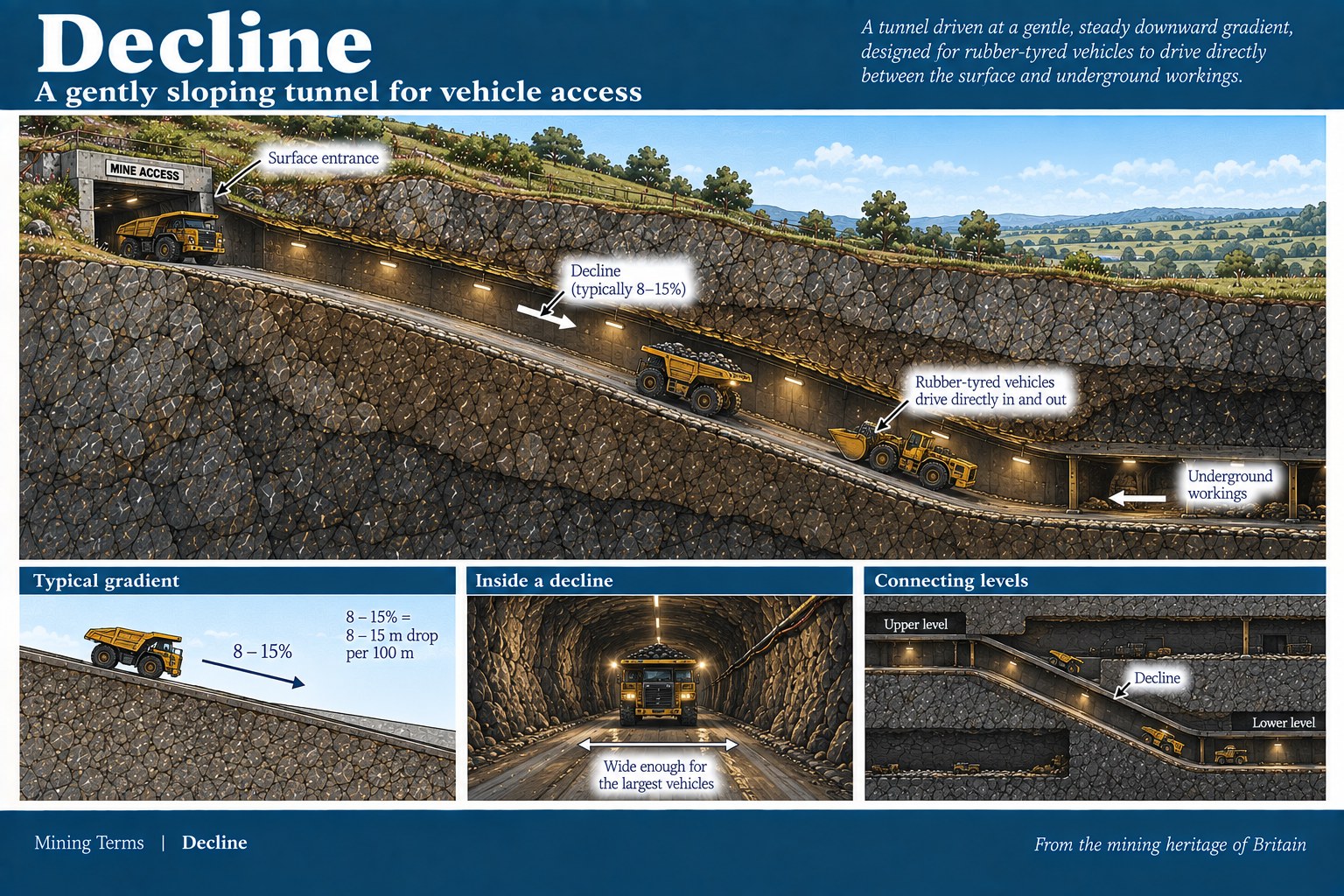
A tunnel driven at a gentle, steady downward gradient from the surface, or between underground levels, sized and graded for rubber-tyred vehicles to drive directly in and out — the modern, vehicle-based counterpart to the older, rope-hauled Incline, and an alternative to a vertical Shaft.
Historical usage
A recent development in mine access relative to the archive's usual period: declines became the standard way to open a new hard-rock mine only once diesel-powered, rubber-tyred loaders and trucks became practical underground, from the mid-to-later 20th century onward, and remain the normal choice for a new mine (or a modern reopening of an old one) today, in preference to sinking a new shaft where the ground allows it.
How it worked
Driven downward at a steady gradient — typically in the region of 8-15% — wide enough for the largest vehicle expected to use it, a decline lets trucks, loaders and drill rigs drive directly between the surface and the working levels, rather than being lowered down a shaft or hauled up an incline by rope. Comparative teaching material on mine access notes that a shaft costs roughly three times as much to construct as a decline (a 'slope', in some terminology) for a given depth, but that the decline's own tunnelling footage runs to roughly three times the shaft's in return, and that fitting large machinery down a shaft is far harder than simply driving it down a decline.
Why it was used
A decline lets ore, waste, equipment and people all move on wheels rather than being wound, avoiding the fixed load and headroom limits of a shaft cage, and it can double as a ventilation and services route for power and water lines. It suits shallow-to-moderate-depth mines particularly well, and is the access method Cornish Metals is currently using in South Crofty's redevelopment, where a 300-metre decline gives access to the upper workings alongside the mine's four older shafts.
Risks & limitations
A decline cannot easily support the continuous belt or rail haulage a shaft or a rope-hauled incline can, so at greater depth or higher tonnage a shaft usually becomes the more efficient choice again — declines suit shallower, vehicle-based operations rather than being a universal replacement for a shaft.
Regional variation
Called a ramp in Australia, Canada and parts of the United States for the same thing. Britain has few declines in the strict sense, because it has few modern underground mines to put them in, and the largest recent piece of inclined underground access here is not one. The mineral transport tunnel being driven from Woodsmith Mine on the North York Moors to Wilton on Teesside runs 36.7 km and falls at gradients between about 3.5 and 0.9 per cent, which is decline gradient, but it was built to carry a conveyor rather than vehicles and the mine itself is entered by shafts. It is a useful reminder that a gently graded tunnel is not automatically a decline: the defining feature is that rubber-tyred vehicles drive in and out of it.
Related terminology
Mines associated with this term
Included only where MineArchive's own research gives a reasonable evidential basis — not every mine where this might plausibly apply.
- Wollaton Colliery — Nottinghamshire (well documented example)
Named in this record’s history: “…in 1900, and remained above a thousand until the First World War. Decline was long and steady: 904 in 1923, 700 in 1933, 380 in 1940 and, at…” - Rainford Colliery — Merseyside (well documented example)
Named in this record’s history: “…1 and 2 employed 455, working the Arley, Rushy Park and Seven Feet. Decline followed the 1926 strike, and the colliery closed around 1928-29. A…” - South Crofty — Cornwall (well documented example)
Named in this record’s surface remains: “…controls four usable shafts in total, along with a 300-metre decline giving access to the upper workings.”
Sources
- (secondary) Lesson 10.1: Orebody Access — Penn State, MNG 230: An Introduction to Mining Engineering
- (secondary) Mining terms explained, A to Z: Decline tunnel — Anglo American
- (secondary) Woodsmith Mine Tunnel — Wikipedia
Record created: 27 August 2026 · Last researched: 9 September 2026