 MineArchive
South Crofty
| Location | Pool, Camborne, Cornwall — 50.2227, -5.2746 (exact) |
|---|---|
| Commodities | Tin, Copper |
| Type | Metal |
| Worked | 1592–1998 |
| Maximum depth | workings extend to around 3,000 ft (about 910 m) |
| Operators | South Crofty Limited (1906–1982), Cornish Metals Inc (2016–?) |
Overview
South Crofty, at Pool near Camborne, was Europe's last working tin mine when it closed in 1998 — not because its ore had run out, but because world tin prices had collapsed. Unlike most of Cornwall's mines, it was never sealed and abandoned, and its owner is now working toward reopening it as a producing mine once again.
History
Mining evidence at the site dates to 1592, with full-scale working under way by the mid-17th century; the mine was originally known as Penhellick Vean before later consolidation with neighbouring workings under the South Crofty name. Francis Bassett obtained the lease in 1710 and began driving a drainage adit. The mine worked chiefly for copper through the early 19th century — as East Wheal Crofty from 1822 to 1833 — before shifting to tin as its main product from the 1860s and 1870s. Production was interrupted in 1896 when the mine was suspended and allowed to flood, but it reopened in 1899 and absorbed the neighbouring New Cooks Kitchen mine. South Crofty Limited was incorporated in 1906, and the mine went on to absorb the historic Dolcoath mine in 1936. Output grew steadily through the 20th century, passing 92,000 tons of ore a year by 1959 and 100,000 tons by 1968.
The collapse of the International Tin Agreement in October 1985 sent world tin prices into freefall, and the mine passed through Charter Consolidated and Rio Tinto Zinc ownership before its mill was progressively shut down from 1988, with ore sent instead to Wheal Jane for processing. Closure was announced in August 1997 and the mine finally closed in March 1998, ending some 400 years of recorded mining on the site — Europe's last primary tin mine.
Geology
The mine's workings extend across roughly 40 tin- and copper-bearing lodes beneath Camborne and Pool, reaching depths of around 3,000 ft (roughly 910 m) and spanning nearly 2.5 miles laterally.
Geological setting: Hydrothermal Deposits (well documented example), Veins and Lodes (well documented example)
Workings
Because tin prices, not ore exhaustion, forced closure in 1998, the underground workings were deliberately left unsealed rather than being abandoned outright — a decision that later proved central to reopening plans, since flooded and sealed mines are far more costly to bring back into production.
Closure
The mine closed in March 1998 after a sustained fall in world tin prices, following the October 1985 collapse of the International Tin Agreement, made continued extraction uneconomic.
What remains
A succession of companies have pursued reopening since South Crofty's 1998 closure: Baseresult Holdings bought the site in 2001; Western United Mines, formed in 2007, forecast £50 million of investment and a reopening by the end of 2009, a target that passed unmet. Strongbow Exploration (renamed Cornish Metals Inc in 2020) acquired the site from administration in March 2016, received a dewatering permit from the UK Environment Agency in October 2017, and commissioned a water treatment plant in October 2023, with active dewatering beginning that November. Cornish Metals now holds a mining licence valid until 2071.
By early 2026, dewatering had reached 370 metres, on track toward the 400-level (roughly 730 metres below surface) in the first half of 2027; refurbishment of the New Cook's Kitchen shaft's mid-level pump station, around 360 metres down, was well advanced, with old pumps, pipes and steelwork removed and new permanent pumps being installed. On the surface, Phase 1 of the Mine Dry's refurbishment (changing rooms and canteen) was completed in October 2025, with Phase 2 expected in early 2026; pre-production development at the 290-level was expected to begin in late 2026. In January 2025 the UK government announced £28.6 million of investment to support the reopening; company updates have since given target production dates ranging from 2027 to mid-2028, reflecting the project's still-evolving financing and construction timeline rather than a single settled date. UNESCO called for a halt to reopening work in November 2012 pending an impact assessment, given the site's location within the Cornwall and West Devon Mining Landscape World Heritage Site.
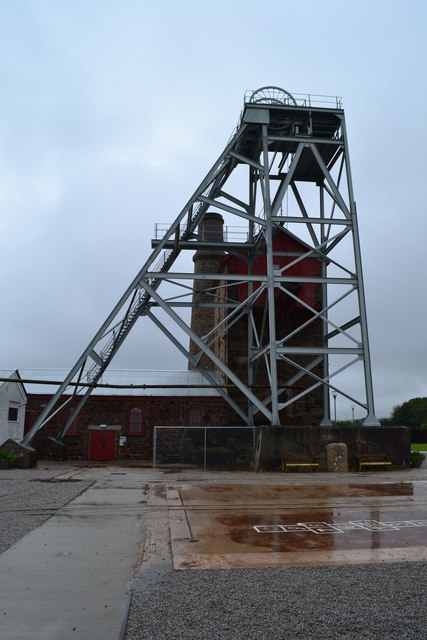
Robinson's Shaft itself, part of the surface site since the 1990s, later became the centrepiece of Heartlands, a National Lottery-funded visitor attraction and 'World Heritage Site Gateway' that opened in April 2012 after 14 years of planning; persistent low visitor numbers forced years of restructuring, and Heartlands closed on 28 February 2024, its trust wound up that April and its assets sold. Cornwall Council now controls the 19-acre park, where a Saturday parkrun continues; some independent shops on the site remained open as of April 2024.
Robinson's Shaft, sunk vertically below the 265-fathom level between 1900 and 1912 for pumping, reached around 2,060 feet before being abandoned on safety grounds in 1996, after movement was detected in a 'tooth' of rock between two stopes next to the shaft; its surviving winding house, chimney and other engine-house buildings, including a pumping engine installed in 1903, form part of the wider surface site. The New Cook's Kitchen Shaft, which replaced Robinson's as the mine's primary access from 1996, reached 2,523 feet by the time of the 1998 closure; Cornish Metals' current redevelopment controls four usable shafts in total, along with a 300-metre decline giving access to the upper workings.
Redevelopment
An active reopening programme is under way, targeting commercial tin production around 2028 and, if successful, an estimated 300 direct jobs plus wider regional economic benefit.
Related mines
- Cook's Kitchen Mine — South Crofty sank the New Cook's Kitchen shaft from 1907 on the northern half of the old Cook's Kitchen sett, and works it still.
- Dolcoath Mine — South Crofty absorbed the historic Dolcoath mine in 1936.
- East Pool Mine — South Crofty took over its neighbour East Pool and closed it in 1945.
- Mount Wellington Mine — Operated as part of a single integrated mining unit with Wheal Jane under RTZ management from 1984.
- Tregurtha Downs Mine — Tregurtha Downs' 80-inch pumping engine, designed by Samuel Grose and built at the Copperhouse Foundry, was moved on to South Crofty in 1903 and was still extant when this engine house was listed in 1987.
- Wheal Harmony — Wheal Harmony followed the same Wheal Tolgus main lode worked at much greater scale by South Crofty and East Pool.
- Wheal Jane — South Crofty's ore was sent to Wheal Jane for processing once its own mill was progressively shut down from 1988.
Nearby mines
- Carn Brea Mine — 0.2 miles (0.3 km) SW
- Tincroft Mine — 0.3 miles (0.5 km) SW
- Cook's Kitchen Mine — 0.5 miles (0.7 km) SW
- Dolcoath Mine — 0.5 miles (0.7 km) SW
- Wheal Buller — 0.6 miles (0.9 km) E
Straight-line distance, within 9 miles (15 km). Show on the map.
What's uncertain
Points where sources disagree or the record could not be settled; both accounts are kept. All open questions in the archive.
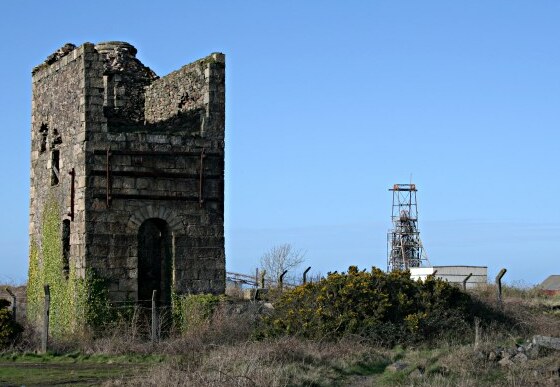
- A 2008 report on Robinson's Shaft describes the winding house as roofless and deteriorating despite being otherwise complete, and the bathhouse as retaining period fittings including a lamp rack, 1970s safety posters and showers. (uncertain) 3
Recorded claims
Individual factual claims, each attached to the source(s) that support it below. Where sources disagree, both are kept.
- South Crofty closed in March 1998 because tin prices had collapsed, not because the ore had run out; the underground workings were deliberately left unsealed rather than abandoned. 1
- In January 2025 the UK government announced £28.6 million of investment supporting the mine's reopening, with commercial tin production currently targeted for around 2028. 2
- A 2008 report on Robinson's Shaft describes the winding house as roofless and deteriorating despite being otherwise complete, and the bathhouse as retaining period fittings including a lamp rack, 1970s safety posters and showers. (uncertain) 3
- Baseresult Holdings bought South Crofty in 2001 to pursue reopening; Western United Mines, formed in 2007, forecast £50 million of investment and a reopening by the end of 2009, a target that passed unmet. 1
- Robinson's Shaft became the centrepiece of Heartlands, a National Lottery-funded visitor attraction that opened in April 2012; persistent low visitor numbers forced years of restructuring, and Heartlands closed on 28 February 2024, with Cornwall Council now controlling the 19-acre park. 4
- Robinson's Shaft, reaching around 2,060 feet, was abandoned on safety grounds in 1996 after movement was detected in a 'tooth' of rock between two stopes next to the shaft; the New Cook's Kitchen Shaft, which replaced it as primary access, reached 2,523 feet by the 1998 closure. 5
- By early 2026, dewatering had reached 370 metres, on track toward the 400-level around 730 metres below surface in the first half of 2027, alongside advanced refurbishment of the New Cook's Kitchen shaft's mid-level pump station and, on the surface, completion of Phase 1 of the Mine Dry's refurbishment in October 2025. 6
- Cornish Metals holds a mining licence for the site valid until 2071, and controls four usable shafts along with a 300-metre decline giving access to the upper workings. 5
Photographs & further reading
An extensive historic and modern photographic archive of the mine.
View sourceFurther freely-licensed photographs of Robinson's Shaft and the surviving surface buildings.
View sourceA 2008 report on Robinson's Shaft, covering the engine hall, headgear, winding house and the bathhouse (“dry”), noting the rare survival of three winding wheels on the headgear.
View sourceSources
- (secondary) South Crofty — Wikipedia
- (secondary) South Crofty tin mine restart: Cornwall's path to 2028 production — Discovery Alert
- (observational) South Crofty, Robinson's Shaft — 28DaysLater
- (secondary) Heartlands Cornwall — Wikipedia
- (observational) Deep Mine Headstocks, Part 2: Wales & Cornwall, 2022-23 — 28DaysLater
- (secondary) Cornish nears investment decision as South Crofty early works takes shape — Mining Weekly
Record created: 19 August 2026 · Last researched: 27 August 2026