 MineArchive
Wheal Jane
| Location | Baldhu, near Chacewater, Cornwall — 50.2420, -5.1264 (exact) |
|---|---|
| Commodities | Tin, Arsenic, Copper, Lead, Silver, Zinc |
| Type | Metal |
| Worked | 1861–1991 |
| Operators | Falmouth Consolidated (1906–?), Rio Tinto Zinc (1969–1991), Carnon Consolidated Tin Mines Ltd |
Overview
Wheal Jane, near Chacewater, was one of Cornwall's last major working tin mines, closing in 1991 — and the site of a major mine-water pollution incident the following year (see Disasters, below).
History
Individual workings on the site date back to the mid-18th century; Wheal Jane itself was formed in 1861 through the amalgamation of five smaller mines. The mine was reworked in 1906 as part of Falmouth Consolidated, and again from 1969 in a major modern redevelopment that eventually brought it under the ownership of Rio Tinto Zinc. Through the 1970s and 1980s the mine produced tin, alongside copper and zinc as by-products — tin output peaked at 4,828 tons in 1987, zinc at 10,855 tons in 1981, and copper at 945 tons in 1990. Employment peaked at 1,061 workers in 1985 before falling sharply to 216 by 1991, the year underground operations finally ceased as tin prices collapsed.
Geology
The mine worked polymetallic lodes in the Carnon Valley producing tin, copper, lead, silver and zinc, alongside pyrite and arsenopyrite as associated minerals.
Geological setting: Veins and Lodes (well documented example)
Workings
Modern underground workings dated mainly from the 1969 redevelopment onward, though the site incorporated much older workings from the mid-18th century amalgamated mines.
Closure
Underground mining ceased in 1991 as falling tin prices made the operation uneconomic, ending regular pumping of the workings.
What remains
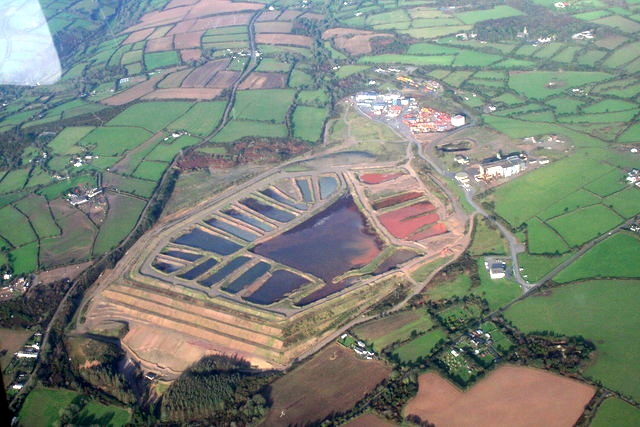
Little remains of the working mine above ground. What stands on the site now is the infrastructure built to deal with what the mine left behind — the treatment plant, settling ponds and the Clemows Valley Tailings Dam — together with the buildings of the business park that has grown up around them.
Redevelopment
Emergency and then permanent treatment measures were developed from 1992 onward. Settling ponds, including the Clemows Valley Tailings Dam, were in place by 1994, and a lime-dosing plant was built to precipitate dissolved metals before water is released (see Disasters, below, for cost and regulatory detail). The plant still runs continuously, now on a High Density Sludge process, operated by John F Hunt Regeneration for the Mining Remediation Authority and funded by DEFRA; in an average year it treats around 5.6 million cubic metres of water and takes out some 430 tonnes of metals. The wider 170-acre site has been redeveloped in parallel as the Wheal Jane Earth Science Park, a cluster of specialist businesses run by the Wheal Jane Group, which also maintains the 114-acre tailings dam.
Related mines
- Mount Wellington Mine — Reopened in 1979 as a satellite operation of Wheal Jane, and later run as a single integrated unit with it under RTZ management.
- Nangiles Mine — Nangiles' own drainage adit was the exact point through which Wheal Jane's flooded workings released their notorious 1992 acid mine water discharge.
- South Crofty — South Crofty's ore was sent to Wheal Jane for processing once its own mill was progressively shut down from 1988.
- Wheal Maid — Tailings from Wheal Jane and neighbouring Mount Wellington were stored in the shared Wheal Maid lagoons.
Nearby mines
- Nangiles Mine — 0.6 miles (1.0 km) SW
- Great County Adit — 0.8 miles (1.3 km) SW
- Mount Wellington Mine — 1.0 miles (1.5 km) SW
- Cusvey Mine — 1.1 miles (1.7 km) SW
- Consolidated Mines — 1.7 miles (2.7 km) W
Straight-line distance, within 9 miles (15 km). Show on the map.
Disasters & major incidents
-
Wheal Jane acid mine water discharge, 1992
13 January 1992 · Flooding / Inundation · 0 fatalities
An estimated 50,000 m³ of acidic mine water burst from the flooding, abandoned Wheal Jane workings and turned the Carnon River and Fal estuary ochre-yellow — one of the most notorious mine-water pollution incidents in British history, and one still being actively treated more than three decades later.
What's uncertain
Points where sources disagree or the record could not be settled; both accounts are kept. All open questions in the archive.
- A January 2007 report describes an emergency light still on and a transformer still humming in the main processing building at Wheal Jane several years after closure, alongside catwalks, control panels and floors under one to three inches of red mine water. (uncertain) 2
Recorded claims
Individual factual claims, each attached to the source(s) that support it below. Where sources disagree, both are kept.
- Wheal Jane's recorded production peaked at 4,828 tons of tin in 1987, 10,855 tons of zinc in 1981, and 945 tons of copper in 1990. 1
- A January 2007 report describes an emergency light still on and a transformer still humming in the main processing building at Wheal Jane several years after closure, alongside catwalks, control panels and floors under one to three inches of red mine water. (uncertain) 2
- The Wheal Jane treatment plant runs continuously, using a High Density Sludge active treatment process on mine water from the historic tin and copper workings of central Cornwall. It is operated by John F Hunt Regeneration on behalf of the Mining Remediation Authority — the body formerly called the Coal Authority — and funded by DEFRA, under a contract awarded in 2021 for five years with an option to extend by five more. 3
- In an average year the scheme treats about 5,600,000 cubic metres of water and removes around 430 tonnes of metals, among them arsenic, cadmium, copper, iron, lead, manganese, mercury and zinc. 3
- The 170-acre Wheal Jane site now operates as an Earth Science Park, a cluster of specialist businesses managed by the Wheal Jane Group alongside its environmental obligations, chief among them the 114-acre Clemows Valley Tailings Dam. 4
- The BGS mine plans catalogue holds a run of Wheal Jane plans deposited by Carnon Consolidated Tin Mines Ltd, including a general plan of the mine and a plan of the Wheal Maid tailings dam. 5
Photographs & further reading
An academic environmental-science account of the site and its ongoing water treatment.
View sourceFurther freely-licensed photographs of the tailings dam and treatment works.
View sourceA January 2007 report inside the mine's main processing building, covering catwalks, control rooms and switchgear, with the surrounding pink/red tailings lakes formed after the mine's 1992 flood and pollution incident.
View sourceSources
- (secondary) Wheal Jane — Wikipedia
- (observational) Wheal Jane Mine, Baldhu, Cornwall — 13/01/07 — 28DaysLater
- (secondary) Wheal Jane: Operating and Optimising the UK's Flagship Mine Water Treatment Plant — Institution of Environmental Sciences
- (primary) About Wheal Jane — the Wheal Jane Group — Wheal Jane Ltd
- (primary) Wheal Jane mine plans (BGS catalogue MP23679, MP24967-MP24999) — British Geological Survey
- (primary) Wheal Jane Tin Mine: Pollution — Hansard, House of Lords
Record created: 19 August 2026 · Last researched: 28 August 2026