 MineArchive
Cusvey Mine
| Also known as | Coosvean Mine, Cuzveth Mine, Coosvea, Cuzveth |
|---|---|
| Location | Above Twelveheads, eastern end of Gwennap parish, Cornwall — 50.2345, -5.1472 (approximate) |
| Commodities | Copper, Tin |
| Type | Metal |
| Worked | 1734 (tin dues)–1870 |
| Maximum depth | 150 fathoms (Shear's Shaft) |
| Operators | John Taylor (1819–1857), Clifford Amalgamated Mines (?–1870) |
Overview
A Gwennap mine above Twelveheads, worked for tin in the 1730s and then for copper with its neighbour Wheal Fortune, which became part of John Taylor's Consolidated Mines in 1819. Its pumping engine house of about 1826 on Shear's Shaft is among the oldest in Cornwall.
History
Cusvey, also recorded as Coosvea, Coosvean and Cuzveth, lies at the eastern end of Gwennap parish immediately north-east of Wheal Fortune, and for most of their lives the two setts were worked together. Tin dues for 'Cuzveth' were paid to the Manor of Cusgarne between 1734 and 1764, probably from the Bread and Cheese Lode shown on a plan of Cusgarne Common of about 1780 along Cusvey's southern side. By 1790 Wheal Fortune had become an important copper producer with the Cusvey lodes a significant part of it, and by the end of the 1790s the two were making considerable profits. Idle when Richard Thomas reported on them in 1819, the setts were then taken into John Taylor's Consolidated Mines, soon to be the largest copper producer in the world; Thomas's plan of 1821 shows Coosvea Lode just south of Coosvea Shaft and Coosvea East Shaft, both worked by horse whims and drained by Wheal Fortune's pumps. In 1826 a 70-inch pumping engine was placed on Shear's Shaft at Cusvey, later replaced by a 65-inch, and its engine house, beside a winding engine house that is older still, is one of the oldest in Cornwall. Cusvey closed again in 1857 and, as the group passed to United Mines and finally Clifford Amalgamated, played a diminishing part until the whole group closed in 1870, when its engines and machinery were sold or scrapped. Its engine houses and stack above Twelveheads were consolidated in 2009 as part of the Mineral Tramways trail.
Geology
Tin at first, probably from the Bread and Cheese Lode on the southern side of the sett, then copper from Coosvea Lode and the other lodes worked with Wheal Fortune.
Geological setting: Veins and Lodes (well documented example)
Workings
Coosvea Shaft and Coosvea East Shaft with horse whims (1821), drained by Wheal Fortune's pumps; from 1826 Shear's Shaft, 150 fathoms deep, pumped by a 70-inch and later a 65-inch engine, and an east shaft of 100 fathoms worked by a whim engine. A calciner burned off arsenic.
Closure
Closed in 1857, then worked as a minor part of United Mines and Clifford Amalgamated until the whole group closed in 1870, when Wheal Fortune and Cusvey had their engines and machinery sold or scrapped. The Wheal Jane group explored around the site in the late 20th century.
What remains
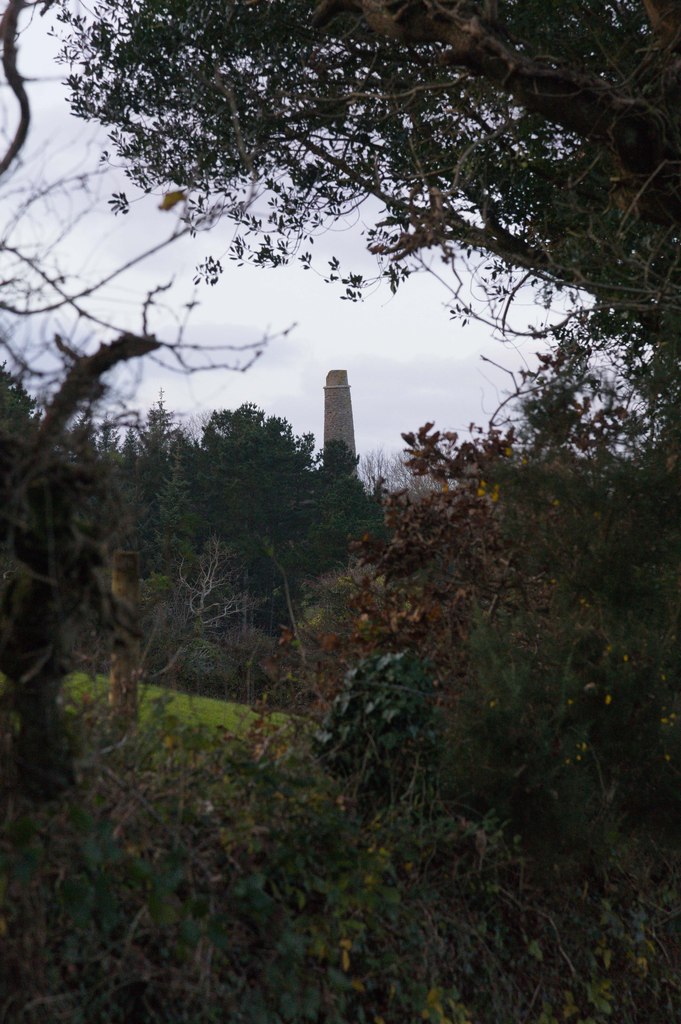
The pumping engine house, the older winding engine house and a single stack stand above Twelveheads, consolidated in 2009 as part of the Mineral Tramways trail; the whim engine house and calciner flue are overgrown (photographed 2023).
Shear's pumping engine house (c. 1826), the earlier whim engine house with its beam inside the house, a chimney of about 1826 serving both, and remains of the calciner flue.
Related mines
- Consolidated Mines — Cusvey was incorporated into John Taylor's Consolidated Mines from 1819 and later worked with the group under United Mines and Clifford Amalgamated.
Nearby mines
- Mount Wellington Mine — 0.2 km E
- Nangiles Mine — 0.8 km E
- Consolidated Mines — 1.1 km W
- Wheal Clifford — 1.1 km W
- Wheal Squire — 1.3 km W
Straight-line distance, within 15 km. Show on the map.
People
- John Taylor · proprietor, 1819–1857 — via the operator record
- Richard Thomas · surveyor, 1819–1821 — Reported on Wheal Fortune and Cusvey in 1819 and drew the 1821 plan of Consolidated Mines.
Recorded claims
Individual factual claims, each attached to the source(s) that support it below. Where sources disagree, both are kept.
- Tin dues for Cusvey ('Cuzveth') were paid to the Manor of Cusgarne between 1734 and 1764; a plan of about 1780 shows the Bread and Cheese Lode along the southern side of Cusvey. 1,2
- In 1819 Richard Thomas reported that Wheal Fortune and Cusvey, though idle, had made considerable profits; the setts were then incorporated into John Taylor's Consolidated Mines. 1,2
- Thomas's 1821 plan of Consolidated Mines shows Coosvea Lode just south of Coosvea Shaft and Coosvea East Shaft, both with horse whims and no pumping engine, the workings drained by Wheal Fortune's pumps. 1
- In 1826 a 70-inch pumping engine was placed on Shear's Shaft at Cusvey, later replaced by a 65-inch; the engine house is one of the oldest in Cornwall, though younger than the whim engine house. 1,2
- Cusvey closed again in 1857, later became part of Clifford Amalgamated, and closed finally in 1870. 1,2
- Shear's Shaft reached 150 fathoms and the east shaft 100 fathoms. 2
- The stack of Cusvey Mine was photographed from the track in November 2023. 3
Photographs & further reading
Tin dues from 1734, Consolidated Mines and the 1826 engine on Shear's Shaft.
View sourceThe two engine houses, the stack, shaft depths and the calciner flue, with references.
View sourceSources
- (secondary) Cusvey Mine — Cornwall Calling
- (secondary) Cusvey Mine — Explore Cornwall
- (observational) View to Cusvey Mine (Geograph photo 7658233, Elizabeth Scott, 2023) — Geograph Britain and Ireland
Record created: 18 September 2026 · Last researched: 19 September 2026