 MineArchive
Calciner
| Category | Ore Processing |
|---|
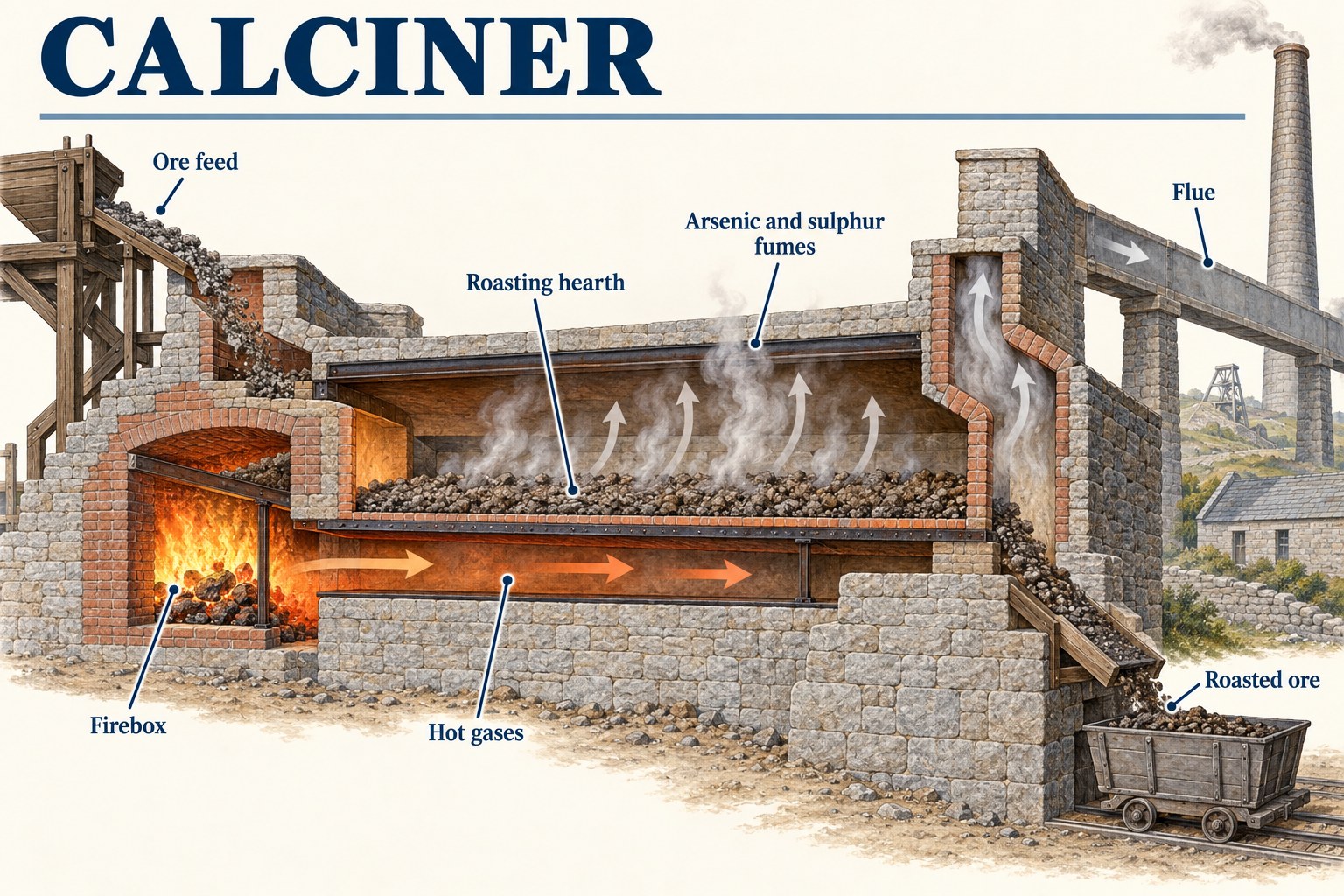
A furnace used to roast ore at high temperature, driving off impurities as gas — in Cornwall, most often used to burn arsenic and sulphur out of tin ore, and to recover the arsenic itself as a saleable by-product.
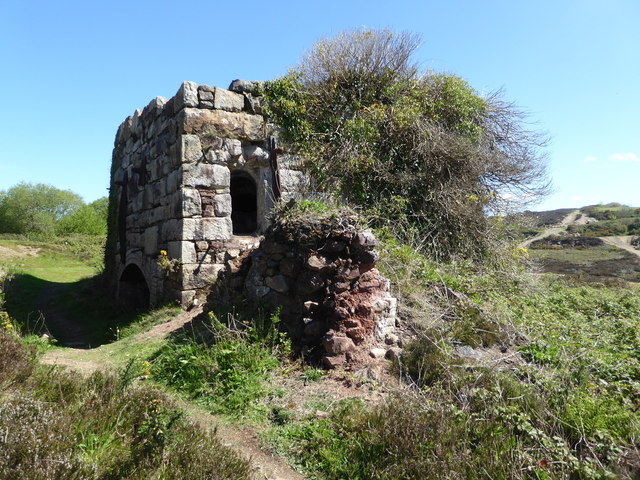
Historical usage
Calciners became a standard part of Cornish tin processing through the 19th century, as tin ore increasingly needed roasting to remove the arsenic and sulphur that made smelted tin brittle and less valuable. Recovering that arsenic rather than simply venting it became commercially worthwhile as industrial and agricultural demand for arsenic grew, turning a waste problem into a genuine by-product industry at many Cornish mines.
How it worked
Ore was roasted in the calciner at temperatures up to around 600°C, driving off arsenic and sulphur as gas. Where the arsenic was wanted, the hot gas was drawn through a long, zig-zagging brick flue known as a 'labyrinth', cooling as it went; arsenic condensed out along the flue walls as a grey-white crust, which was scraped off by hand, while a tall chimney at the flue's end kept a strong draught through the whole system.
Why it was used
Roasting was the only practical way to remove arsenic and sulphur contamination from tin ore before smelting, and — once a market for arsenic existed — the same process let a mine turn a troublesome impurity into a second saleable commodity rather than simply venting it as waste.
Risks & limitations
Calciners were commonly worked by women and girls, protected from the arsenic fumes by little more than cotton wool in the nostrils and clay smeared on the skin; scraping condensed arsenic from the labyrinth walls by hand was a direct, repeated exposure to a highly toxic substance, and the areas around calciners still show localised, severe soil contamination from arsenic processing today.
Regional variation
Calciners and their labyrinths are a distinctively Cornish and west Devon feature, tied directly to the region's 19th-century arsenic industry — Botallack, Wheal Busy and Tolgus are among the sites where calciner and labyrinth remains still stand.
Related terminology
Chalcopyrite, Lime Kiln, Smelt Mill, Smelt Mill Flue
Mines associated with this term
5 examples chosen from 12 linked records — the term page is not an index.
- Botallack Mine — Cornwall (surviving physical example)
The Arsenic Labyrinth at Botallack is one of the best-preserved calciner flue systems in Cornwall. - Wheal Busy — Cornwall (well documented example)
Named 5 times in this record, first in the summary: “…life a century and a half later roasting arsenic, and the Brunton calciner that did it still stands to roof level.” - Gawton Mine — Devon (well documented example)
Named 4 times in this record, first in the summary: “…complex of its type in the country, with two rare surviving Brunton calciners and the longest, most impressive arsenic flue in England, ending in…” - Wheal Friendship — Devon (well documented example)
Named twice in this record, first in the workings: “…the 1870s the mine was transformed again by the arsenic works: large calciners roasted the ore, and condensing chambers and flues, connected by an…” - Cusvey Mine — Cornwall (well documented example)
Named 3 times in this record, first in the workings: “…engine, and an east shaft of 100 fathoms worked by a whim engine. A calciner burned off arsenic.”
Sources
- (secondary) Extracting Arsenic — Cornish Mining World Heritage Site
- (secondary) Secondary mineral phases associated with a historic arsenic calciner — ScienceDirect
Record created: 22 August 2026 · Last researched: 22 August 2026