 MineArchive
Smelt Mill Flue
| Also known as | Condenser flue, Smelt mill chimney (the chimney at the flue head, often all that survives) |
|---|---|
| Category | Structures & Machinery |
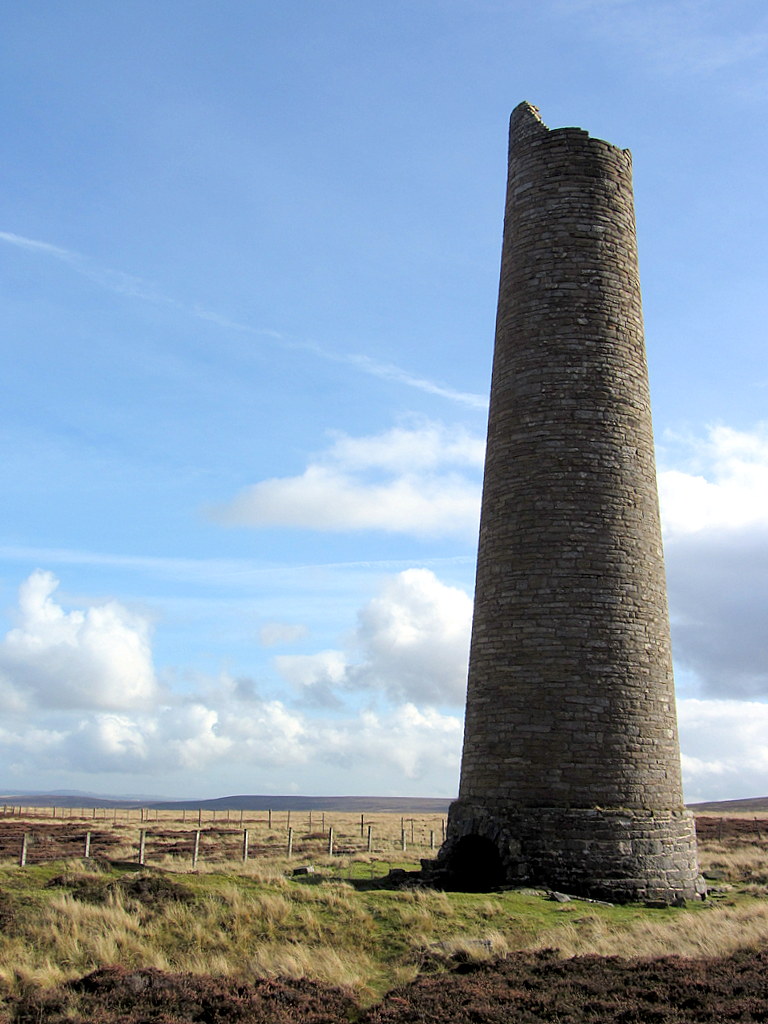
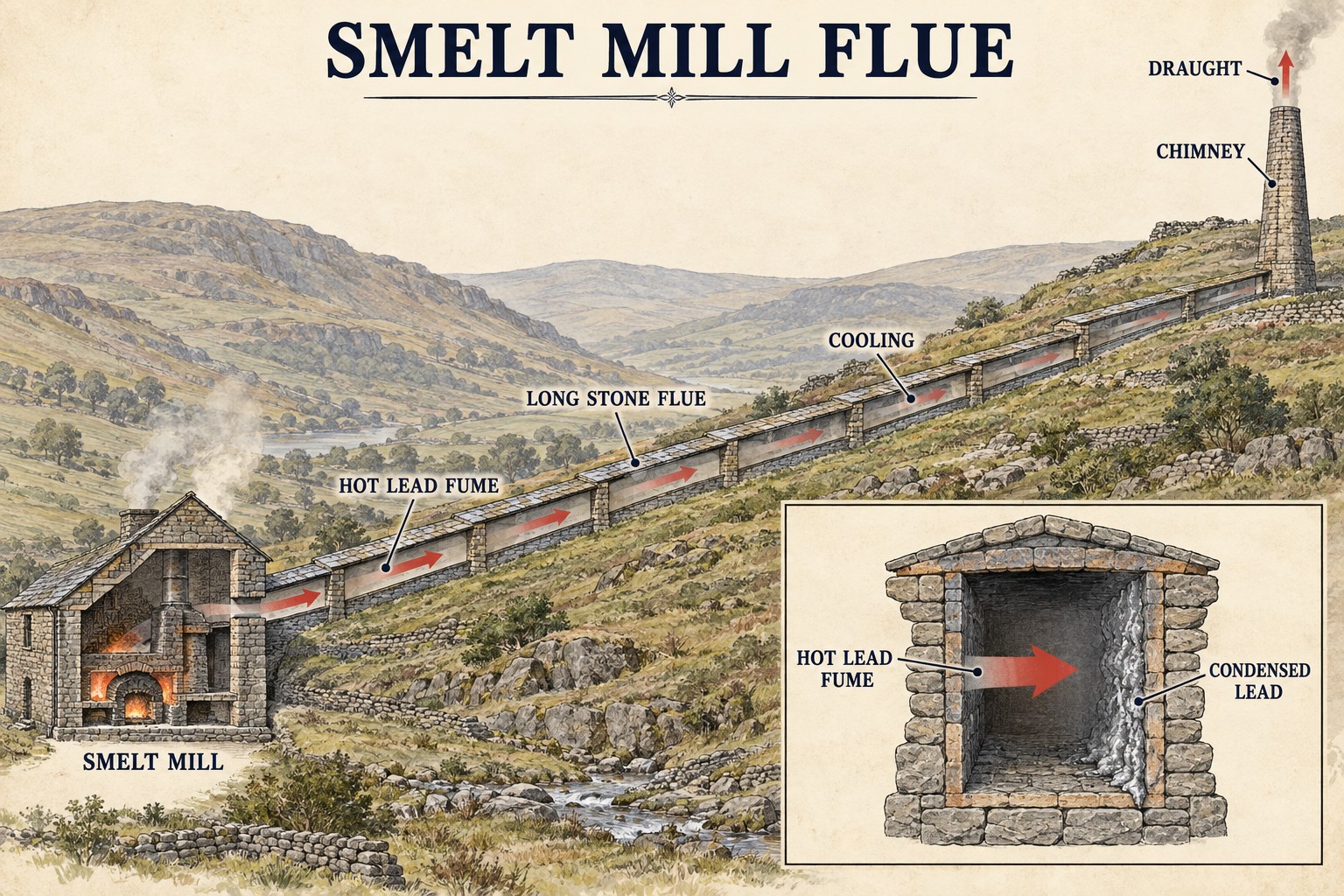
A long stone flue running from a lead smelt mill up the hillside behind it to a chimney, built to take the poisonous fume away from the men at the hearths — and, just as importantly, to let the lead carried in that fume cool and settle on the flue walls, where it could be scraped off and smelted again.
Historical usage
Early mills made do with a short horizontal flue and a chimney. Nineteenth-century mills built systems on an entirely different scale: commonly up to a kilometre, and in the largest cases several miles of flue. Nenthead's ran about 1.1 km to its chimney and survives as two parallel banks of rubble; Grassington Moor is still dominated by the flue and chimney of its Cupola mill; Old Gang, Surrender, Alport and Blakethwaite all had them, and Alport's system was reckoned among the best developed anywhere in the Peak. Where fume was not taken away it caused trouble: at Braithwaite in Bishopdale the smoke was blamed for killing farm animals in the fields around, and in 1747 local men encouraged a boy to set the mill alight.
How it worked
Fume left the ore hearths and was drawn along the flue by the draught of the chimney at the top. As it travelled it cooled, and vaporised lead condensed on the flue walls as a grey crust. Periodically the flue was taken out of use and cleaned: the crust was scraped off and returned to the mill to be smelted again, so the flue was a piece of processing plant as much as a chimney. Because the flues were low and narrow, boys were sent inside to do the scraping. Some works went further — Nenthead added a Stagg condenser in 1843, driven by a waterwheel, which precipitated lead oxide in water.
Why it was used
Two reasons at once, and the money was the stronger of them. A long flue recovered lead that would otherwise have gone up the chimney and been lost, and it moved sulphur dioxide and lead vapour away from the mill floor and, with luck, from the farmland immediately around it.
Risks & limitations
Cleaning a flue is one of the worst jobs the lead industry produced: children working in a confined space thick with lead dust, for the sake of the material they were scraping up. Almost every surviving flue carries a story of boys sent up it or men trapped inside. The lead did not go away either — flue lines and the ground around them remain contaminated, which is part of why so many are now scheduled rather than cleared.
Regional variation
A North Pennines and Yorkshire Dales signature above all — Allendale, Nenthead, Grassington, Swaledale — where the hillsides allowed a long climb to a chimney on the skyline. Not to be confused with the Cornish arsenic flue, which condensed arsenic from a calciner as a saleable product in its own right.
Related terminology
Arsenic Flue, Calciner, Lead, Ore Hearth, Smelt Mill, Spoil Heap
Mines associated with this term
5 examples chosen from 6 linked records — the term page is not an index.
- Blakethwaite Mine — North Yorkshire (surviving physical example)
Fumes from the two ore hearths were carried up a flue to a chimney on the crag above the mill. - Grassington Moor Mines — North Yorkshire (surviving physical example)
The site is dominated by the 1,600 m flue and chimney of its Cupola smelt mill. - Nenthead Mines — Cumbria (surviving physical example)
The smeltmill flue runs about 1.1 km south-east as two parallel banks of rubble to a collapsed chimney, with a rare 1843 Stagg condenser alongside. - Alport Mines — Derbyshire (well documented example)
Alport is reputed to have had one of the best-developed flue systems anywhere in the Peak District, the long flues catching lead carried off in the fume. - Lintzgarth Mine — County Durham (well documented example)
Named in this record’s current condition: “…which are visible on the fellside above the hamlet. The arch of the smelt-mill flue survives beside the Rookhope Burn and is a Grade II listed building,…”
Sources
- (primary) Lead mines, ore works and smeltmill at Nenthead, Alston Moor — scheduled monument — Historic England (via Ancient Monuments)
- (secondary) Lead mining in Wensleydale and Bishopdale — Yorkshire Dales National Park Authority
- (secondary) Processing Ore — The Smelt Mill — MyLearning / Yorkshire Dales museums
Record created: 25 August 2026 · Last researched: 25 August 2026