 MineArchive
Grassington Moor Mines
| Location | Grassington Moor, Yorkshire Dales, including the Yarnbury shallow-shaft workings and mine offices below the moor, North Yorkshire — 54.0975, -1.9625 (exact) |
|---|---|
| Commodities | Lead, Barite, Fluorspar |
| Type | Metal |
| Worked | 16th century–1880 |
| Operators | Duke of Devonshire (1792–1880) |
Overview
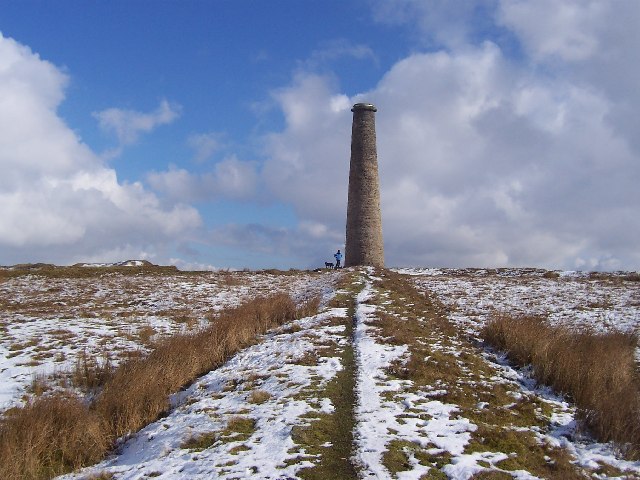
Grassington Moor, in the hills above Grassington in the Yorkshire Dales, was one of the most extensive lead-mining landscapes in northern England, worked from at least the 16th century to 1880 under the Duke of Devonshire, and dominated today by the 1,600m flue and chimney of its Cupola smelt mill.
History
Mining on Grassington Moor began on a small scale in the 16th century. By the early 19th century the Duke of Devonshire's Mineral Agents were exploiting the lead veins intensively, sinking deep shafts and putting water to ingenious use to power ore crushing, sorting, ventilation and the smelt mill's bellows. A Cupola smelt mill was built in 1792, with two coal-fired reverberatory (‘cupola’) furnaces, a roasting furnace and a slag hearth; between 1821 and 1861 the mines produced 20,273 tonnes of lead and employed around 170 people. To recover lead lost in waste gases, an elaborate flue nearly 1,600 metres long was built in the 1850s, with two brushwood-filled condensers along its course; workers periodically scraped and washed the flue out by hand — a dangerous and unpleasant job — channelling the recovered material to settling ponds above the mill. In 1849 the mill's original two chimneys were demolished and replaced by a single 18-metre chimney, which still stands at the end of the flue. Work at the mines on Grassington Moor stopped in May 1880. The spoil heaps were later reworked for barytes, fluorspar and residual lead, most intensively between 1916 and 1920 and again between 1956 and 1963. The moor's earliest lead extraction, however, predates all of this: at Yarnbury, a hamlet on the Duke's New Road below the moor, 17th- and 18th-century miners worked shallow shafts under the historic 'meer' system, allotting each miner a 30-yard block of vein with a buffer either side for spoil, ore-dressing and shelters. Yarnbury also became the mines' administrative centre: Yarnbury House, built in 1826 for the Duke of Devonshire's Mineral Agent, still stands there alongside Yarnbury Lodge, both now listed buildings.
Geology
The workings follow two main lead-bearing seams running roughly northwest to southeast across the moor.
Workings
Mine shafts, engine houses, ore-processing works, drainage channels and ropeways for distributing mechanical power survive across the moor; the powder house at Beever Mine, used for storing the gunpowder needed for deep shaft mining, survives nearly intact.
Closure
Unknown.
What remains
The chimney and much of the flue survive, having been repaired by the Earby Mines Research Group in 1966 and 1971; the site is a scheduled monument, and the locally run Grassington Mines Appreciation Group documents and maintains it, with Subterranea Britannica funding shaft-protection fencing and interpretive signage in 2021.
Related mines
- Beever Mine — Beever is one of the Yarnbury workings within the Grassington Moor complex, sharing its dams, leats and centralised dressing floors; Beever is named on the Grassington Moor record.
- Frankland Fold Mine — Frankland Fold is one of the named workings of the Grassington Moor lead field, under the Duke of Devonshire's lordship and drained by the Duke's Level.
Nearby mines
- Frankland Fold Mine — 0.4 miles (0.7 km) W
- Beever Mine — 1.7 miles (2.8 km) SW
- Red Scar Mine — 1.9 miles (3.0 km) E
- Swinden Quarry — 4.3 miles (6.9 km) SW
- Stony Grooves Mine — 4.6 miles (7.5 km) E
Straight-line distance, within 9 miles (15 km). Show on the map.
Recorded claims
Individual factual claims, each attached to the source(s) that support it below. Where sources disagree, both are kept.
- Between 1821 and 1861, the mines on Grassington Moor produced 20,273 tonnes of lead and employed around 170 people. 1
- The Cupola smelt mill, built in 1792, was linked to its 18-metre chimney by nearly 1,600 metres of flue, built in the 1850s to recover lead lost in waste gases via two brushwood-filled condensers. 2
- The mill's original two chimneys were demolished in 1849 and replaced by the single 18-metre chimney that still stands on Grassington Moor today. 2
- Following the Earby Mines Research Group's repairs to the chimney in 1966 and 1971, Subterranea Britannica funded shaft-protection fencing and interpretive signage on the moor in 2021. 2,3
- Spoil heaps on Grassington Moor were reworked for barytes, fluorspar and residual lead, most intensively between 1916 and 1920 and again between 1956 and 1963. 1
- The earliest phase of lead extraction on the moor was worked from the hamlet of Yarnbury as shallow shafts under the historic 'meer' system: miners worked 30-yard blocks along a vein with a 7.5-yard buffer on each side for spoil, ore dressing and shelters, sinking shafts probably no more than 30 metres deep. These 17th- and 18th-century workings predate the deep 19th-century shafts and the 1792 Cupola smelt mill described above. 4
- Yarnbury House, built in 1826 for the Duke of Devonshire's Mineral Agent, served as the administrative hub for the mines at the height of their 19th-century operation; it and the neighbouring Yarnbury Lodge both survive as listed buildings. 1
Photographs & further reading
A detailed account of the smelt mill's furnaces, flue and condenser system.
View sourceSources
- (secondary) Multi-period lead mines and processing works and 20th century barytes mill on Grassington Moor — Historic England
- (secondary) Cupola smelt mill — Out of Oblivion
- (secondary) Grassington Moor Lead Mines — Subterranea Britannica
- (secondary) Yarnbury Shallow Shafts — Out of Oblivion (Yorkshire Dales National Park / Historic England)
Record created: 19 August 2026 · Last researched: 31 August 2026