 MineArchive
Smelt Mill
| Also known as | Smelting Mill (Equally common spelling), Cupola Mill (A mill using reverberatory furnaces) |
|---|---|
| Category | Ore Processing |
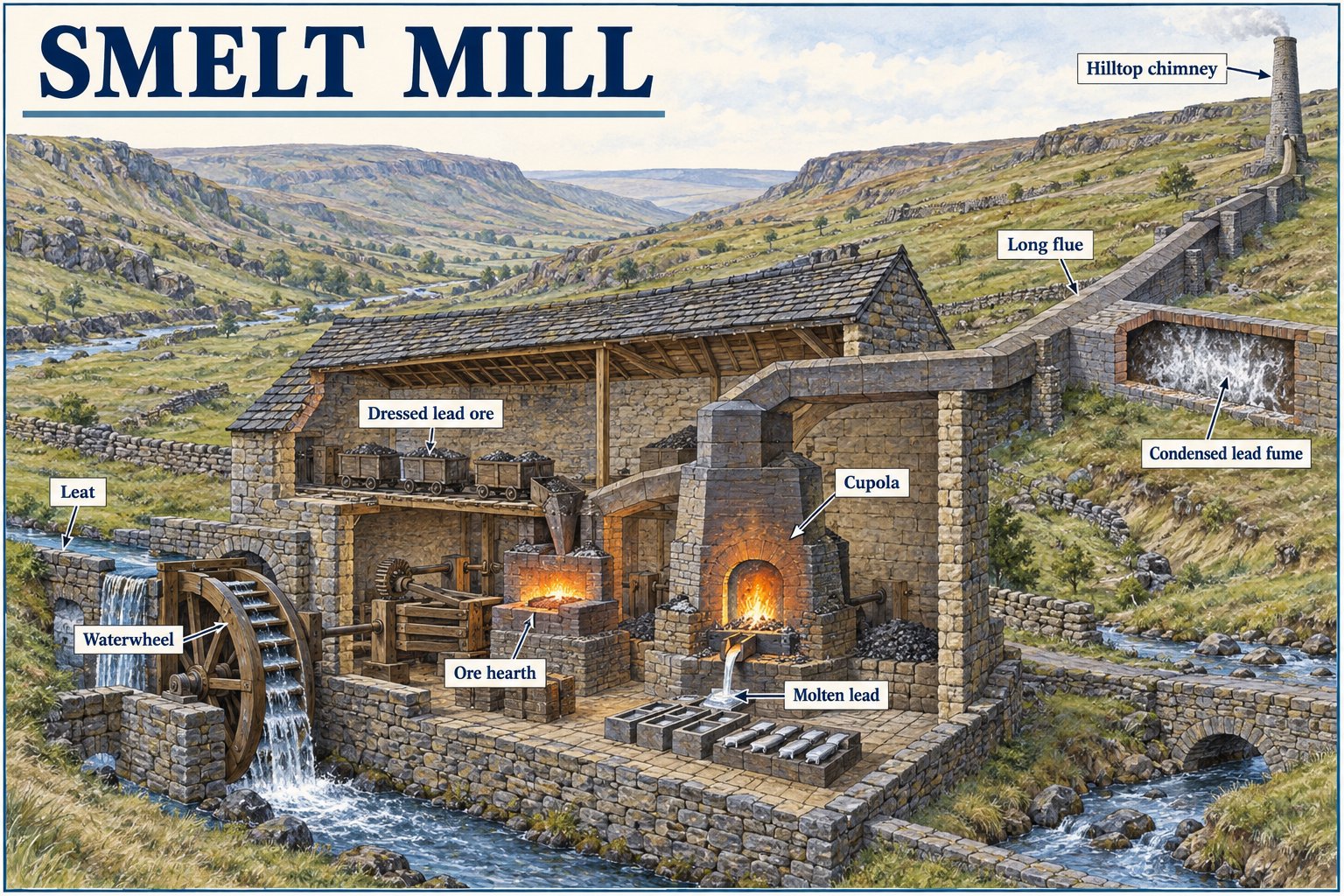
A water-powered works where dressed lead ore was reduced to metal, usually built on a stream below the mines it served and recognisable today by its flue running away up the hillside.
Historical usage
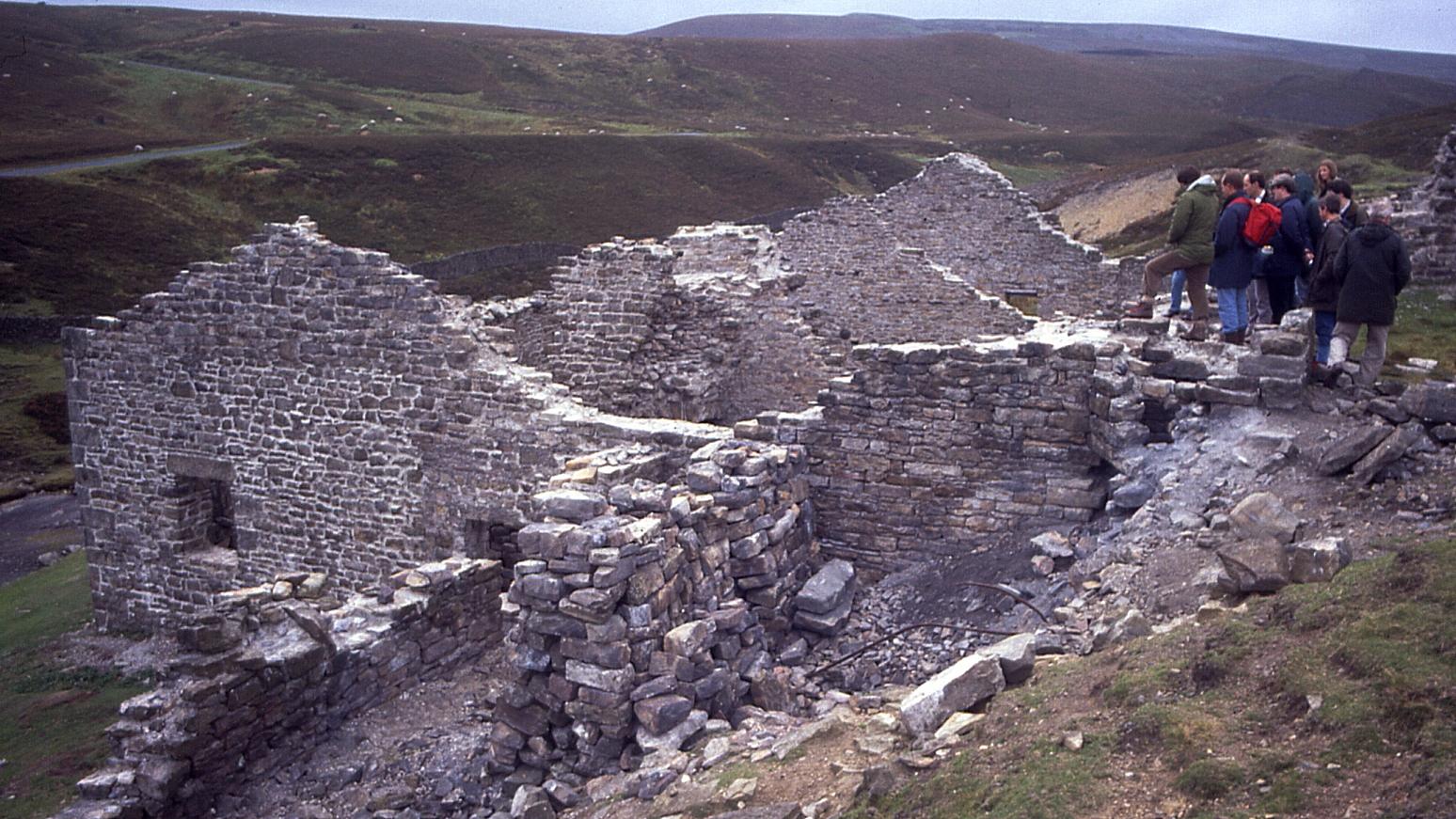
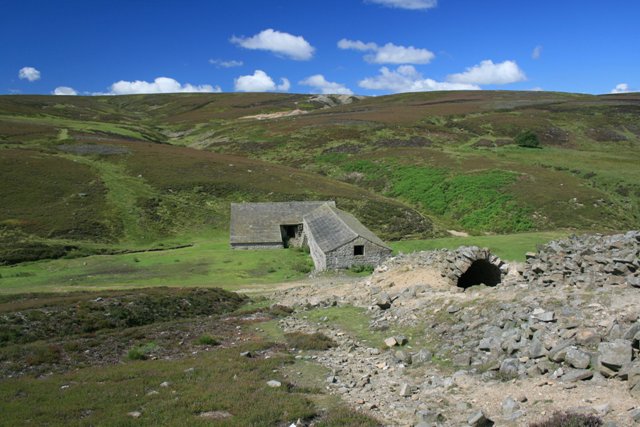
Smelt mills replaced the medieval bale — a simple wind-blown hearth on an exposed hilltop, little more than a bonfire — and by the 18th and 19th centuries had grown into substantial complexes serving whole mining fields. Grassington's Cupola Mill was built in 1792 and took over the work of several smaller mills; Surrender Mill in Swaledale was rebuilt in 1841 on the site of two earlier water mills that had been smelting since before 1720. Their working lives ended with the fields around them, Surrender closing in 1880 as the ore went to larger smelters elsewhere and Grassington in 1882.
How it worked
Two furnace types matter. The older ore hearth melted the galena directly on top of the fire, blown by bellows driven from a waterwheel and burning peat and chopped wood; a separate slag hearth then reworked the waste at higher temperature to recover the lead the first pass had missed. The reverberatory furnace — called a cupola — burnt its coal on a separate grate and reflected the heat down onto the ore, so the fuel's smoke never touched the metal and far more could be smelted at once. Grassington took its name from the cupolas installed there, which were unusual in Yorkshire, and by its peak ran two of them alongside a roasting furnace and a slag hearth.
Why it was used
A mill had to sit where the water, the fuel and the ore could all reach it, which is why smelt mills are found on streams below the mines rather than at them. The flue is the part worth understanding. Early mills vented through a short horizontal flue to a chimney, but through the 19th century these were extended enormously — Grassington's ran about 1.8 km to an 18-metre chimney built in 1849, Surrender's was extended to 745 m after 1854 — because the fume coming off the furnaces carried lead worth recovering. As the smoke cooled along the flue the lead condensed onto the walls and onto wet brushwood packed into condensers along the way; the flues were swept out periodically through access points and the deposit re-smelted. Settling pits caught more. A long flue also put the fume further from the mill.
Risks & limitations
Lead fume is poisonous, and a long flue moved the problem rather than solving it — smelt-mill smoke damaged pasture and livestock downwind, and sweeping a flue for its deposit was among the worst work on any mining field. Fuel supply was a constant constraint: when a dispute in 1794 stopped Grassington cutting peat, coal had to come by the Leeds and Liverpool Canal to Gargrave and then by horse and cart onto the moor. And a mill was only ever as good as the field it served — once ore could be railed cheaply to a larger smelter, the local mill closed whether or not the mines had.
Regional variation
The ore hearth mill was the Pennine norm, in Swaledale, Arkengarthdale and Weardale; the cupola was commoner in Derbyshire and unusual enough in Yorkshire to give Grassington's mill its name. Peat stores — long, low buildings for drying the fuel — survive beside several northern mills, including Blakethwaite, Surrender and Old Gang.
Related terminology
Calciner, Dressing Floor, Ore Hearth, Reverberatory Furnace, Slag Hearth, Smelt Mill Flue
Mines associated with this term
5 examples chosen from 42 linked records — the term page is not an index.
- Cobscar Mill — North Yorkshire (surviving physical example)
The record is itself a smelt mill: Cobscar's is one of the best-preserved in Wensleydale. - Grassington Moor Mines — North Yorkshire (surviving physical example)
The Cupola Mill of 1792 and its 1,600 m condensing flue and chimney are the headline survival of the whole Grassington Moor complex. - Hafna Mine — Conwy (surviving physical example)
Hafna’s smelt house and its round-plan chimney both survive, conserved and interpreted — unusual for a Welsh lead mine, where the smelting plant is normally the first thing to go. - Derwent Lead Mines — County Durham (well documented example)
Named 5 times in this record, first in the summary: “…in the valley, the Sikehead dams that fed them, Jeffrey's smelt mill with its mile-long flue and standing chimney, and the Sikehead…” - Alport Smelt Mill — Derbyshire (well documented example)
Named twice in this record, first in the workings: “Masonry remains of the smelt mill building, a head-race, a 40m slag tip, and an unusually complex…”
Sources
- (secondary) Lead — Out of Oblivion
- (secondary) Surrender Mill — Northern Mine Research Society
- (secondary) The Cupola Smelt Mill — The Grassington Mines Appreciation Group
Record created: 24 August 2026 · Last researched: 24 August 2026