 MineArchive
Hafna Mine
| Also known as | Hafna Lead Mine, Hafna Mill |
|---|---|
| Location | Gwydir Forest, near Llanrwst, Conwy — 53.1245, -3.8239 (exact) |
| Commodities | Lead, Zinc, Pyrite |
| Type | Metal |
| Worked | to about 1915 |
| Maximum depth | Unknown. The mine was worked from levels driven into the hillside as well as from shafts, seven plans of which are catalogued at BGS. |
Overview
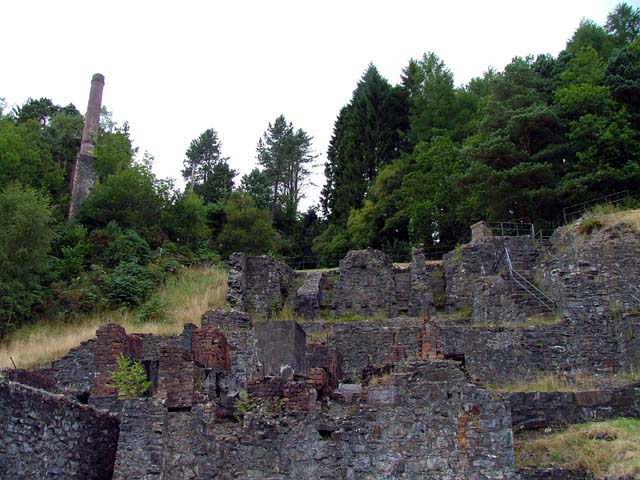
Hafna is the best-preserved of the lead and zinc mines of the Gwydir Forest, a mile and a half south-west of Llanrwst. After a long period of abandonment it was revived in 1860 and worked more or less continuously under new ownership from 1862 until 1913, recording 783 tons of lead concentrates and 2,555 tons of zinc concentrates over that half-century. What makes it worth visiting is not the tonnage but the mill: a stepped ore-processing plant with its incline, smelt house and round chimney, conserved and interpreted by Natural Resources Wales and reached by a waymarked trail through the forest.
History
Lead and zinc were worked across the Gwydir Forest — Parc, Cyffty, Pandora, Cae Coch and the rest — from at least the seventeenth century, and Hafna belongs to that older story before it belongs to the industrial one. The early workings are not securely dated. What is clear is that after an extended period of abandonment the site saw a minor revival in 1860, and that a more sustained if intermittent working began under new ownership in 1862 and lasted until 1913.
Official production returns for that half-century record 783 tons of lead ore concentrates and 2,555 tons of zinc ore concentrates — a ratio worth noting, since it was zinc rather than lead that Hafna mostly sold. The Eagle Lead Company is recorded in the title of one of the mine sections held at the British Geological Survey, and the Hafna and Pandora workings met underground: one BGS plan exists specifically to record the overlap between them.
The mill that survives dates from the last phase. Its power arrangements are a summary of the period in themselves — it used water, then steam, then electricity over its working life.
Geology
The Gwydir Forest orefield is a set of steep, narrow lead-zinc veins cutting Ordovician sedimentary rocks and associated volcanic rocks. The mineralisation is hydrothermal — deposited from hot mineralising fluids moving through fractures — and the ore minerals are galena for lead and sphalerite for zinc, with minor pyrite, in a gangue of quartz and calcite. The veins are narrow and irregular, which is why the Gwydir mines were worked as a scatter of small operations following individual lodes rather than as a few large ones, and why so many of them connected up underground where their veins converged.
Geological setting: Hydrothermal Deposits (well documented example), Veins and Lodes (well documented example)
Workings
Hafna was worked from levels driven into the hillside as well as from shafts, and the workings ran far enough to meet the neighbouring Pandora mine. The distinctive survival is the surface plant: a stepped mill built into the slope so that ore fed downwards through the successive dressing stages by gravity, with an incline serving it, a smelt house and a round-plan chimney on the western side of Bwlch yr Haearn. Seven plans of the mine, its reservoir and its relationship to Pandora are catalogued at BGS Keyworth, one of them received from Gwynedd Quarries in 1969 and another traced from an Eagle Lead Company section.
Closure
Working stopped in 1913, and the mill is recorded as having ceased about 1915. Gwydir lead and zinc had been competing with cheap imported ore for a generation by then, and Hafna was neither large enough nor rich enough to outlast the rest of the orefield.
What remains
The site sits beside the Gwydyr road in forest owned and managed by Natural Resources Wales, which has partially restored and made safe several of the most important mines in the park, Hafna among them. The surface structures are conserved and can be walked around; the underground workings are gated and not accessible. Interpretative panels on site explain the mine, the mill and the smelter.
The most extensive and best-preserved remains of any mine on the Gwydyr estate: the stepped ore-processing mill and its tip, the incline, the conserved smelt house and the round chimney that marks the site from the road, together with a deep cutting, capped shafts and the ruins of the mine buildings. The waymarked Hafna Miners' Trail links them with neighbouring workings.
Related mines
- Pandora Mine — The two mines' workings met underground.
Nearby mines
- Parc Mine — 0.4 miles (0.7 km) E
- Pandora Mine — 0.8 miles (1.3 km) W
- Cae Coch Sulphur Mine — 3.5 miles (5.6 km) N
- Cedryn Quarry — 4.3 miles (7.0 km) NW
- Cwm Eigiau Quarry — 5.3 miles (8.6 km) W, Gwynedd
Straight-line distance, within 9 miles (15 km). Show on the map.
What's uncertain
Points where sources disagree or the record could not be settled; both accounts are kept. All open questions in the archive.
- The Geograph record gives the mill complex an original construction date of 1879, with working ceasing around 1915. (disputed) 2
- The Gwydyr Forest record describes the stepped mill as dating from 1889–1905, of French design, and powered successively by water, steam and electricity. (disputed) 1
Recorded claims
Individual factual claims, each attached to the source(s) that support it below. Where sources disagree, both are kept.
- Official returns for 1862–1913 record 783 tons of lead ore concentrates and 2,555 tons of zinc ore concentrates. 1
- The site was revived in 1860 after a long abandonment, and worked more or less continuously under new ownership from 1862 until 1913. 1
- The Geograph record gives the mill complex an original construction date of 1879, with working ceasing around 1915. (disputed) 2
- The Gwydyr Forest record describes the stepped mill as dating from 1889–1905, of French design, and powered successively by water, steam and electricity. (disputed) 1
- Galena was the lead ore, with sphalerite frequently present and minor pyrite. 1
- Seven Hafna entries are catalogued in the BGS mine plans collection, including a section traced from an Eagle Lead Company plan and one recording the overlap between the Hafna and Pandora workings. 3
- The surface structures are conserved and open to visitors on the waymarked Hafna Miners’ Trail; the underground workings are gated. 4
Photographs & further reading
All seven catalogue entries, including the reservoir plans, the Eagle Lead Company section and the plan recording where Hafna meets Pandora underground.
View sourceSources
- (secondary) Mines of the Gwydyr Forest, Part 2: The Hafna Mine, Llanrwst, and some early ventures in Gwydyr Nant — Bennett & Vernon (Gwydyr Forest mines series)
- (observational) Hafna Mine and Mill (photograph and note) — Geograph Britain and Ireland
- (primary) BGS mine plans catalogue: HAFNA MINE — British Geological Survey
- (primary) Natural Resources Wales: Gwydir Forest Park — Hafna, near Llanrwst — Natural Resources Wales
Record created: 26 August 2026 · Last researched: 26 August 2026