 MineArchive
Pyrite
| Category | Commodities |
|---|---|
| Commodity page | Pyrite → |
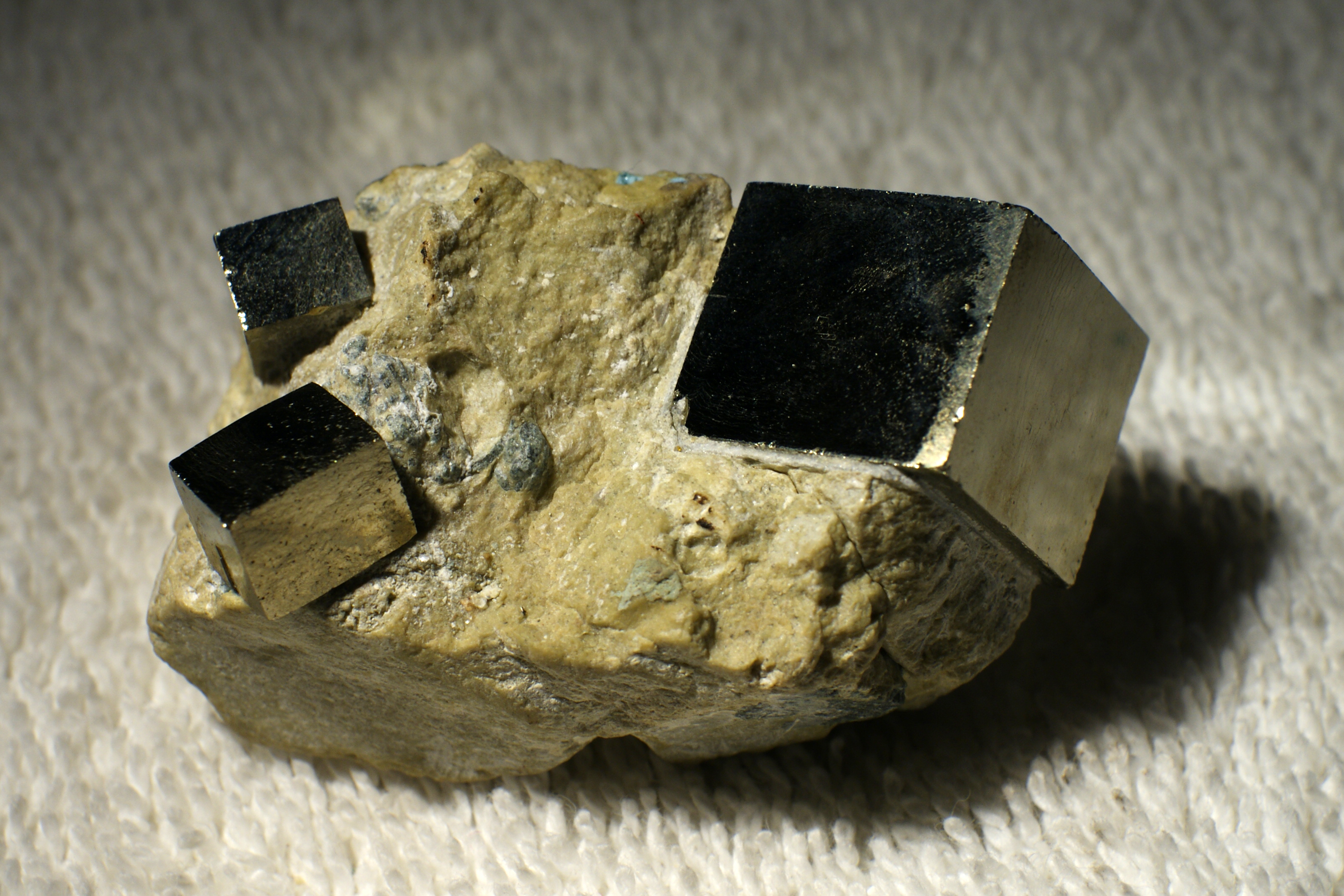
Iron pyrite (FeS₂), "fool's gold" — a common, brassy-yellow mineral mined and roasted not for its iron but for its sulphur, the raw material of the sulphuric acid that underpinned much of Victorian Britain's chemical industry.
Historical usage
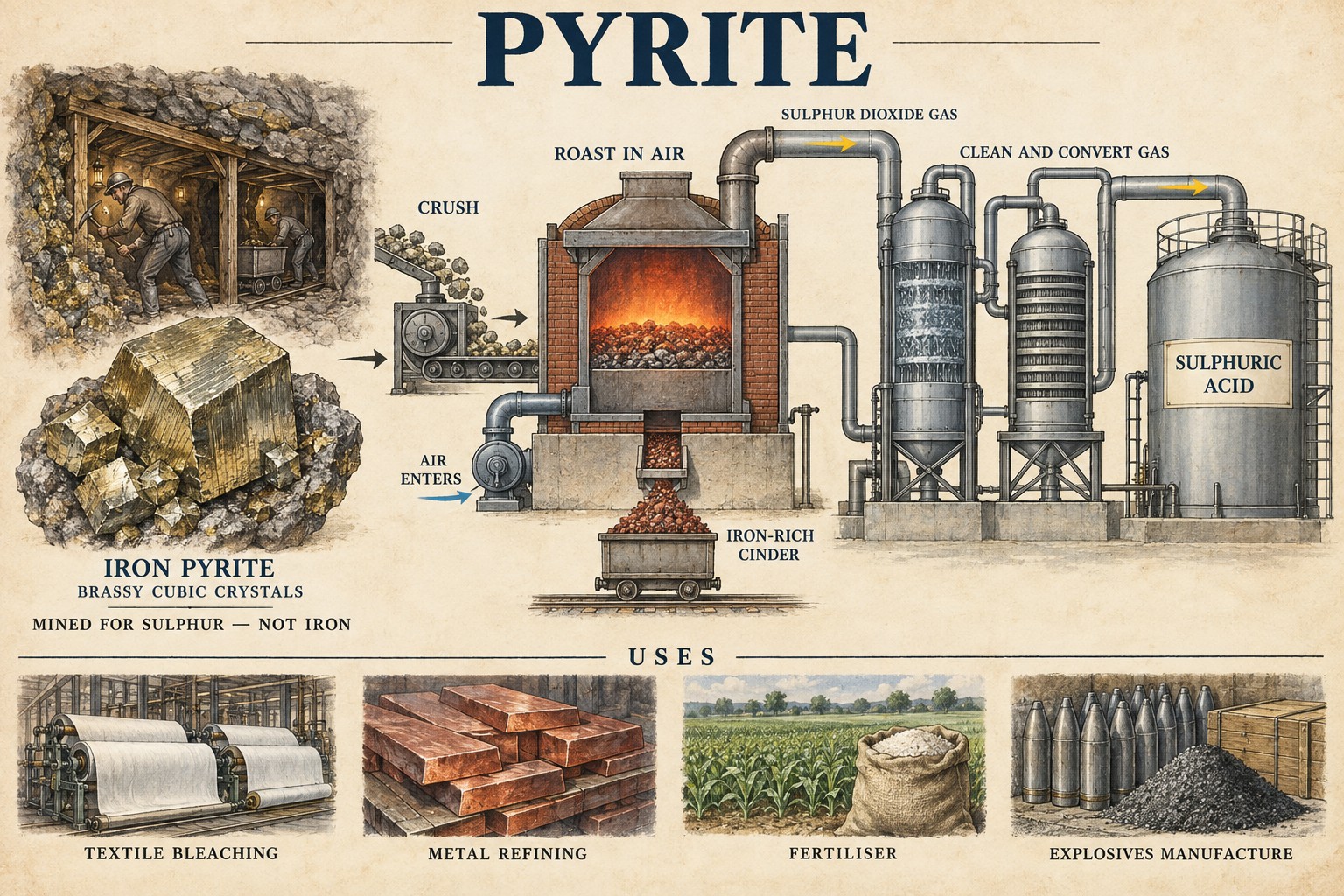
Demand for sulphuric acid ("oil of vitriol") grew rapidly through the 18th and 19th centuries as it became central to bleaching textiles, refining metals and manufacturing fertiliser, initially made by burning sulphur imported from Sicily. As Sicilian sulphur remained expensive under a long-standing monopoly, British chemical manufacturers turned increasingly to roasting pyrite ore instead from the 19th century onward, which had the added advantage of leaving a residue that could itself be processed for iron or copper. Cae Coch, in the hills above Trefriw in north Wales, is the only mine of its kind worked in the country, first recorded in 1607 and reaching its peak in 1918 — wartime demand for sulphuric acid, itself needed for explosives manufacture, meant Cae Coch alone was responsible for over half of all the pyrite mined anywhere in Britain that year.
How it worked
Pyrite was mined by conventional shaft and level methods, then roasted in a furnace to drive off sulphur dioxide gas, which was converted into sulphuric acid; the iron-rich roasted residue ("cinder") could be sold on for ironworking, so a well-run pyrite operation produced two saleable outputs from one ore.
Why it was used
Pyrite offered a cheaper, more reliably available domestic alternative to imported Sicilian sulphur for acid manufacture, at a time when sulphuric acid had become one of the most important bulk chemicals in the industrial economy — a status often used as a rough measure of a nation's industrial output.
Value over time
Pyrite's value tracked the wider sulphuric acid market rather than having any independent price history of its own — demand, and with it British pyrite mining, spiked sharply during major wars when explosives manufacture required vast quantities of acid, as at Cae Coch in 1918. That demand structurally disappeared after 1945, as the petrochemical industry began recovering sulphur as a cheap by-product of oil and gas refining, undercutting mined pyrite for acid manufacture almost everywhere.
Hazards & challenges
Pyrite reacts with air and water to generate sulphuric acid directly, meaning worked-out pyrite deposits and waste tips continue producing acidic, heavy-metal-laden drainage for decades after mining ends — an effect studied in unusual detail at Cae Coch itself, where the mine is internationally significant to geologists precisely because its ongoing pyrite oxidation is driven largely by bacteria rather than simple chemistry, offering a natural laboratory for understanding acid mine drainage generally.
Risks & limitations
Pyrite roasting was tied directly to demand for sulphuric acid and, during wartime, explosives — production at Cae Coch peaked sharply in 1918 and declined once that demand eased, and pyrite mining generally struggled to compete once cheaper sulphur sources, including sulphur recovered from oil and gas refining, became available after the Second World War.
Regional variation
Cae Coch (Conwy, north Wales) stands alone in Britain as a mine worked specifically and solely for pyrite; elsewhere pyrite occurred more often as an incidental mineral within other metal veins rather than a mining target in its own right.
Related terminology
Alum, Mundic, Nickel, Spontaneous Combustion
Mines associated with this term
5 examples chosen from 15 linked records — the term page is not an index.
- Peak Alum Works — North Yorkshire (well documented example)
The iron pyrite in the alum shale is what made the process work at all — its slow oxidation in the burning clamps generated the heat and the sulphate that turned the shale's aluminium into soluble alum. - Alum Bay Sand and Copperas Workings — Isle of Wight (well documented example)
The bay never yielded the alum it was named for, but its cliffs did give up pyrite for copperas — a consolation product from the same shales. - Brora Colliery — Highland (well documented example)
The defining nuisance of Brora coal: pyrites in the seam made it liable to spontaneous combustion, and the resulting fires ran through the colliery's history — one of them closed the Ross Pit for good in May 1969. - Cae Coch Sulphur Mine — Conwy (well documented example)
Wales's only pyrite mine, responsible for over half of all pyrite mined anywhere in the UK at its 1918 wartime peak. - Cononish Mine — Stirling (well documented example)
The ore is pyrite-rich and galena-bearing, running about 9.4 grams of gold and 53 grams of silver to the tonne — high grade for a UK deposit, if narrow.
See every mine that worked pyrite →
Sources
- (secondary) Neglected Bradford Industries: Vitriol (sulphuric acid) making — Bradford and District Local Studies
- (secondary) The Many Faces of Fool's Gold — American Scientist
- (secondary) The trouble with pyrite — Deposits Magazine
Record created: 22 August 2026 · Last researched: 22 August 2026