 MineArchive
Nickel
| Category | Commodities |
|---|---|
| Commodity page | Nickel → |
A hard, corrosion-resistant metal won from two quite different kinds of ore: sulphides such as pentlandite and pyrrhotite, which are richer and account for about 40% of land-based resources, and oxide laterites — nickeliferous limonite and garnierite — which hold the other 60%. Around 130 million tonnes of nickel is estimated in land-based resources.
Historical usage
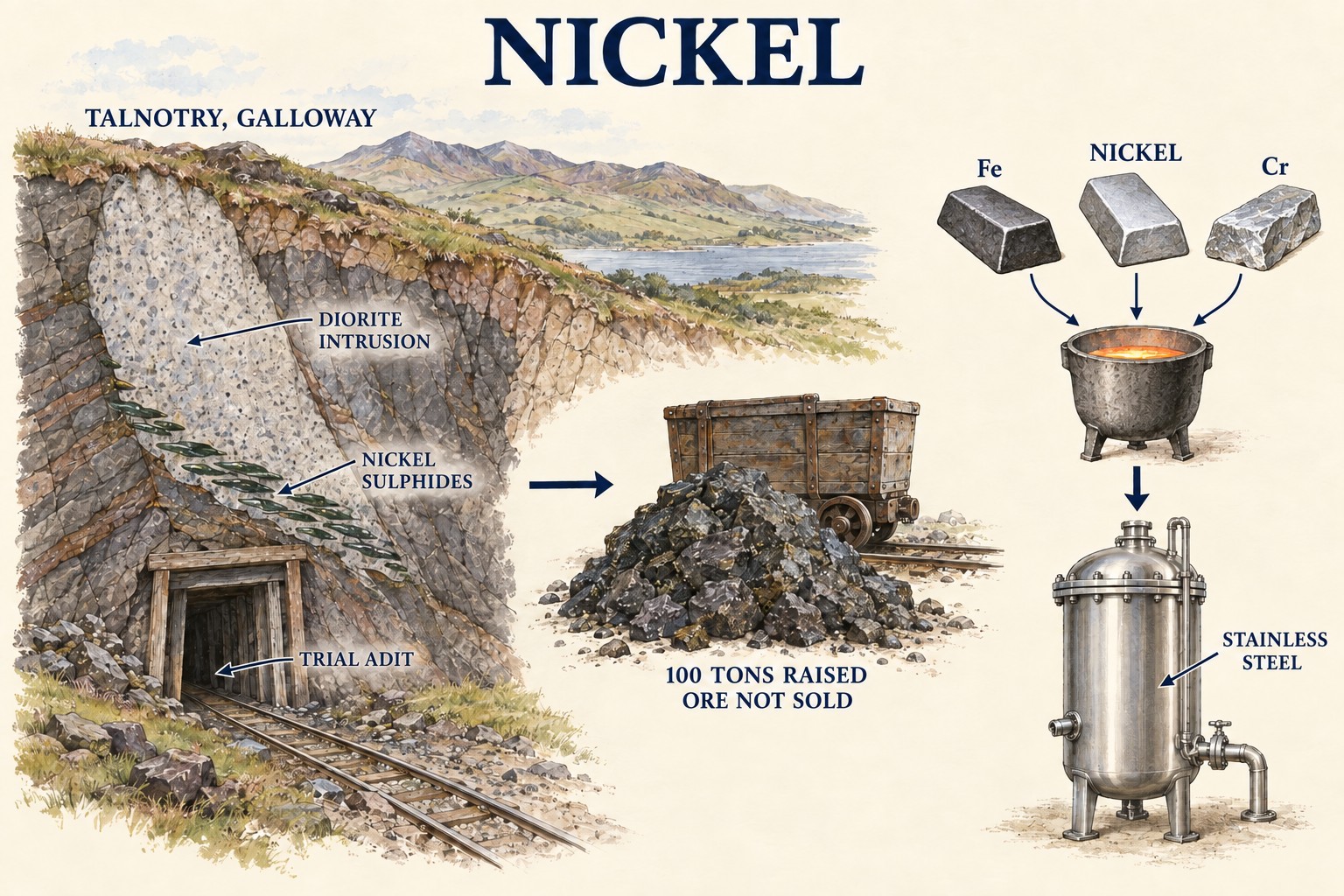
Britain barely has a nickel history, which is what makes Talnotry worth a record. The deposit in Galloway was found by chance around 1885 as a magmatic segregation near the base of a diorite intrusion where it meets hornfelsed Ordovician and Silurian rocks — genuinely unusual ground for southern Scotland. A small syndicate opened it up, raised about 100 tons of ore, sold none of it and gave up. Government-funded exploration reassessed the site in the 1970s and 1980s and identified other targets nearby, but nothing followed, and the mineralogy — nickeline, gersdorffite, pyrrhotine, pentlandite, chalcopyrite — has since made it a conservation site rather than a prospect. World production sits with Indonesia at about 2.2 million tonnes a year, then the Philippines, Russia, Canada, China and Australia.
How it worked
Sulphide and laterite ores need quite different treatment, pyrometallurgical or hydrometallurgical. The refining step worth naming is the Mond process, which exploits nickel's willingness to form a volatile carbonyl gas: the gas is drawn off and then decomposed back to metal, giving a purity of over 99.99%. At Talnotry none of this was ever reached — the ore was raised and left.
Why it was used
Almost entirely for stainless steel, which takes about 68% of world production. The rest goes to nickel-based alloys (10%), electroplating (9%), alloy steels (7%), foundry work (3%) and batteries (4%). It is a metal wanted for what it does to other metals rather than on its own account.
Value over time
There is no British value history to write, and that absence is the story. Talnotry raised about 100 tons of ore in the 1880s and sold none of it; the reassessments of the 1970s and 1980s, funded when strategic-minerals anxiety was running high, found nothing worth developing. Globally nickel has moved from a specialist alloying metal to a stainless-steel commodity and latterly a battery metal, with prices that swing hard on supply shocks — the $100,000-a-tonne spike of March 2022 being the extreme case.
Hazards & challenges
The serious hazards are in refining rather than mining. Nickel tetracarbonyl, the volatile compound the Mond process depends on, is a highly toxic liquid at room temperature and one of the more dangerous substances handled routinely in metallurgy. Refinery workers have historically carried raised cancer risk. Nickel allergy is common enough in the general population to have caused public argument over nickel-plated steel coinage and the dermatitis it provokes. At the mining end the hazards are those of any small hard-rock working.
Risks & limitations
Nickel is a volatile commodity tied to stainless steel demand, and the 2022 Ukraine crisis showed how violently: the price briefly touched $100,000 a tonne before exchanges suspended trading. For a British prospect the limitation was simpler — the deposit was small, isolated and never worth the cost of getting the ore to a smelter.
Regional variation
Nickel has effectively no regional vocabulary in Britain because it has effectively no British industry. Talnotry, in what is now Galloway Forest Park, is the exception that proves it.
Related terminology
Mines associated with this term
Included only where MineArchive's own research gives a reasonable evidential basis — not every mine where this might plausibly apply.
- Hilderston Silver Mine — West Lothian (well documented example)
Named in this record’s history: “…Henry Aitken reopened it in search of silver, finding instead the nickel ore niccolite and baryta, which were sent to Germany for processing.” - Talnotry Mine — Dumfries and Galloway (well documented example)
Talnotry is the archive's only nickel record and very nearly Britain's — a genuine trial working on a magmatic segregation in a diorite intrusion, opened around 1885 and abandoned with about 100 tons of ore raised and none of it sold.
See every mine that worked nickel →
Sources
- (primary) Talnotry Mine Site of Special Scientific Interest: Site Management Statement — NatureScot
- (primary) Talnotry Nickel Workings (BGS Mine Plans Catalogue) — British Geological Survey
- (secondary) Nickel — Wikipedia
- (secondary) Talnotry Nickel Mine — Scottish Cave and Mine Database
Record created: 22 August 2026 · Last researched: 26 August 2026