 MineArchive
Copper
| Category | Commodities |
|---|---|
| Commodity page | Copper → |
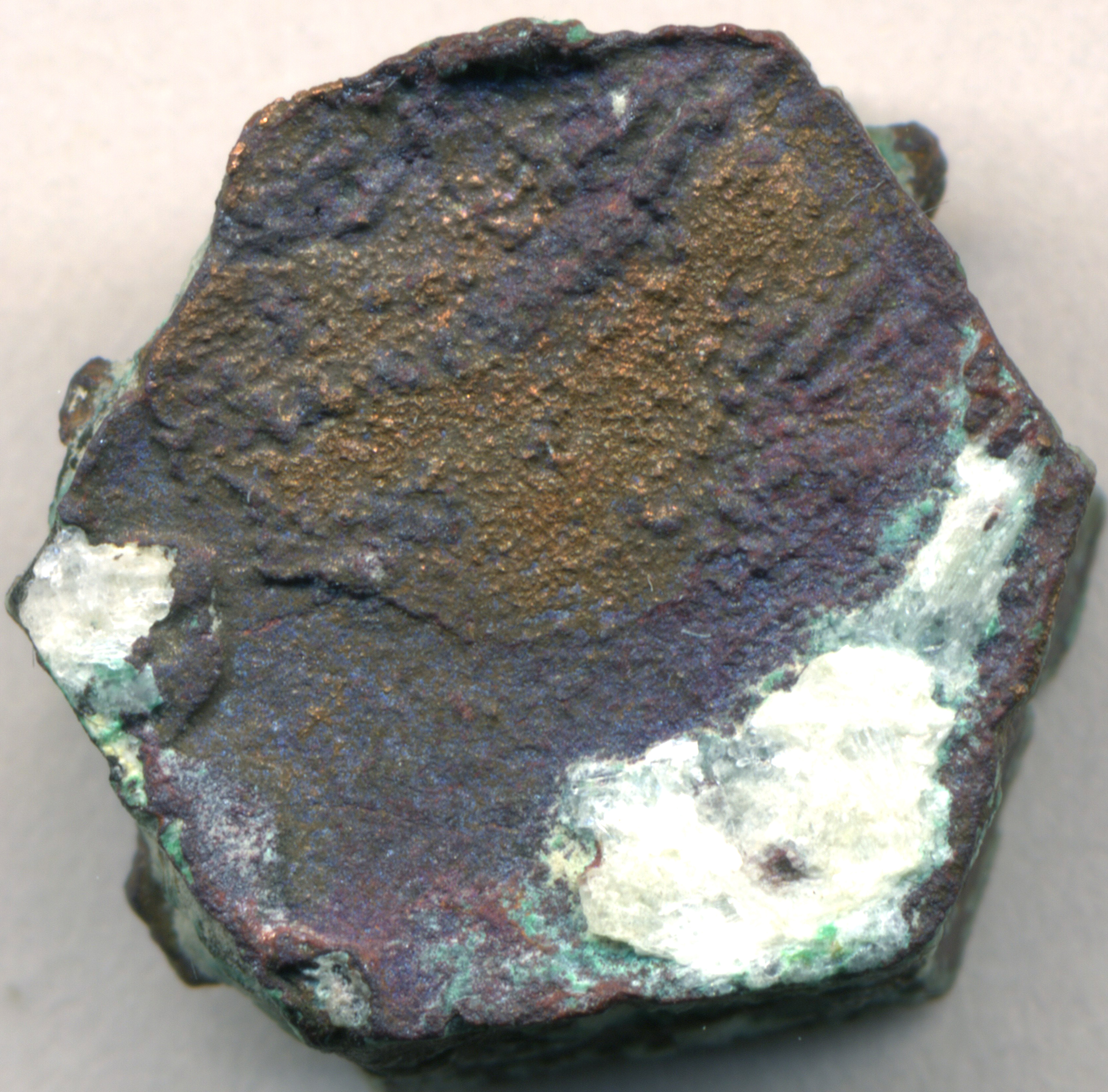
A reddish, highly conductive metal (Cu) mined in Britain from the Bronze Age onward, worked at Parys Mountain and Great Orme on a scale that briefly made Wales the centre of the world copper trade.
Historical usage
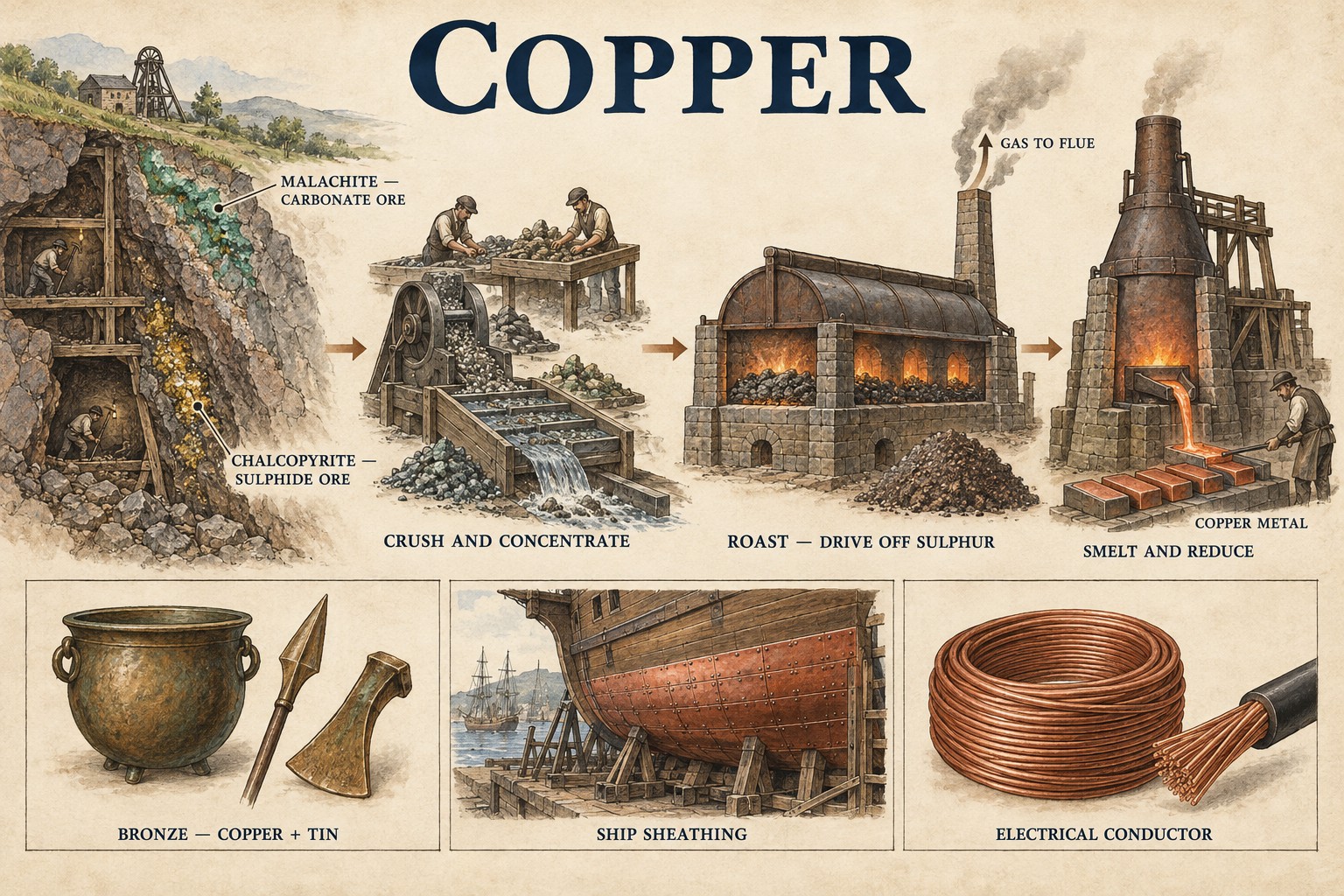
Copper was Britain's first major metal industry: the Great Orme mine above Llandudno was worked for roughly eight centuries in the Bronze Age (c.1600-1400 BC), producing an estimated 3,000 tonnes of metal via extensive shallow galleries. Large-scale copper mining revived in Cornwall from the 17th century, and exploded at Parys Mountain on Anglesey after a huge lode was discovered in 1768 — briefly making it the largest copper mine in the world, and its owner Thomas Williams (the "Copper King") controller of roughly half of Britain's entire copper industry by 1800. Devon Great Consols, discovered in 1844, became for a time the world's largest copper mine in its own right. Cornish output then declined sharply through the second half of the 19th century as cheaper foreign ores displaced it.
How it worked
Copper occurs both as native metal and, far more commonly in Britain, as sulphide ores (chalcopyrite) and carbonate ores (malachite), reached by shaft and adit mining. Ore was crushed, hand-dressed and concentrated before smelting — a multi-stage roasting and reduction process that drove off sulphur as sulphur dioxide gas, a major source of pollution around smelting sites such as Parys Mountain and Swansea.
Why it was used
Copper's conductivity, malleability and resistance to corrosion made it essential first for tools and weapons (alloyed with tin as bronze), then for boilers and sheathing on Royal Navy ships' hulls, and — as the 19th century went on — the fast-growing electrical industry, which kept demand strong even as British mining declined.
Value over time
Copper prices rose through the early 19th century, reaching around £135/ton in London by the 1850s amid Crimean War demand, but Britain's dominance collapsed as tariff reductions from the 1820s onward opened the market to much cheaper ore from Chile, Cuba and later the United States; domestic output fell from over 18,000 tons a year to a negligible amount by 1900. The rise of the electrical industry from the late 19th century kept global copper demand — and, eventually, price — strong even as British mines themselves fell silent.
Hazards & challenges
Roasting sulphide copper ore released large volumes of sulphur dioxide, which stripped vegetation for miles around sites like Parys Mountain (still visible today as its barren "Copper Mountain" landscape), while copper ores commonly carry arsenic and lead as accessory minerals; smelter and mine workers absorbed both, with elevated blood-lead and urinary-arsenic levels documented among copper smelting workers and a well-established link between arsenic exposure and lung disease.
Risks & limitations
British copper lodes were rich in the Bronze Age and again in the 18th-century Anglesey boom, but by the mid-19th century Cornish deposits were increasingly exhausted and low-grade, while South America and North America opened far larger, cheaper deposits; output that had stood at over 18,000 tons a year fell toward zero by the century's end.
Regional variation
Anglesey (Parys Mountain) and north Wales (Great Orme) for the two most historically significant sites; Cornwall and west Devon (Devon Great Consols, Dolcoath), plus the Coniston and Ecton fields in Cumbria and the Peak District, for the broader industry.
Related terminology
Bronze Age, Cornish Rolls, Fire-setting, Nickel
Mines associated with this term
5 examples chosen from 106 linked records — the term page is not an index.
- Britannia Copper Mine — Gwynedd (well documented example)
Named 5 times in this record, first in the summary: “A copper mine on the side of Snowdon, whose ruined crushing mill sits beside…” - Cwmavon Copper Works — Neath Port Talbot (well documented example)
Named 18 times in this record, first in the summary: “A major Swansea-district copper smelting works in the Afan Valley, begun in 1835 and at its…” - Ecton Copper Mines — Staffordshire (well documented example)
Named 4 times in this record, first in the summary: “…for the Peak District orefield in having been worked mainly for copper rather than lead and zinc. Deep Ecton, the principal mine, was one…” - Marke Valley Mine — Cornwall (well documented example)
Named 5 times in this record, first in the summary: “A substantial copper and tin mine on the north side of Caradon Hill, worked from 1828 to…” - Mona Mine — Anglesey (well documented example)
Named 15 times in this record, first in the summary: “One of the two great copper mines that made Parys Mountain briefly the largest copper mine in…”
See every mine that worked copper →
Disasters associated with this term
Included only where MineArchive's own research gives a reasonable evidential basis, with the nature of the relationship stated — not every disaster where this term might plausibly apply.
- Parys Mountain boiler explosion, 1870 (contextual relationship)
Occurred at Parys Mountain during its working life as a major copper mine.
Sources
- (primary) Boom and bust in Bronze Age Britain: major copper production from the Great Orme mine and European trade, c. 1600-1400 BC — Antiquity (Cambridge University Press)
- (primary) Effects of low-level lead and arsenic exposure on copper smelter workers — PubMed
- (secondary) A Complete History of the Price of Copper — World Coppersmith
- (secondary) History — Grwp Tanddaearol PARYS Underground Group — Grwp Tanddaearol PARYS Underground Group
Record created: 22 August 2026 · Last researched: 22 August 2026