 MineArchive
Consols
| Category | Labour & Roles |
|---|
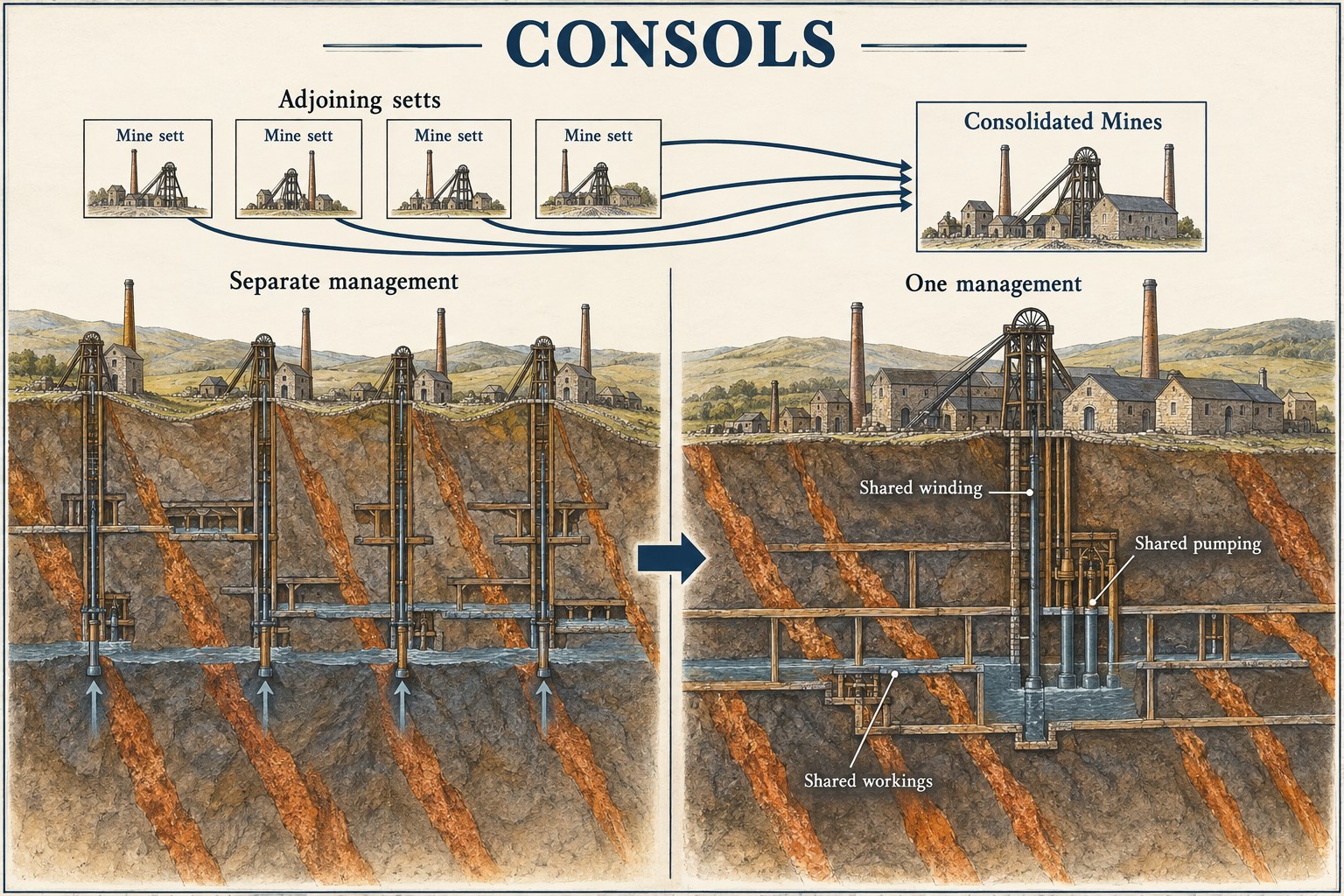
A shortened form of 'Consolidated Mines': several adjoining setts, often already worked so close together that their underground workings had run into one another, brought together and worked as a single company under one management.
Historical usage
The practice takes its name from Consolidated Mines itself, formed in 1782 near Gwennap, Cornwall, by merging Wheal Virgin, West Wheal Virgin, Wheal Girl, Wheal Maid, Wheal Fortune and Carharrack Mine -- all of which had been struggling separately with the same flooding problem and had closed by 1779 rather than keep paying for seven individual Newcomen pumping engines. Under a single management the mines replaced those seven old engines with five new Boulton & Watt engines, saving an estimated £11,000 a year in fuel, and in 1784 the company installed Cornwall's first steam-powered whim. Revived by John Taylor from 1819, Consolidated Mines became the largest single producer of copper ore in Cornwall, raising 442,493 tons of ore between 1819 and 1858 and paying shareholders £480,156 in dividends between 1819 and 1840. It amalgamated with the neighbouring United Mines in 1857 to form Clifford Amalgamated Mines, which itself closed in 1870. The success of the original Consolidated Mines made 'Consols' a fashionable suffix, and it went on to appear in dozens of Devon and Cornish mine names, including the already-published Devon Great Consols near Tavistock and the operator Tankerville Great Consols in Shropshire.
How it worked
A consolidation combined the setts, workforce and, most importantly, the expensive infrastructure of several adjoining mines under one company, still typically financed the same way as any other mine of the period: adventurers bought shares under the cost book system, and were called on for further capital or paid a dividend at periodic meetings depending on how the combined operation was faring. Consolidation made most sense where the individual setts' underground workings had already grown close enough to share the same drainage problem, since one large pumping and winding operation could then serve ground that would otherwise have needed several separate, smaller and less efficient engines.
Why it was used
The main saving was capital: a single set of large, efficient engines -- pumping, winding, sometimes crushing -- could serve ground that had previously needed a duplicated engine at every small mine, and the combined company could raise the far larger sums a 19th-century deep mine required more readily than any one of its constituent setts could alone.
Risks & limitations
The word's later reputation undercut its own early promise: because the original Consolidated Mines succeeded so spectacularly, 'Consols' became a suffix used to promise size, wealth and stability when raising new share capital, whether or not a genuine merger of adjoining setts stood behind it -- a mine could be renamed with 'Consols' attached purely to make its shares more attractive, and such renamings often failed to deliver on the name's implication.
Regional variation
Overwhelmingly a Devon and Cornish naming convention, tied to the cost book system those counties' mines were financed under. The same underlying practice appears elsewhere in Britain under the alternative wording 'United Mines' -- as at the already-published Halkyn District United Mines in Flintshire, an amalgamation of nine former companies -- without borrowing the Cornish 'Consols' name for it.
Related terminology
Mines associated with this term
5 examples chosen from 32 linked records — the term page is not an index.
- Consolidated Mines — Cornwall (well documented example)
Named twice in this record, first in the current condition: “…fame was such that later ventures elsewhere, including Devon Great Consols, borrowed the ‘Consols’ name.” - Esgair Hir and Esgair Fraith Mines — Powys (well documented example)
Named twice in this record, first in the history: “…in 1856 and the company was declared bankrupt in 1857. Cardigan Consols worked the site from 1858 to 1867, concentrating on shaft…” - Bagtor Mine — Devon (well documented example)
Named twice in this record, first in the summary: “…of Bagtor, amalgamated into the larger Hemsworthy Mine (Haytor Consols) in the 1850s before a brief independent revival in the 1860s that…” - Bedford United Mine — Devon (well documented example)
Named twice in this record, first in the summary: “Bedford United, next door to the much larger Devon Great Consols, was Devon's third-largest copper producer in its own right — an…” - Great County Adit — Cornwall (well documented example)
Named in this record’s history: “…to Wheal Peevor by 1778, and gained a further westward branch, the Consols Adit, through the 1770s and 80s to drain the Consolidated and United…”
Sources
- (secondary) Consolidated Mines — Wikipedia
- (secondary) Consolidated Mines — Graces Guide
- (secondary) Some Cornish Mining Terms — navsbooks
Record created: 31 August 2026 · Last researched: 31 August 2026