 MineArchive
Adventurer
| Also known as | Adventurers (plural form used in most historical mine records) |
|---|---|
| Dialect | Cornish |
| Category | Labour & Roles |
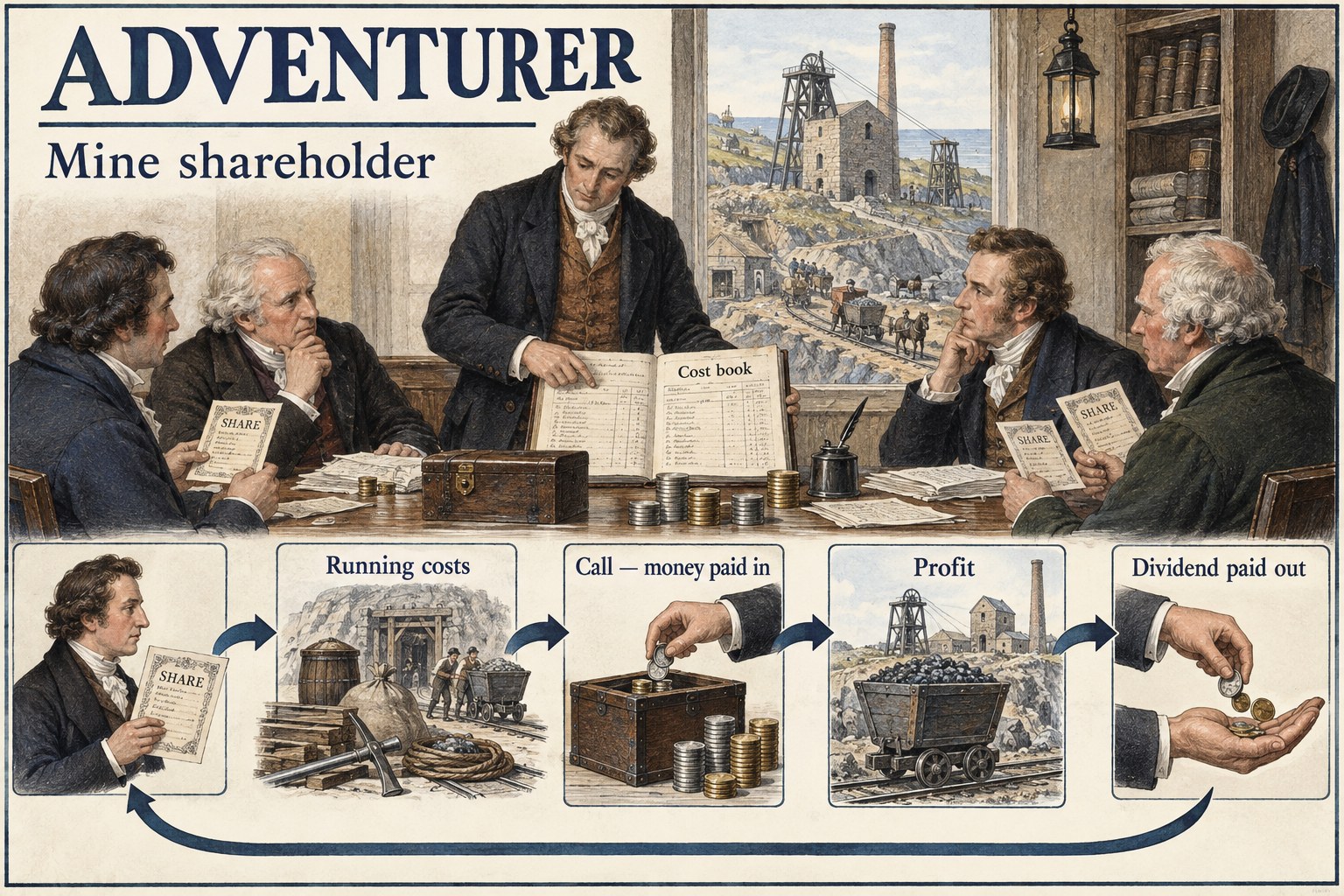
A shareholder in a mine. Under the Cornish and Devon cost book system an adventurer did not simply buy a stake and wait for a dividend: he took a share of the mine's running costs as well as its profits, meeting a call for more money whenever the accounts showed the working had spent more than it earned.
Historical usage
A shareholder in a mine, financing its running costs in return for a share of any profit — the role at the heart of the Cornish and Devon cost book system (see that term).
How it worked
Adventurer was the standard term across Cornish and Devon mining for anyone who bought shares in a mine and shared in its costs and profits under the cost book system; the earliest recorded use at Levant Mine dates from April 1787, when local resident William Veale noted in his diary that he had become an adventurer in the mine. Adventurers paid into a mine's running costs by 'calls' — extra payments per share — when expenses outran income, and received dividends when the mine was in profit; a distinction was also drawn between ordinary adventurers and 'out-adventurers', shareholders who held shares mainly to secure the right to supply the mine with goods or services rather than purely for investment return.
Why it was used
Being an adventurer let anyone with capital take a direct financial stake in a mine's fortunes without needing to run it themselves, spreading both the cost and the risk of mining across however many shareholders bought in.
Risks & limitations
An adventurer's exposure was open-ended in practice, if not in law: repeated calls for more money on a struggling mine could turn what began as a modest investment into a mounting drain, with no guarantee the mine would ever turn a profit in return.
Regional variation
The word is Cornish and Devon usage, tied to the cost book system rather than to mining in general; elsewhere in Britain a mine's backers were shareholders, partners or, in the Derbyshire orefield, took their interest as shares in a meer of ground. The Cornish Mining World Heritage Site glossary gives the plain definition — a shareholder in a mining operation — and lists the offices an adventurer dealt with rather than filled: the agents, who managed the mine, and the purser, its treasurer and secretary, responsible for the accounts and for paying the workers. Adventurers met at the count house, properly the account house, which was the mine office. The word did travel beyond Cornwall, but thinly and in a looser sense: Healey Hero's coalfield glossary defines adventurers simply as the original promoters or speculators in a search for coal, which is the risk-taking sense without any of the cost book machinery of calls, dividends and the count house that gives the Cornish term its precision.
Related terminology
Mines associated with this term
5 examples chosen from 18 linked records — the term page is not an index.
- Ecton Copper Mines — Staffordshire (well documented example)
An 'Adventurers' company financed and ran the mine. - Esgair Hir and Esgair Fraith Mines — Powys (well documented example)
An 'Adventurers' company financed and ran the mine. - Wheal Mary Ann — Cornwall (well documented example)
Named twice in this record, first in the history: “…so it was granted in July 1845 to three men acting, the Trelawney adventurers understood, on their behalf: Peter Clymo (Trelawney's purser), James…” - Beldi Hill Mine — North Yorkshire (well documented example)
Named twice in this record, first in the history: “…The mine is a genuinely complex site, with different groups of 'adventurers' driving levels from several directions to reach ore veins running…” - Cuddra Mine — Cornwall (well documented example)
Named twice in this record, first in the summary: “…of his generation — held a thirty-second share in the Cuddra Adventurers from 1815, and in April 1817 had word that the Crinnis lode had been…”
Disasters associated with this term
Included only where MineArchive's own research gives a reasonable evidential basis, with the nature of the relationship stated — not every disaster where this term might plausibly apply.
- Botallack Mine shaft accident (contextual relationship)
The mine's adventurers — its shareholders — contributed £50 to the subscription the inquest jury recommended for the widows and orphans of the nine killed.
Sources
- (secondary) A Cornish mining glossary — Cornish Mining World Heritage Site (UNESCO)
- (secondary) An eternal lesson for investors from a ill-fated silver mine — The Flying Frisby
- (secondary) History of Levant Mine and Beam Engine — National Trust
- (secondary) Pit Terminology — Healey Hero
Record created: 22 August 2026 · Last researched: 11 September 2026